
Diarrhea and implantation are not connected. The gut and the uterus are separate systems, and an embryo attaching to the lining of the uterus cannot change how your bowel behaves. Loose stools in the two week wait usually come from progesterone support, from the stress of the wait itself, or from a sudden change in what you are eating.
Listen to this article, about 11 minutes. A synthetic voice reads the article and announces each section title as it begins; tables are read row by row and the questions at the end are left out.
Recorded 10 October 2026 from the article as published that day. Press a chapter to jump there; the highlighted line is what is playing. A play button sits beside every section heading, and once you scroll past this player a bar at the bottom of the screen keeps the controls in reach. Tap or click any sentence to hear the reading start from there.
On this page: a comparison table of progesterone side effects, patient experiences from IVF communities, and a guide on when to contact your clinic.
Think you already know this? Five questions, one minute.
Every answer is on this page. Answer from what you know now; the page fills in the rest.
-
1. Why is diarrhea mechanically unrelated to embryo implantation?
Implantation occurs in the endometrium, which does not touch or affect the bowel. Early pregnancy hormones like hCG are also not detectable enough in the first few days to cause digestive changes, as noted in Biomedicines. Read the section
-
2. Which symptom is a key sign of ovarian hyperstimulation syndrome (OHSS) rather than an ordinary stomach upset?
The HFEA lists symptoms like a swollen and painful stomach, nausea, vomiting, shortness of breath, faintness, and reduced urine output as indicators of OHSS, according to the HFEA lists for ovarian hyperstimulation syndrome. Read the section
-
3. How does progesterone typically affect the digestive tract according to clinical studies?
Progesterone relaxes smooth muscle, slowing down food transit and making constipation much more common, as shown in a 2024 study in Heliyon. Read the section
-
4. Why does diarrhea generally not interfere with a vaginal progesterone pessary?
Vaginal progesterone is absorbed directly through the vagina rather than the digestive tract, so diarrhea does not affect its absorption. Read the section
-
5. What pattern did patients report when comparing successful and unsuccessful IVF cycles?
Patients frequently report experiencing the same cramps, constant diarrhea, sore breasts and nausea in both cycles, showing that symptoms do not reliably indicate the outcome. Read the section
Can diarrhea be a sign of implantation?
No, and the reason is mechanical rather than reassuring. Implantation happens at the endometrium, where an embryo roughly the width of a hair burrows into tissue. Nothing about that process touches the bowel, which sits behind its own wall and answers to its own nerves.
The hormone that eventually produces recognisable pregnancy symptoms is hCG, and it arrives late. A review of hCG in early embryogenesis published in Biomedicines puts detection in maternal blood at around ten days after ovulation. For most of the two week wait there is not enough of it circulating to do anything to your digestion, whatever the outcome turns out to be. Symptom lists that promise otherwise are working from a version of the biology that runs about a week fast. The day by day sequence after a day 3 or a day 5 transfer, and where hCG first becomes measurable in it, is set out in the implantation timeline after a day 3 or day 5 transfer.
This is the same pattern as every other symptom in this fortnight. We have written about why the absence of bleeding is not evidence either, and the logic does not change when the symptom moves from the uterus to the gut.
What actually explains loose stools in the two week wait?
Four ordinary explanations cover almost all of it, and a fifth is the one that needs a phone call. None of the first four carries any information about whether a transfer has worked.
| What is behind it | What is going on | What it tells you about the outcome |
|---|---|---|
| Progesterone support | Depends entirely on the route, and the labels disagree with each other. See the table below. | Nothing |
| The wait itself | Acute stress reliably speeds up the colon. A review of corticotropin releasing factor signalling in the colon and ileum states that acute stress has been clearly established to stimulate colonic transit and defecation. | Nothing |
| A sudden diet change | Pineapple core, pomegranate juice, brazil nuts, a wall of new fibre and a fresh supplement stack, all started in the same week. Your bowel notices. | Nothing |
| An ordinary stomach bug | Bugs do not check your calendar before arriving. Two weeks is plenty of time to catch one. | Nothing about the transfer, though the illness itself may need treating |
| Ovarian hyperstimulation syndrome, after a fresh cycle | A reaction to stimulation drugs. The HFEA lists a swollen and painful stomach, nausea and vomiting, shortness of breath, faintness and reduced urine output, usually in the week after egg collection. | This one is not a symptom to interpret. It is a reason to contact your clinic straight away |
Does progesterone cause diarrhea, or the opposite?
Progesterone is more likely to slow the gut down than speed it up. This is because progesterone relaxes smooth muscle, including the muscles that help move food through the intestines. When those contractions become slower and weaker, bowel movements can take longer to pass. That is why constipation is a much more familiar progesterone-related symptom, especially during the luteal phase and pregnancy.
There is some research showing this effect quite clearly. For example, a 2024 study in Heliyon of progesterone-mediated slow colon transit in pregnant mice found that increased relaxation of the bowel was linked with weaker contractions and slower movement through the colon. While animal studies cannot be directly applied to everyone, the basic idea fits what many people experience: higher progesterone tends to slow things down rather than act as a laxative.
That said, diarrhea can still happen during the progesterone-dominant part of the cycle. If it does, progesterone may not be the only reason, or even the main one. Hormonal fluctuations can affect the digestive system in different ways, and factors such as diet, stress, supplements, medications, or the approaching period can also change bowel habits.
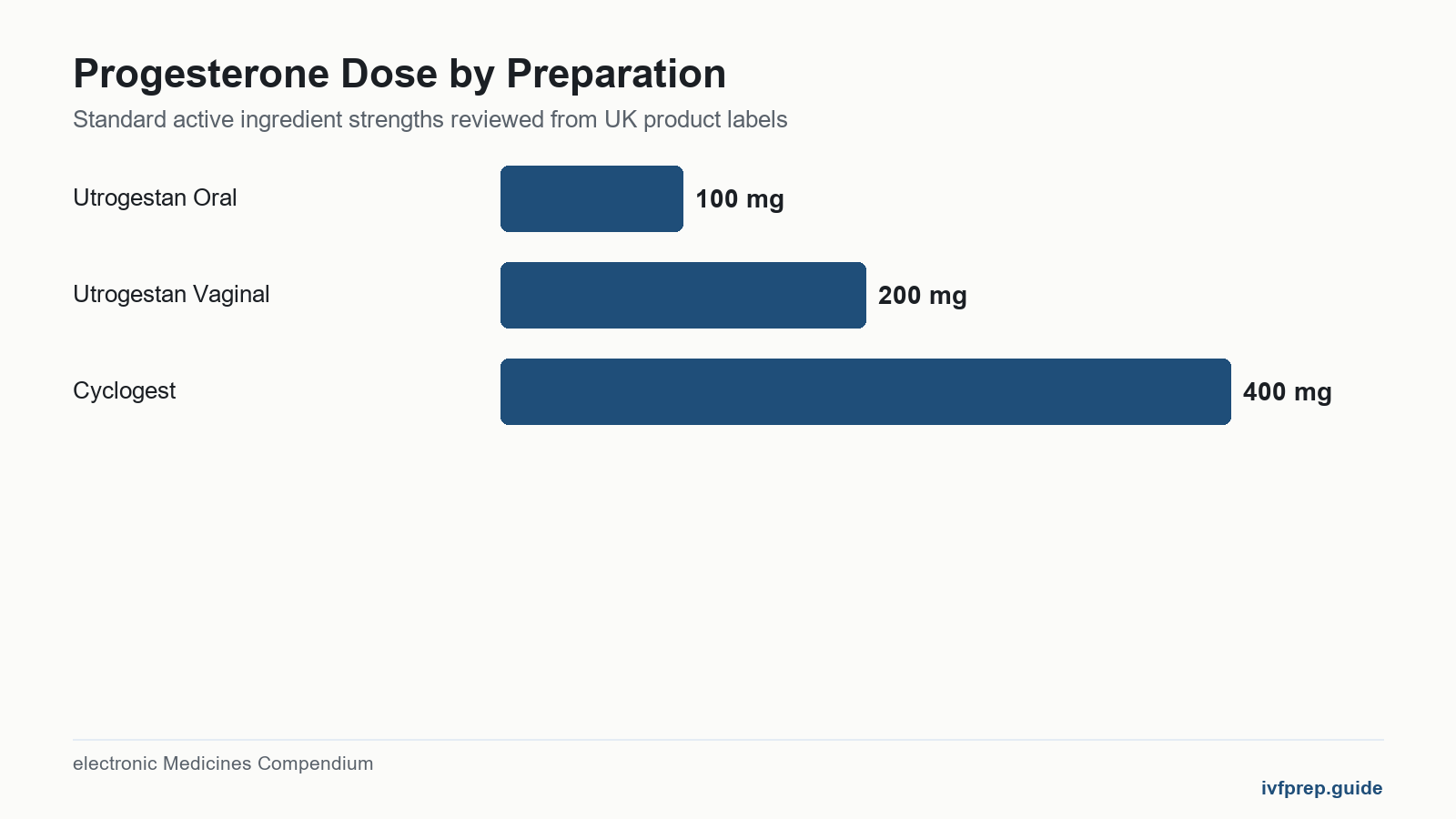
The UK product labels make this distinction a little easier to see. We checked the electronic Medicines Compendium (emc) on 11 September 2026, and again on 4 October 2026, when the oral Utrogestan label still carried its March 2025 revision with the same gut effects listed, and compared the three products side by side, because the listed digestive side effects are not necessarily the same for every progesterone-containing medicine.
| Preparation | Route | What section 4.8 of the UK label says about the gut |
|---|---|---|
| Utrogestan Vaginal 200mg | Vaginal | No gastrointestinal effects listed at all. The undesirable effects are local: burning, itching and oily discharge, plus transient fatigue or dizziness. |
| Utrogestan 100mg | Oral | Abdominal distension, abdominal pain and nausea are listed as common. Constipation, diarrhoea and vomiting are listed as uncommon, meaning fewer than one in a hundred. |
| Cyclogest 400mg pessaries | Vaginal or rectal | The label carries one line on this: diarrhoea and flatulence may occur with rectal administration. |
Read that again and notice what it does not say. If you are using a vaginal pessary or capsule, diarrhea is not on the label as a side effect of it. The one place a UK progesterone label puts diarrhoea, spelled the British way, is next to the rectal route, which makes obvious sense once you picture where the medicine is going. This does not prove your symptom is unrelated, because a label records what trials captured rather than everything a body does. It does mean the confident claim that progesterone is behind your loose stools is thinner than it sounds at two in the morning. Which route you are on is a decision your clinic made about your cycle, and it is not one to change on the strength of a table on a website.
Progesterone Route Side Effect Finder
Select your progesterone medication type and route to see what the official UK product labels list regarding digestive side effects.
Always consult your clinic before changing your medication route or dosage.
Can diarrhea stop a pessary from working?
The good news is that diarrhea should not stop a vaginal progesterone pessary from working. The medicine is absorbed through the vagina, not your digestive system, so bowel movements do not normally affect the dose.
If the pessary falls out, a dose is missed, or you are using progesterone rectally, that is different. In those situations, check with your doctor or pharmacist rather than guessing.
What do people who have done this actually report?
We read three threads in the r/IVF community, roughly forty five comments between them, looking for accounts specific enough to be worth citing. The pattern that came back was not about diarrhea at all. It was about repetition.
In a thread from September 2025 asking whether two week wait symptoms could all be down to the medication, one person who had been through two transfers, one that failed and one that worked, described the same cramps, constant diarrhea, sore breasts and nausea in both cycles and put them down to the drugs. Another commenter in the same thread reported that their clinic had told them plainly that having symptoms or not having them indicated nothing either way. Of everything on that list, nausea is the one with the clearest dates, and the diary data on when pregnancy nausea starts compared with implantation puts most of it a week or more after the first rise of hCG.
A thread from October 2025 asked which signs had made people think a transfer had failed. The person who started it had read a change in cervical mucus as bad news, then edited the post to say the transfer had in fact worked. In the replies, someone who had been through five transfers and tracked every symptom in an app each time said the symptoms were the same on all five occasions. Someone else with three transfers, one baby, one blighted ovum and one that did not implant, described all three as identical. Two others reported no symptoms whatsoever, and both had read that silence as a bad sign.
For balance, the gut thread that actually fills up in that community runs the other way. A discussion from April 2026 about progesterone and constipation is people comparing notes on nothing moving at all, which is what the pharmacology predicts.
So the accounts and the official guidance agree on the part that matters: the same body, in cycles with opposite outcomes, produces the same signals. Where they diverge is in the detail. People do report diarrhea on vaginal progesterone even though the label does not list it, and the honest reading is that a forum records everything a person noticed while a label records what a trial measured. Neither is a finding. None of it is evidence about any individual cycle, including yours. These are accounts, and we are treating them as accounts.
When is an upset stomach a reason to call the clinic?
This part is written straight, because it is the only part of the article that could matter medically.
Contact your clinic without waiting if you have had a fresh cycle and you develop a swollen or painful stomach, persistent nausea or vomiting, shortness of breath, faintness, or you are passing much less urine than usual. Those are the features the HFEA lists for ovarian hyperstimulation syndrome, which usually appears in the week after egg collection. Its guidance is to contact the clinic immediately and to never feel you are wasting their time.
Separately, diarrhea with a fever, with blood in the stool, or lasting long enough that you are becoming dehydrated is an illness that needs treating on its own terms. It is not a pregnancy sign in either direction, and treating it as one delays care you need. Severe or persistent abdominal pain deserves the same call, as does bleeding you are unsure about, which we cover alongside where two week wait cramps are usually felt.
Your clinic knows your protocol, your medication, your cycle type and your history. This site knows none of those things, and no article is a substitute for the people holding your notes.
Why does the symptom checking never help?
Because the question being asked has no available answer yet. Every symptom in the two week wait is produced by the medication, the waiting, or ordinary life, and in a medicated cycle the medication is doing a fair impression of early pregnancy the whole time. We have set the same problem out in more detail for discharge in the two week wait and for the signs of implantation generally.
The thing symptom lists never mention is the survivorship problem underneath them. Nobody posts a thread called nothing happened today, so the accounts that reach you are weighted towards people who felt something. Transfers that work with no symptoms at all are common and almost invisible. That asymmetry shapes what you expect far more than any hormone does.
A blood test is the only thing that settles this, which is a deeply unsatisfying sentence to read on day six. It has the advantage of being true.
Frequently asked questions
Is diarrhea a sign that a transfer has failed?
No. Diarrhea does not mean a transfer has failed. People can have diarrhea in both successful and unsuccessful cycles. It is simply not a reliable sign of what is happening in the uterus.
How common is diarrhea in the two week wait?
There is no reliable number for this. Some people experience it, while many do not. Vaginal progesterone is not usually associated with diarrhea, so other things may be responsible.
Can I take something to settle my stomach during the two week wait?
That is a question for your clinic rather than for an article. What is safe alongside your particular protocol depends on your medication and your cycle, and your clinic is the only party that knows both. Ask them before taking anything new, including remedies bought over the counter.
Does the embryo transfer procedure itself upset the bowel?
Usually, no. The transfer is a short procedure and does not involve the bowel. If you recently had egg retrieval, however, the medicines and procedure can affect your digestion.
Could my prenatal supplements be causing it?
Possibly. Iron and magnesium are both commonly reported as changing how the bowel behaves, and many people start several new supplements in the same week as a transfer. It is one of the most ordinary explanations available, and like the others it says nothing about the outcome.
Should I tell my clinic about diarrhea even if I feel fine otherwise?
Mentioning it at your next contact is reasonable, and there is no version of this where a clinic minds being told. Call straight away rather than waiting if there is fever, blood in the stool, severe abdominal pain, a swollen stomach, reduced urine output or shortness of breath.
Finished the page? The same five questions from the top, to see what stuck.
This article is general information, not medical advice, and is not a substitute for care from a qualified healthcare professional. Speak to your doctor about your own situation.
Leave a Reply