
A modified natural FET cycle uses your own ovulation to prepare the lining, with one hCG trigger injection given to set the hour that ovulation happens. That single injection is what lets the clinic put a transfer date in the diary. It is not there to improve the embryo, and your clinic decides which protocol you are on.
Listen to this article, about 10 minutes. A synthetic voice reads the article and announces each section title as it begins; tables are read row by row and the questions at the end are left out.
Recorded 25 September 2026 from the article as published that day. Press a chapter to jump there; the highlighted line is what is playing. A play button sits beside every section heading, and once you scroll past this player a bar at the bottom of the screen keeps the controls in reach. Tap or click any sentence to hear the reading start from there.
On this page: what the single trigger injection is actually for, how the three preparation routes differ and what each times the transfer from, what the pooled trials found, why the big trial has not reported, and how much monitoring fifteen people described.
Think you already know this? Five questions, one minute.
Every answer is on this page. Answer from what you know now; the page fills in the rest.
-
1. What is the hCG trigger for in a modified natural cycle?
The NatPro trial record says it is given to assist with timing of the embryo transfer. The 2023 review describes the trigger at a leading follicle of roughly 16 to 20 mm, with a blastocyst transferred about seven days later. Read the section
-
2. In a medicated or programmed cycle, what is the transfer timed from?
A programmed cycle switches your own cycle off and transfers a blastocyst on day six or seven of progesterone. Frozen transfers made up 48 percent of UK IVF cycles in 2024, per the HFEA, up from 24 percent a decade earlier. Read the section
-
3. What did the pooled review of 32 randomised trials and 6,352 women conclude about which regimen produces more babies?
The Cochrane review, updated June 2025, found probably little or no difference in ongoing pregnancy between an unmodified natural cycle and one with an hCG trigger. The trigger buys predictability, not a better chance. The protocol decision belongs to the team who know your cycle. Read the section
-
4. As of 12 September 2026, what had the NatPro trial published?
788 women randomised, pre-eclampsia the primary outcome, estimated completion in early 2026, no results posted at the last check. Anyone quoting a NatPro result today is quoting something that does not exist. Read the section
-
5. Across the fifteen forum accounts, how wide was the monitoring range?
One person had one scan on day ten and a transfer on day twenty; another was seen every other day or daily until the trigger. The phrase modified natural tells you very little about how much of your month it takes, so the number of appointments is a question for your own clinic. Read the section
What is a modified natural FET cycle, and what is the trigger for?
The name is doing a lot of work and none of it is clear. A frozen transfer has to land the embryo in the short window when the lining is receptive, so every protocol is really an answer to one question: how does the clinic know which day that is?
A fully natural cycle watches for your luteinising hormone surge and counts forward from it. A medicated cycle switches your own cycle off and counts forward from the day progesterone starts. The modified natural cycle sits between the two. You grow your own follicle and make your own hormones, and then, once the leading follicle is judged ready, an injection of human chorionic gonadotrophin triggers ovulation on purpose rather than waiting for it.
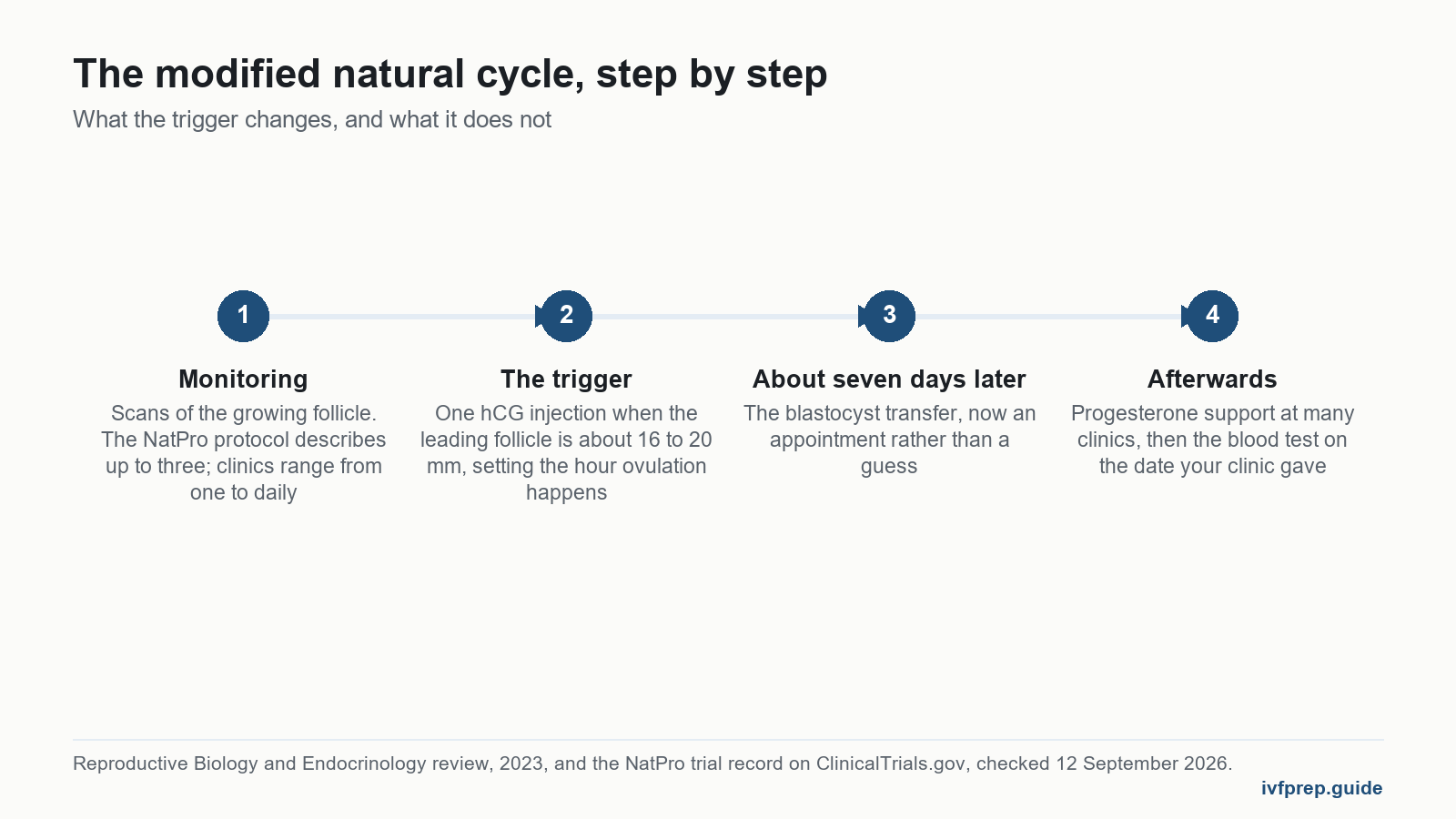
The 2023 review in Reproductive Biology and Endocrinology describes the trigger being given when the leading follicle reaches roughly 16 to 20 mm, with a blastocyst then transferred about seven days later. The NatPro trial record on ClinicalTrials.gov puts it in plainer words in its own arm description: hCG is administered “to assist with timing of the embryo transfer”.
That is the whole modification. Not a stronger cycle, not a boosted lining, not a better embryo. A scheduling device, and an effective one: ovulation is the least punctual event in the calendar, and the trigger turns it into an appointment. If you have been reading about what a frozen transfer timeline actually looks like, this is the step that pins the rest of the dates in place.
How does it compare with a true natural cycle and a medicated one?
Three protocols, three different answers to the timing question. The table below is compiled from the review and trial records linked in each row, so you can check any line of it yourself.
| Protocol | What your body does | What is given | Transfer timed from | Source |
|---|---|---|---|---|
| True natural | You ovulate on your own, and the follicle supplies the oestrogen and progesterone | Nothing to build the lining. Luteal progesterone is used by some clinics and not others | Blastocyst about 6 days after the LH surge | 2023 review in Reproductive Biology and Endocrinology |
| Modified natural | You still ovulate on your own, but an injection sets the hour | One hCG trigger, commonly with progesterone support afterwards | Blastocyst about 7 days after the trigger | 2023 review in Reproductive Biology and Endocrinology and the NatPro trial record on ClinicalTrials.gov |
| Medicated or programmed | No ovulation and no corpus luteum | Oestradiol, then progesterone, continued well into pregnancy | Blastocyst on day 6 or 7 of progesterone | 2023 review in Reproductive Biology and Endocrinology |
This is a very ordinary conversation to be having. Frozen transfers made up 48 per cent of UK IVF cycles in 2024, up from 24 per cent a decade earlier, according to the HFEA figures for 2024. Half of everyone in treatment is choosing between these three routes.
What does the evidence actually say about the three protocols?
Two things, and they point in slightly different directions, which is why the pages you have been reading disagree.
On whether one protocol produces more babies, nobody has shown that it does. The Cochrane review of cycle regimens, updated in June 2025 pooled 32 randomised trials covering 6,352 women and found insufficient evidence to favour any one regimen. On natural versus hormone therapy cycles its wording is “we are uncertain of a difference in live birth rate”, with the certainty of the evidence running from moderate down to very low. On the narrower question here, it found probably little or no difference in ongoing pregnancy between an unmodified natural cycle and a modified one with an hCG trigger. The trigger buys predictability, not a better chance.
On maternal safety the picture is firmer, and it is about the corpus luteum. A natural or modified natural cycle leaves one behind after ovulation, and it makes more than progesterone. A programmed cycle has none. In a secondary analysis of the PnROVE randomised trial in Frontiers in Medicine, which randomised 4,376 women, pre-eclampsia occurred in 38 of 1,261 pregnancies after a natural ovulation regimen and 60 of 1,280 after a programmed one, an absolute difference of about 1.67 percentage points.
Read that as what it is: a real difference, and a small one, in a complication most people will not have. It is not a reason to arrive at your next appointment with a protocol request. Programmed cycles exist because plenty of people do not ovulate predictably, and for them the medicated route is the one that works. The decision belongs to the team who know your cycle and your lining history. The full set of randomised trials comparing the two routes, including the main PnROVE results later published in the BMJ, is laid out in our side by side comparison of medicated and natural FET trials.
Has the big trial on this reported yet?
No, and it is worth knowing that before you read a page implying otherwise. NatPro is the trial built to answer exactly this question: 788 women randomised to a modified natural or a programmed FET, with pre-eclampsia as the primary outcome and live births as the second.
Checked on 12 September 2026, the NatPro trial record on ClinicalTrials.gov listed the study as active but not recruiting, with an estimated primary completion date of 1 February 2026, an estimated study completion of 1 April 2026, no results posted, and a last update of 16 May 2025. So the definitive randomised comparison of the two protocols is finished or close to it, and has not yet been published. Anyone quoting a NatPro result to you today is quoting something that does not exist.

How much monitoring do people who have done this actually report?
This is the part clinics describe in one sentence and patients find out the hard way. The literature says a modified natural cycle needs less monitoring than a true natural one, and the NatPro protocol describes up to three ultrasounds before the trigger. Fifteen people describing their own cycles across three public threads reported something much wider than that.
In a thread in r/IVF from March 2026 asking how much monitoring a modified natural transfer involves, ten people answered with specifics. At one end, two posters described a single appointment: one wrote that she called the clinic on day one, had one scan and blood test on day 11, triggered on day 13 and transferred on day 20. Another said her clinic scans once, on day 10, and that is it. At the other end, one poster described baseline on day three, day ten, then every other day or daily until the trigger, for five or six visits in total. Another was seen on days one, seven, ten and twelve, and noted that the day ten and day twelve appointments were given at short notice, which she flagged as the thing to plan work around.
The r/IVF thread from August 2026 repeats the pattern with a different complication attached: distance. The person asking lived two hours from her clinic and wanted to know how many days a week she would be driving. One reply described four to five appointments over two weeks on a fully natural cycle, then only one appointment on her third cycle because the clinic triggered on day nine rather than waiting for the surge. Another was scanned every day from day five because a cyst was being watched. A third went every other day from day seven, surged early, skipped the trigger altogether and had the transfer anyway.
The Mumsnet thread from April 2025 catches the disagreement that runs underneath all of this. One poster reported being offered a cycle with no scans at all, tracked on ovulation sticks, for around 1,700 pounds. Two others in the same thread said flatly that they would not accept that level of monitoring. One described asking for a scan on transfer day in her second cycle, after having none in her first, and the transfer being cancelled because the lining was too thin.
Where the accounts agree with the guidance: the trigger really does cut the number of visits, and several people said so directly. Where they part company: the guidance describes a typical protocol, while practice runs from one appointment to daily scans depending entirely on which clinic you walk into. That says nothing about your body or how your cycle will go. It is a practical warning that the phrase “modified natural” tells you very little about how much of your month this will take, and that the number of appointments is a question for your own clinic, asked before the cycle starts rather than during it.
These are forum accounts, not data. Nobody posts a monitoring schedule because it was representative, and the people who had an uneventful cycle mostly say nothing at all.
Does the trigger shot interfere with a home pregnancy test?
It can, and this is the one practical consequence of the trigger that catches people out. The injection is hCG, which is the hormone a home pregnancy test looks for, so it can produce a positive test that reflects the injection rather than a pregnancy while it clears. How long that takes depends on the dose and on you, which is why clinics count on the blood test they booked instead. There is more on that in our piece on why a home test after IVF can mislead you, and on the separate question of what happens in the room on transfer day.
What is worth asking your own clinic?
Not which protocol is best, because that is their call and it rests on facts about you that no article has. The useful questions are logistical, and nobody volunteers them: how many monitoring appointments this protocol usually needs at this clinic, how much notice you get for each, which days of the week the unit does transfers, and what happens if you ovulate before the trigger. Those four answers are what the accounts above show people wishing they had asked for.
If the vocabulary is still slippery, our plain language guide to the different assisted reproduction techniques untangles the acronyms without the clinic marketing attached.
The four questions nobody volunteers, plus two
Not which protocol is best, because that is your clinic’s call. These are the logistics the accounts on this page show people wishing they had asked before the cycle started.
Ticks are saved on this device only.
Frequently asked questions
Is the hCG trigger in a modified natural FET cycle the same as the one before egg collection?
It is the same hormone, human chorionic gonadotrophin, used for a different job. Before egg collection it matures eggs for retrieval. In a modified natural frozen transfer cycle it is used to make ovulation happen at a known time so the transfer can be scheduled. The dose and brand are set by your clinic.
Do you still take progesterone in a modified natural cycle?
Often, but not always. The 2023 review in Reproductive Biology and Endocrinology describes the evidence on luteal progesterone support in modified natural cycles as contradictory, with some studies favouring it and others finding no significant difference. Clinics differ on this and your own team will tell you what they use.
Can a modified natural cycle be cancelled?
Yes. A cycle can be stopped if ovulation happens before the planned trigger, if the lining is not judged ready, or if the follicle does not develop as expected. Forum accounts describe both outcomes, including transfers cancelled on the day after a scan. Your clinic decides and will explain what happens to the embryo, which stays frozen.
Does a modified natural cycle require you to ovulate regularly?
It relies on you growing a dominant follicle and ovulating, because the lining is prepared by your own hormones. That is why programmed cycles exist for people who do not ovulate predictably. Whether your cycle is suitable is a question for the clinic monitoring it, not something to work out from a calendar app.
How many days after the trigger is the embryo transferred?
For a blastocyst, commonly about seven days after the hCG trigger, according to the 2023 review in Reproductive Biology and Endocrinology. Cleavage stage embryos are transferred earlier. Clinics count this themselves and will give you the date, and small differences between units are normal rather than a sign anything is wrong.
Is a modified natural FET cycle cheaper than a medicated one?
Usually there are fewer drugs, which is where the saving comes from, but there can be more monitoring appointments and each one may be charged. Reported costs vary widely by clinic and country, so the only reliable figure is the itemised one your own clinic gives you in writing before the cycle starts.
Finished the page? The same five questions from the top, to see what stuck.
This article is general information, not medical advice, and is not a substitute for care from a qualified healthcare professional. Speak to your doctor about your own situation.
Leave a Reply