
The types of assisted reproductive technology come down to a short list: IUI, IVF, ICSI, frozen embryo transfer, treatment with donor eggs or sperm, and genetic testing of embryos, and each one exists to solve a different obstacle. Fertility treatment still arrives as a wall of acronyms, usually at a moment when you have limited capacity for new vocabulary. This is a plain guide to what they mean and, more usefully, what problem each one is trying to solve.
Listen to this article, about 9 minutes. A synthetic voice reads the article and announces each section title as it begins; tables are read row by row and the questions at the end are left out.
Recorded 11 October 2026 from the article as published that day. Press a chapter to jump there; the highlighted line is what is playing. A play button sits beside every section heading, and once you scroll past this player a bar at the bottom of the screen keeps the controls in reach. Tap or click any sentence to hear the reading start from there.
On this page: the six types of assisted reproductive technology in one table with the obstacle each one solves, what actually separates IVF from ICSI, why frozen transfers became so common, the shape of a cycle stage by stage, and the five questions worth taking to your appointment.
Think you already know this? Five questions, one minute.
Every answer is on this page. Answer from what you know now; the page fills in the rest.
-
1. Which treatment injects a single sperm directly into an egg?
It exists for sperm that cannot fertilise an egg unaided, per the HFEA’s description of ICSI; where that is not the obstacle it adds nothing. Read the section
-
2. In IUI, where does fertilisation happen?
Per the HFEA’s page on IUI; it is less invasive and less expensive than IVF, with a lower success rate per cycle. Read the section
-
3. According to the HFEA, for how long are embryos allowed to develop in the laboratory before transfer?
Per the HFEA’s description of IVF; after fertilisation the IVF and ICSI routes look identical. Read the section
-
4. What is one reason frozen transfers became so common?
It also changes the two week wait, because there is no recent retrieval and usually no trigger shot to confuse a home test. Read the section
-
5. What does PGT involve?
It is used in defined circumstances rather than as standard, per the HFEA’s embryo testing pages, and it adds cost and involves a biopsy of the embryo. Read the section
The thing worth understanding first: these are not a ladder from basic to advanced. They are different tools for different obstacles. Using a more complex treatment does not improve your chances if the complexity addresses something that was never the problem.
The main treatments
| Name | What happens | Typically used when |
|---|---|---|
| IUI | Prepared sperm placed into the uterus, fertilisation happens inside the body | Mild issues, unexplained infertility, donor sperm |
| IVF | Eggs retrieved, combined with sperm in a laboratory, embryo transferred | Tubal issues, unexplained infertility, when IUI has not worked |
| ICSI | A single sperm injected directly into an egg, then as IVF | Sperm quality issues, previous fertilisation failure |
| Frozen transfer | An embryo frozen earlier is thawed and transferred | Very common, allows recovery from stimulation first |
| Donor eggs or sperm | Donor material used in an IVF or IUI cycle | Where own gametes are not viable or available |
| PGT | Embryo cells tested before transfer | Specific genetic circumstances, recurrent loss, older age |
IUI, the simplest
Sperm is prepared and placed directly into the uterus around ovulation. Fertilisation, if it happens, happens inside the body exactly as it normally would.
It is less invasive, less expensive and less demanding than IVF, and its success rate per cycle is lower. It suits situations where the obstacle is relatively mild, or where donor sperm is being used without any other complicating factor.

IVF and ICSI, and what separates them
In conventional IVF, eggs are retrieved and placed together with sperm in the laboratory, and fertilisation is left to happen on its own. In ICSI, an embryologist selects a single sperm and injects it directly into an egg.
ICSI exists to solve a specific problem: sperm that cannot fertilise an egg unaided, whether through low count, poor motility or a previous cycle where fertilisation did not occur. Where that is not the obstacle, ICSI does not add anything, and it is worth asking why it is being suggested if it is.
After fertilisation, both routes look identical. Embryos are cultured for a few days, between two and six according to the HFEA’s description of IVF, assessed, and one is transferred.

Fresh and frozen transfer
A fresh transfer places an embryo during the same cycle as the egg retrieval. A frozen transfer freezes embryos and transfers one in a later cycle.
Frozen transfers have become extremely common. The HFEA’s Fertility treatment 2024: trends and figures, published 16 June 2026, puts them at 48 percent of all IVF cycles in the UK in 2024, with around 53,000 patients treated and an average birth rate of 30 percent per embryo transferred. One reason is straightforward: stimulation puts the body through a great deal, and a later cycle allows hormone levels and the uterine lining to return to something more ordinary before transfer.
It also changes the two week wait practically. There is no recent retrieval, so there are fewer explanations for pain and bleeding, and usually no trigger shot to confuse a home test. testing at home covers why that matters. Whether the frozen cycle itself is medicated or natural is a separate decision, and what the big trials found comparing medicated and natural frozen cycles takes that question on.
Genetic testing
PGT involves removing a small number of cells from an embryo and testing them before transfer. It is used in defined circumstances rather than as standard: known genetic conditions in the family, recurrent losses, or sometimes as a factor of age.
It is not a guarantee, it adds cost, and it involves a biopsy of the embryo. The opening the lab makes for that biopsy is often confused with a separate lab extra, and our explainer on what the guidelines say about assisted zona hatching sets the two apart. Whether it is appropriate is a real conversation with your clinic rather than something to decide from an article.
Whatever is being proposed for you, the most useful question you can ask is why this rather than something else. The reasoning tells you what your clinic believes the obstacle is, and understanding that makes the entire process less bewildering than following instructions you do not understand.
What a cycle actually involves
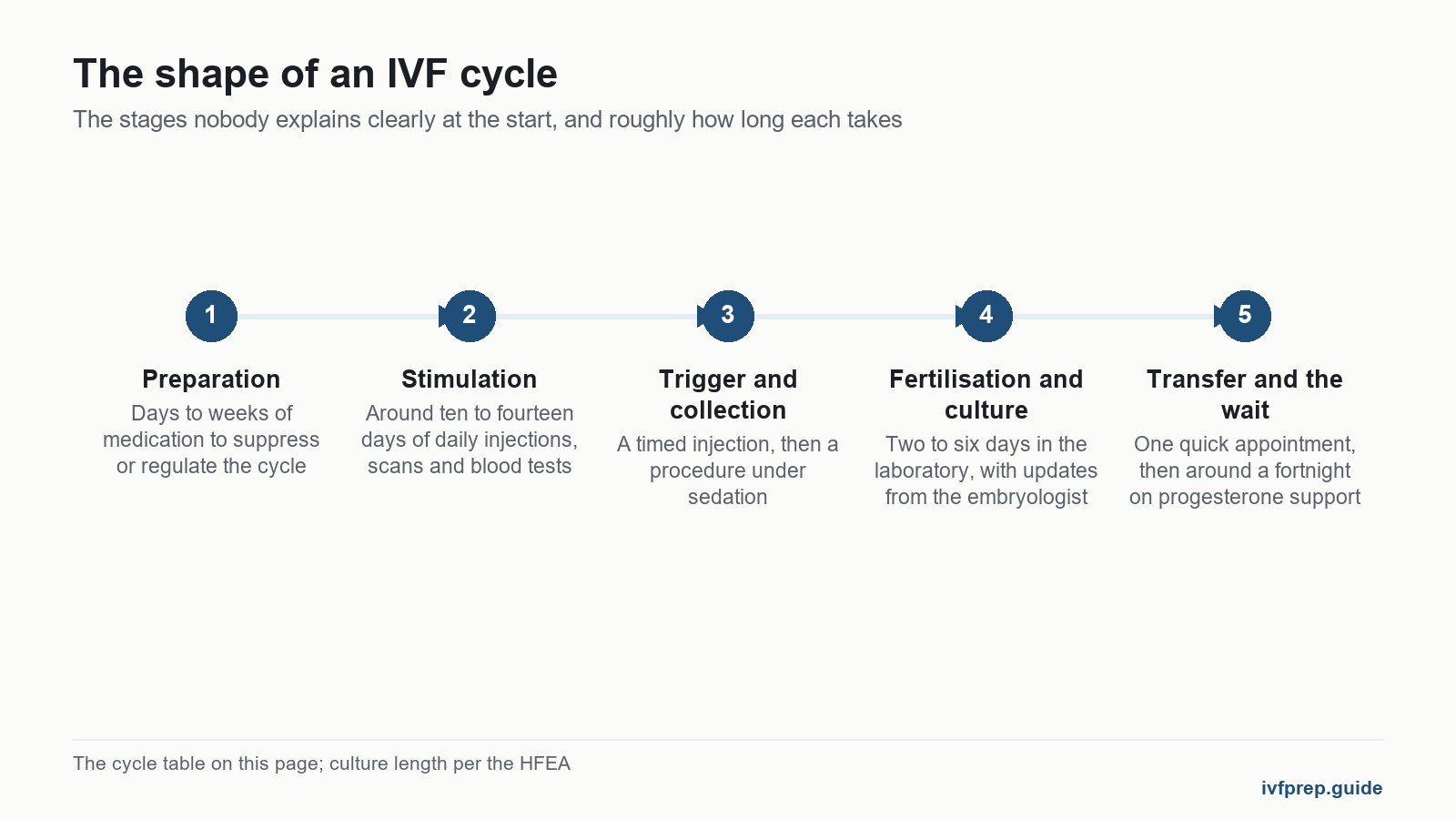
The acronyms describe the technique. This is the shape of the experience, which nobody explains clearly at the start.
| Stage | Roughly how long | What it involves |
|---|---|---|
| Preparation | Days to weeks | Medication to suppress or regulate the cycle |
| Stimulation | Around ten to fourteen days | Daily injections, frequent scans and blood tests |
| Trigger and collection | A few days | A timed injection, then a procedure under sedation |
| Fertilisation and culture | Three to six days | Laboratory work, daily updates from the embryologist |
| Transfer | One appointment | Quick, usually without sedation |
| The two week wait | Around a fortnight | Progesterone support, and waiting |
The stimulation phase is the one people underestimate. It is not the injections so much as the frequency of appointments, often early in the morning, often before work, for two weeks. Arranging your life around it is a substantial part of what makes treatment tiring.
The part that is not medical
Treatment is expensive, time consuming and emotionally heavy, and the fact that this is a medical article does not make those less real.
Most people underestimate the emotional load in particular, partly because the process is presented in clinical terms that make it sound procedural. Cycles can be cancelled. Numbers can disappoint at every stage. And the whole thing runs on a schedule set by biology rather than by what is convenient.
None of that is a reason not to do it. It is a reason to expect it, to accept help, and to be less surprised when a straightforward sounding appointment leaves you flattened.
Questions worth taking to your appointment
- What do you think the main obstacle is in our case?
- Why this treatment rather than the simpler or the more complex option?
- Fresh or frozen transfer, and why that one for me?
- What would change your recommendation if this cycle does not work?
- What are the realistic expectations for someone in my situation, rather than the clinic average?
That last question matters. Published success rates are averages across everyone a clinic treats, and your own situation may sit some distance from the average in either direction.
If you are already in the two week wait, what symptoms can and cannot tell you covers what the fortnight is actually like and what the symptoms can and cannot tell you.
The five questions worth taking to your appointment
The most useful question you can ask about any treatment is why this rather than something else. Tick each one once you have asked it and written the answer down.
A list of questions for your clinic, not a way of choosing a treatment. Ticks are saved on this device only.
What has changed since this was first published?
The treatments themselves do not change from week to week. The figures around them do, so this page is rechecked on the weekly refresh and the entries below carry a date and a source.
- 11 October 2026: the HFEA published Fertility treatment 2024: trends and figures on 16 June 2026. Its headline numbers, frozen transfers at 48 percent of all IVF cycles, around 53,000 patients treated and a 30 percent birth rate per embryo transferred, are now in the frozen transfer section above. The same report puts the share of cycles funded by the NHS at 28 percent in 2024, down from 35 percent in 2019, and marks the 2024 birth data as preliminary.
- 11 October 2026: the six HFEA treatment pages this page links were checked and are live. Their wording was not re-read on this pass, so the two to six day culture figure stands as verified on 25 September 2026.
Frequently asked questions
What is the difference between IVF and ICSI?
In conventional IVF, eggs and sperm are placed together and fertilisation happens on its own. In ICSI a single sperm is injected directly into an egg. ICSI is generally used where sperm quality or previous fertilisation problems make the conventional approach less likely to work.
Is IUI a type of IVF?
No. IUI places prepared sperm directly into the uterus and fertilisation happens inside the body. IVF involves retrieving eggs and fertilising them in a laboratory. IUI is simpler, less invasive and less expensive, with lower success rates per cycle.
Is a frozen transfer worse than a fresh one?
Not inherently, and frozen transfers have become very common. Freezing allows the body to recover from stimulation before transfer, which suits some people better. Which is appropriate depends on your cycle and your clinic’s assessment.
What is PGT?
Preimplantation genetic testing, where a small number of cells are taken from an embryo and tested before transfer. It is used in specific circumstances rather than routinely, and whether it is worthwhile is a genuine discussion to have with your clinic.
Does a more advanced treatment mean a better chance?
No. These are different tools for different problems, not a ladder from basic to advanced. ICSI does not improve outcomes where fertilisation was never the issue, and using the right treatment for your situation matters more than using the most complex one.
Why did my clinic recommend one over another?
Because of what they think the underlying obstacle is. That reasoning is worth asking about directly. Understanding why a particular route was chosen makes the whole process considerably less bewildering.
Finished the page? The same five questions from the top, to see what stuck.
This article is general information, not medical advice, and is not a substitute for care from a qualified healthcare professional. Speak to your doctor about your own situation.
Leave a Reply