
A clot in the two week wait cannot tell you whether the transfer worked. Bleeding happens in pregnancies that continue and in pregnancies that end, and the overlap is wide enough that no clot is evidence either way. What a clot can tell you is whether to phone your clinic today, a different question, and one that has an answer.
Listen to this article, about 10 minutes. A synthetic voice reads the article and announces each section title as it begins; tables are read row by row and the questions at the end are left out.
Recorded 10 October 2026 from the article as published that day. Press a chapter to jump there; the highlighted line is what is playing. A play button sits beside every section heading, and once you scroll past this player a bar at the bottom of the screen keeps the controls in reach. Tap or click any sentence to hear the reading start from there.
On this page: the two bleeding rates that sit six points apart and separate almost nothing, the ordinary causes of clots after a transfer, a table of exactly when guidance says to ring, why a clot feels like it should mean something, and what happens when you call.
Think you already know this? Five questions, one minute.
Five questions on what the studies and the guidance say. None of them are about what you are seeing.
-
1. In the analysis of 4,926 IVF pregnancies, how common was bleeding or spotting in pregnancies still ongoing at the end of the first trimester?
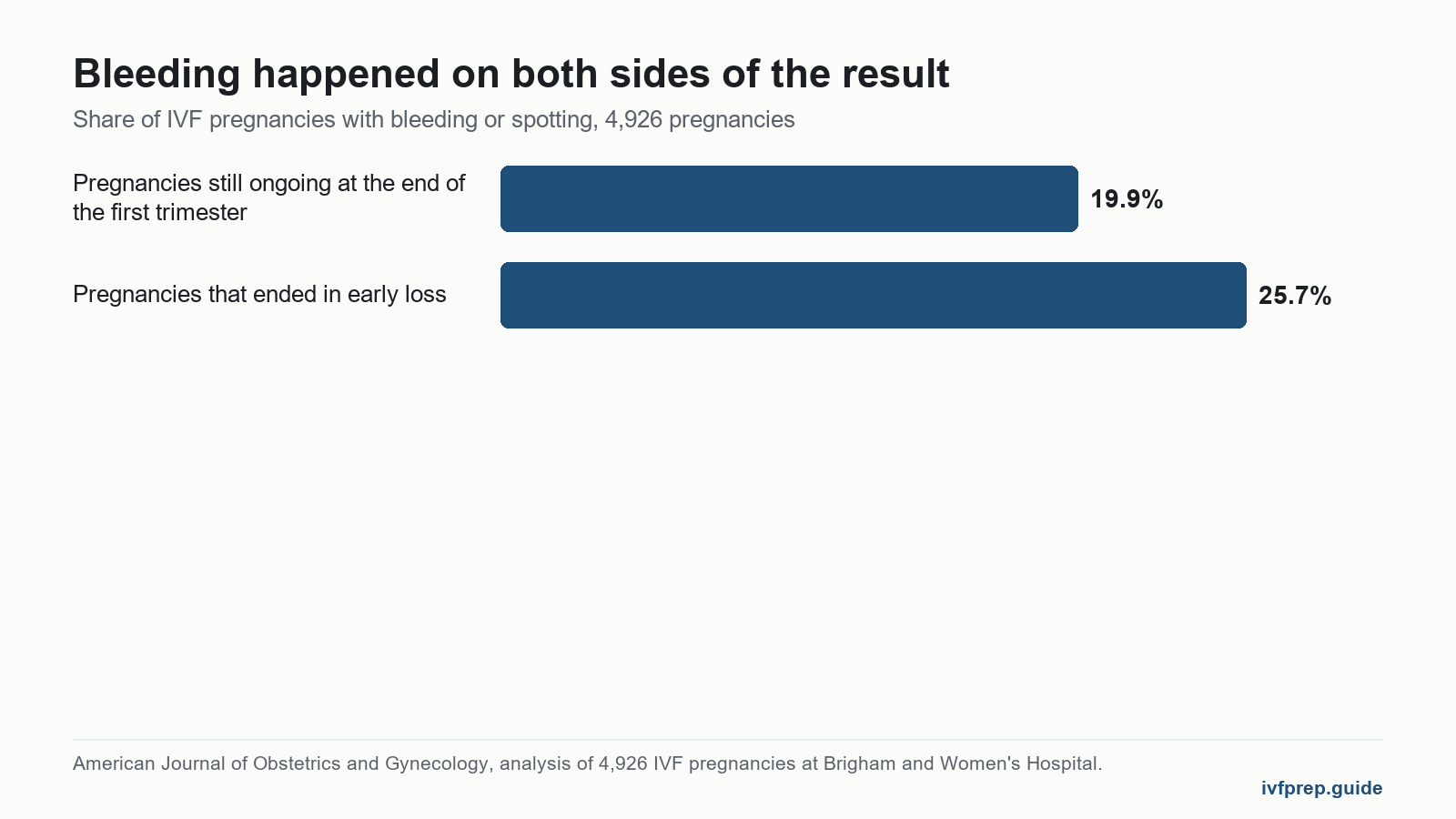
The Brigham and Women’s analysis puts the two figures six points apart, which is real in a database and close to useless at three in the morning, because roughly one in five people whose pregnancy carried on saw bleeding too. Read the section
-
2. Which of these is a documented cause of a small dark clot after a transfer?
Old blood turns up as a small brown or nearly black clot that looks more dramatic than its volume. The transfer catheter, vaginal progesterone and ordinary early pregnancy bleeding, around a quarter of pregnancies, are the other common explanations. Read the section
-
3. According to the table, which presentation is emergency care now rather than a callback?
The NHS calls soaking a pad soon after putting it on a 999 situation in pregnancy, and American Family Physician uses the two pads an hour threshold. Pain low on one side, shoulder tip pain, dizziness or fainting are urgent assessment in their own right. Read the section
-
4. Do the day by day bleeding timelines circulating online hold up?
The tidy timelines do not survive contact with real cycles. The comparison people reach for is against their own period, and that comparison breaks down under IVF. The scheduled blood test is what answers the question. Read the section
-
5. What do most clinics ask when you ring about bleeding?
Pad count and clot or tissue passage are standard parts of the assessment, so having them ready shortens the call. Bleeding in the two week wait is one of the things clinics expect calls about at any hour, and the NHS ectopic pregnancy page is why one sided pain is always mentioned. Read the section
If you are reading this at two in the morning with a pad in your hand, the honest thing anyone can offer is a clear line between the question that has no answer and the question that does. Nobody can look at what you are seeing and tell you the outcome. Your clinic can tell you whether it needs looking at tonight.
Does a clot mean the transfer has failed?
No, and it does not mean the opposite either. The uncomfortable fact underneath every forum thread on this subject is that bleeding is common on both sides of the result, so it separates almost nothing.
An analysis of 4,926 IVF pregnancies at Brigham and Women’s Hospital, published in the American Journal of Obstetrics and Gynecology, reported bleeding or spotting in 25.7 percent of those that ended in early loss and 19.9 percent of those still ongoing at the end of the first trimester. Look at those two numbers next to each other. A gap of six percentage points is real in a research database and close to useless at three in the morning, because roughly one in five people whose pregnancy carried on saw bleeding too.
Older work pointed the same way. A study in Fertility and Sterility, titled First Trimester Uterine Bleeding in IVF Pregnancies Is Not Detrimental to Reproductive Outcome, found first trimester bleeding common after IVF and not associated with worse outcomes. Neither paper says bleeding is nothing. They say it does not sort people into groups, which is what you are hoping it will do.
The reverse is just as true, and it is why this site exists. Plenty of transfers that worked produced no bleeding and no symptoms at all, and plenty that did not work produced nothing either. We wrote about that asymmetry in no bleeding, no symptoms, and why absence is not evidence. Presence is not evidence in the other direction. Both readings fail for the same reason.

What actually causes bleeding and clots after an embryo transfer?
Several ordinary things, most of which have nothing to do with the embryo:
- The transfer itself. If the catheter needed manoeuvring past the cervix, the cervix can bleed for a day or two afterwards. That is bleeding from tissue the embryo never touched.
- Vaginal progesterone. Product information for vaginal progesterone lists vaginal bleeding, discharge and local irritation among its side effects, and applicators can scratch. This is one of the most common explanations, and the one nobody wants to hear, because it is boring.
- Old blood arriving late. Blood that has sat in the vagina or cervical canal darkens, and can turn up as a small brown or nearly black clot that looks far more dramatic than the volume it represents. We covered colour in brown spotting after embryo transfer.
- Early pregnancy bleeding. Around a quarter of pregnant women bleed before 12 weeks, according to a review in American Family Physician, and that figure includes many pregnancies that continued normally.
- Something that needs assessing. Less often, bleeding is the first sign of a pregnancy loss, or of an ectopic pregnancy. That possibility is why the phone call matters. It is not the same as it being likely.
On ectopic pregnancy, the risk after IVF is low but not zero, and published rates vary depending on who is counted. A registry analysis of UK assisted conception pregnancies between 2000 and 2012 put the overall rate near 1.4 percent, falling from roughly 20 to 12 cases per thousand across those years. Single centre series, and groups with tubal factor infertility, report higher figures. Your own risk depends on your history, which your clinic knows and this page does not.
When is it worth calling the clinic?
This is the part with actual answers. The table sets out how published guidance treats different presentations. It is a guide to urgency, not a diagnosis, and clinics differ in what they ask patients to report, so the instructions you were given after your transfer take priority. The sources behind it, rechecked on 13 September 2026, are the NHS pages on vaginal bleeding in pregnancy, last reviewed in February 2026, and on symptoms of ectopic pregnancy, and the 2019 review First Trimester Bleeding: Evaluation and Management in American Family Physician, which puts first trimester bleeding at about a quarter of pregnancies and links pain and heavy bleeding with a higher risk of loss.
| What you are seeing | How guidance treats it | Reasonable next step |
|---|---|---|
| Light spotting, pink or brown, no pain | Common during progesterone support and in early pregnancy generally | Message or ring the clinic in normal hours and describe it |
| Bleeding as heavy as a period, clots, or bleeding with cramping | American Family Physician: bleeding equal to or heavier than a period, and bleeding with pain, carry a higher risk of early pregnancy loss | Ring the clinic the same day rather than waiting for the test |
| Soaking a pad soon after putting it on, or more than two pads an hour for two hours | The NHS calls soaking a pad soon after putting it on a 999 situation in pregnancy. The two pad threshold is from American Family Physician | Emergency care now, not a callback |
| Pain low down on one side, shoulder tip pain, dizziness or fainting | The NHS lists these among signs of ectopic pregnancy, shoulder tip pain being a possible sign of internal bleeding | Urgent assessment, saying first that you have had an embryo transfer |
| Severe pain you cannot think through, bleeding or not | The NHS test is being unable to focus on a book or daily tasks because of the pain | Emergency care now |
Two details are worth knowing before you dial. Ectopic bleeding is often described as watery, dark brown, and starting and stopping, so light bleeding does not rule it out when there is one sided pain alongside it. And an ectopic can rupture at any hCG level, which is why pain and dizziness are assessed in their own right rather than against a number on a results portal.
Why does a clot feel like it should mean something?
Because you can see it, and almost nothing else in the two week wait is visible. You cannot watch hCG rise. You cannot see an embryo implanting or failing to. A clot is the only physical event in a fortnight of nothing, so the mind treats it as data.
Forums make this worse in a way that is nobody’s fault. People post when something happens. Nobody starts a thread to report that today was uneventful, so every search returns a wall of clots with an outcome attached to each one. Those threads are evidence of what people experienced, not of what a clot predicts. The very large silent group whose two week wait contained nothing worth typing about never appears in the results.
The same distortion runs through symptom lists generally, which is why we wrote implantation bleeding symptoms and why they prove nothing. Clot size and colour belong in that same category. If what you are seeing is light rather than clotted and you are on progesterone support, light bleeding in early pregnancy on progesterone after IVF takes that version of the question on its own terms.

Does the timing of the bleed narrow anything down?
Not reliably. The tidy timelines circulating online, where bleeding on one day past transfer points one way and bleeding two days later points another, do not survive contact with real cycles. Frozen and fresh transfers differ. Day 3 and day 5 transfers differ. Progesterone support changes whether a bleed happens at all. Counting days fares no better, because the published figures for how long implantation bleeding lasts run from a few hours to three days with no study behind any of them.
The comparison people actually reach for is against their own period, and that comparison breaks down under IVF for reasons we set out in implantation bleeding or period, and why the usual test fails. The thing that will answer your question is the blood test your clinic has already scheduled, and if you want to know what that number can and cannot say, the piece on quantitative beta hCG covers it. If the comparison in your head is against a miscarriage rather than a period, the guideline thresholds that actually settle that question are quoted in full on their own page.
What happens when you call?
Less drama than you are braced for. Most clinics work through a short set of questions: when it started, what colour, how many pads and how quickly they filled, whether there were clots or tissue, whether there is pain and where. Pad count and clot or tissue passage are standard parts of the clinical assessment, so having them ready shortens the call.
Depending on the answers they may ask you to keep the scheduled test, bring it forward, or arrange a scan or an early pregnancy assessment appointment. What they will not do is tell you off for ringing. Bleeding in the two week wait is one of the things clinics expect calls about, at any hour.
It is worth saying plainly. Your clinic knows your protocol, your transfer, your dates and your history. This site knows none of that, and no article can. Where anything here differs from what your own team told you, theirs is the version that applies to you.
What can you do in the hours before you can call?
Nothing here changes the outcome, and anyone promising otherwise is selling something. What it does is make the call more useful when it comes:
- Write down the time it started, the colour, how many pads and whether there was pain. That is the exact list the clinic will ask for, and writing it down gives the anxiety somewhere to go.
- Keep the out of hours number visible rather than buried in an email, so ringing stays a small decision rather than a project.
- Stop comparing against forum photographs. Screens vary, pad brands vary, lighting varies, and the outcome attached to a stranger’s photo was never transferable to you.
- If the choice is between waiting alone and ringing the out of hours line, ringing is what the line is for.
You are allowed to find this frightening. It is frightening. The thing that is not true is that the fright is telling you something about the result.
The note the clinic will ask you to read from
When it started, how much, whether there is pain and where. Write it here while it is happening; it shortens the call and gives the anxiety somewhere to go.
Kept on this device only. Soaking a pad soon after putting it on, severe pain, shoulder tip pain or feeling faint are emergency care now, not a note.
Frequently asked questions
Can clots in the two week wait tell me if the transfer worked?
No. Bleeding occurs in pregnancies that continue and in pregnancies that end, and the rates are close enough that no clot separates the two. A quantitative blood test arranged by your clinic is what answers that question.
Are clots after an embryo transfer normal?
Bleeding after a transfer is common, and small dark clots are often old blood that has darkened before leaving. Common is not the same as unimportant, which is why the useful response is describing it to your clinic rather than deciding for yourself what it was.
How much bleeding counts as too much?
NHS guidance treats soaking a period pad soon after putting it on as an emergency in pregnancy, and a review in American Family Physician uses more than two pads an hour for two consecutive hours as a warning threshold. Severe pain is treated as urgent whether or not there is bleeding.
Could progesterone be causing the bleeding?
It is one recognised possibility. Product information for vaginal progesterone lists vaginal bleeding, discharge and local irritation among its side effects. Only your clinic can say whether that explains what you are seeing, and nothing here is guidance to change anything about your medication.
Is it worth doing a home pregnancy test to find out sooner?
That is a decision for you and your clinic, and testing early carries its own problems after IVF because trigger medication can still be in your system. Whatever a home test shows, it does not change the urgency questions in this article, which are about bleeding and pain rather than about the result.
What if the bleeding stops on its own before I call?
Bleeding that starts and stops is described in NHS guidance on ectopic pregnancy, so stopping is not by itself a reason to skip the call, particularly if there was pain on one side. Telling the clinic what happened costs a phone call and gives them information they would rather have.
Finished the page? The same five questions from the top, to see what stuck.
This article is general information, not medical advice, and is not a substitute for care from a qualified healthcare professional. Speak to your doctor about your own situation.
Leave a Reply