
If you are searching ectopic pregnancy implantation bleeding tonight, here is the honest answer: the blood cannot tell you. The NHS, HFEA and NICE lists overlap with ordinary post transfer spotting almost completely. An ectopic is found by serial hCG blood tests and a transvaginal scan, and sudden severe pain, dizziness or fainting is a 999 call.
Listen to this article, about 13 minutes. A synthetic voice reads the article and announces each section title as it begins; tables are read row by row and the questions at the end are left out.
Recorded 7 November 2026 from the article as published that day. Press a chapter to jump there; the highlighted line is what is playing. A play button sits beside every section heading, and once you scroll past this player a bar at the bottom of the screen keeps the controls in reach. Tap or click any sentence to hear the reading start from there.
On this page: the NHS, HFEA and NICE ectopic warning lists side by side with each cell quoted and linked, the published ectopic rates after IVF from four datasets, the 2024 case series in which 9 of 24 ectopics gave no symptom at all, and six r/IVF accounts of how an ectopic was actually found.
Think you already know this? Five questions, one minute.
Every answer is on this page. Answer from what you know now; the page fills in the rest.
-
1. According to the NHS, which combination of symptoms means call 999 or go to A&E immediately?
The NHS ectopic pregnancy symptoms page names that combination as the signs of a rupture and says to call 999 or go to A&E immediately. The other two are reasons to contact a clinic or GP, not a rupture. Read the section
-
2. Which of these appears on the HFEA’s list of ectopic warning signs?
The HFEA risks page lists a one-sided low abdominal pain, vaginal bleeding or dark brown or red discharge, and diarrhoea or pain when you go to the toilet. Shoulder tip pain is on the NHS and NICE lists but not the HFEA’s. Read the section
-
3. What ectopic rate did the analysis of 161,967 pregnancies in the UK HFEA register report for 2000 to 2012?
As reported from the ESHRE 2015 meeting, the HFEA register analysis found 1.4% over the period, falling from 20 to 12 per 1,000 pregnancies. The 5% figure is the older ASRM booklet number that no national dataset supports. Read the section
-
4. Under NICE guideline NG126, what does an early pregnancy assessment service offer to find where a pregnancy is?
NICE NG126 says the service offers a transvaginal ultrasound to identify the location of the pregnancy, with serum hCG assessment, and the RCOG leaflet says the transvaginal scan is the more accurate route. No symptom list diagnoses it. Read the section
-
5. In the CDC data on 553,577 ART pregnancies, how did the ectopic rate change with the number of embryos transferred in fresh non donor cycles?
Perkins et al, 2015 reported 1.6% with one embryo, 1.7% with two, 2.2% with three and 2.5% with four or more. The HFEA register analysis found tubal factor infertility the strongest predictor, with an odds ratio of 2.23. Read the section
When is bleeding after an embryo transfer an emergency?
This part is written straight, because it matters more than everything below it. The NHS ectopic pregnancy symptoms page says to call 999 or go to A&E immediately for the combination of “a sharp, sudden and intense pain in your tummy”, feeling very dizzy or fainting, and feeling sick. Those are the signs of a rupture, and a rupture is why an ectopic pregnancy is treated as an emergency rather than a worry.
Short of that, the same page says to contact a GP or call 111 for a combination of its main symptoms, “even if you haven’t had a positive pregnancy test.” After a transfer the first call is the clinic, and the HFEA’s page on the risks of fertility treatment says so: “If you experience any of these symptoms you should contact your clinic immediately. Never feel you are wasting the clinic’s time.” Your clinic knows your protocol and your dates. This page does not.
What ectopic warning signs do the NHS, HFEA and NICE list?
Three UK bodies publish a list, and they do not quite match. Here they are side by side, each column linked to its page, read on 23 October 2026.
| Warning sign | NHS symptoms page | HFEA risks page, April 2016 | NICE guideline NG126 |
|---|---|---|---|
| Vaginal bleeding | “often starts and stops, and may be watery and dark brown in colour” | “vaginal bleeding or dark brown or red vaginal discharge” | “vaginal bleeding with or without clots”, listed as common |
| Tummy pain | usually low on one side, sudden or gradual, constant or intermittent | “a one-sided low abdominal pain” | abdominal or pelvic pain, listed as common |
| Shoulder tip pain | “an unusual pain felt where your shoulder ends and your arm begins” | not listed | listed as less common |
| Toilet discomfort | pain or pressure on a bowel movement, pain passing urine, or diarrhoea | “diarrhoea or pain when you go to the toilet” | rectal pressure, listed as less common |
| Dizziness or fainting | a rupture sign, with sharp sudden pain and feeling sick | not listed | listed as less common |
Notice what is missing from every column: a colour, an amount or a day count that separates ectopic bleeding from anything else. The NICE guideline adds two sentences the lists tend to bury: atypical presentations are common, and about a third of women with an ectopic pregnancy have no known risk factors. The lists decide who gets checked. They were never built for diagnosing from a sofa.
Can the bleeding itself tell an ectopic from implantation?
The internet has a colour chart for everything, and ectopic bleeding is no exception. The NHS does call it watery and dark brown and says it “often starts and stops”, but it also says it “tends to be a bit different to your regular period”, which is about as honest as a sentence can be while saying almost nothing. Brown, watery, stop start spotting is exactly how this site’s article on what implantation bleeding looks like describes ordinary spotting after a transfer. The miscarriage or implantation bleeding question sank on the same rock.

A 2024 case series in Asian Biomedicine of 24 ectopic pregnancies after IVF or ICSI transfer puts numbers on it. Vaginal bleeding was the presenting complaint in 14 of the 24, lower abdominal pain in 4, and the authors record 9 cases with no symptoms at all. The average interval from transfer to diagnosis was 27.2 days, with a range of 19 to 59. More than a third had given no symptom to go on. The bleeding did not find them; blood tests and scans did. It is the asymmetry behind this site’s article on successful transfers with no symptoms: the absence of a symptom is not evidence, and neither is its presence.
How common is an ectopic pregnancy after IVF?
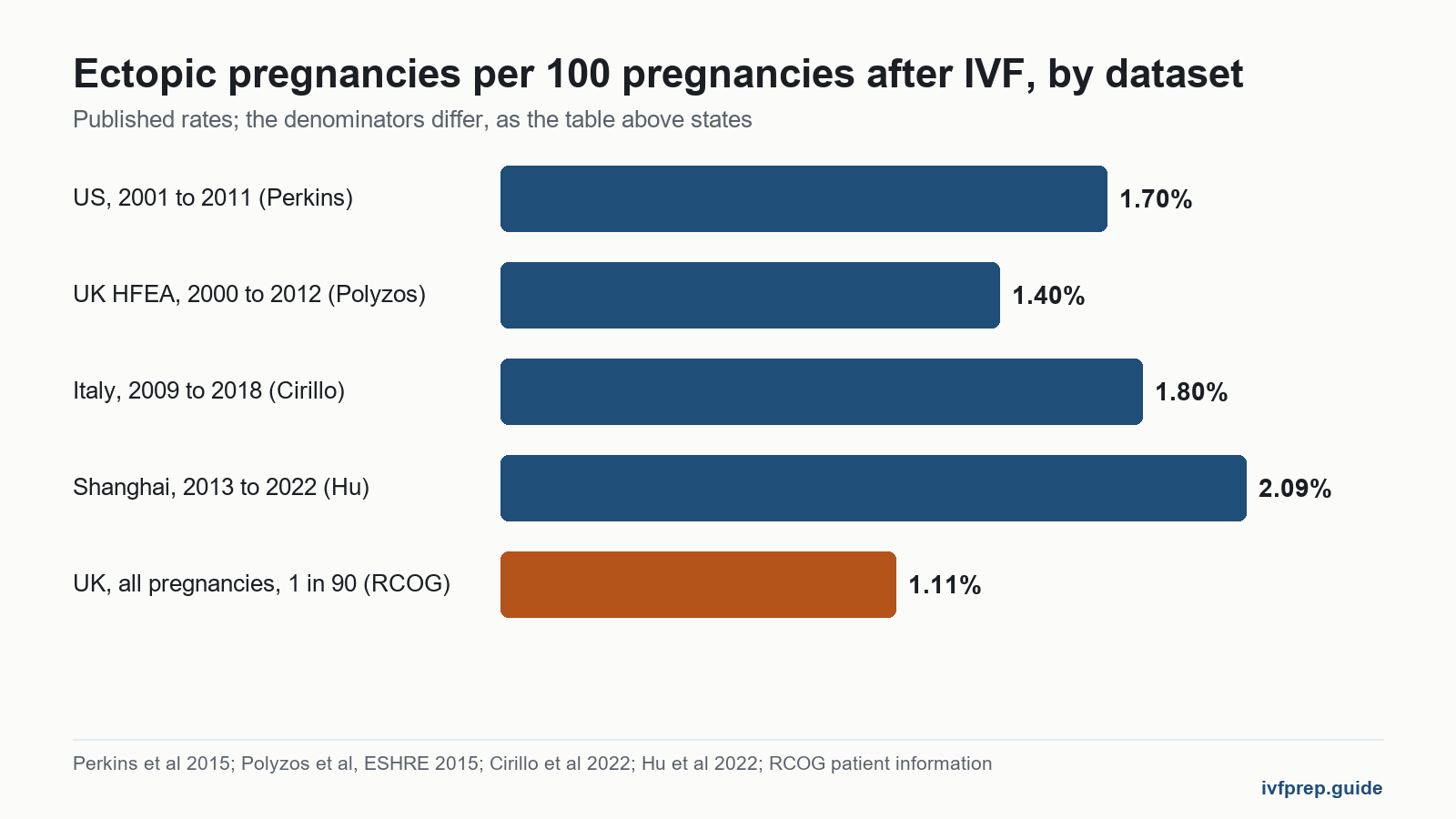
Lower than the forums suggest, higher than the brochure implies. The large datasets agree to within a percentage point, and every one of them counts pregnancies, not people who bled.
| Dataset | Years | What was counted | Ectopic rate | Source |
|---|---|---|---|---|
| US national ART surveillance | 2001 to 2011 | 553,577 clinical pregnancies, 9,480 ectopic | 1.7% | Perkins et al, Obstetrics and Gynecology, 2015 |
| UK HFEA register | 2000 to 2012 | 161,967 pregnancies | 1.4%, falling from 20 to 12 per 1,000 | Polyzos et al, ESHRE 2015, as reported |
| Shanghai single centre | 2013 to 2022 | 16,048 hCG positive cycles | 2.09% | Hu et al, Journal of Clinical Medicine, 2022 |
| Italian single centre | 2009 to 2018 | 7,352 pregnancies from 27,376 cycles | 1.80% | Cirillo et al, Scientific Reports, 2022 |
| UK, all pregnancies | current leaflet | general population | 1 in 90, just over 1% | RCOG patient information |
The US figure fell from 2.0% in 2001 to 1.6% in 2011. The ASRM patient booklet on assisted reproduction is commonly quoted as putting the risk after treatment at about 5%, which none of the datasets above supports; the ASRM’s own ectopic fact sheet, revised in 2023, gives no figure and notes that “Many women who have ectopic pregnancies have no obvious risk factors.” Two things follow. Roughly 98 in every 100 pregnancies after IVF are not ectopic. And the two that are cannot be picked out by how they bleed. Bleeding after a positive beta and a scan that found the pregnancy in the womb is a different question, and the figures for it, including the rare heterotopic case, are in our guide to early pregnancy light bleeding on progesterone after IVF.
How is an ectopic actually diagnosed after a transfer?
Not by symptoms, and not by a single blood test. NICE guideline NG126 says a woman with a positive pregnancy test and pain or tenderness is referred immediately to an early pregnancy assessment service, which offers a transvaginal ultrasound to find where the pregnancy is, with serum hCG alongside it. The RCOG leaflet describes the blood side: beta hCG is usually repeated every 48 hours, a pregnancy in the uterus roughly doubles in that time, and a slower rise or a plateau can suggest an ectopic. Can, not does. The same leaflet says a transvaginal scan “is known to be more accurate in diagnosing an ectopic pregnancy” than a scan through the tummy.
When the test is positive and the scan cannot yet see anything, the label is a pregnancy of unknown location, and NICE’s answer is more blood tests and another scan, not a guess. The clinic already holds the beta hCG result and the exact dates, which is why it, and not a search engine, is where this starts. A home test cannot fill that gap either, because for around ten days after a trigger shot a positive line may be the injection rather than a pregnancy, as the sources on how long a trigger shot shows on a home pregnancy test after IVF set out.
Why can an embryo placed in the womb end up in a tube?
Because the womb is not sealed. The HFEA explains the extra risk in one sentence: during the transfer the embryo “could travel to the fallopian tube instead.” Two things raise the odds. In the HFEA register analysis, tubal factor infertility was the strongest predictor, with an odds ratio of 2.23. In the CDC data, the rate in fresh non donor cycles climbed with the number of embryos transferred: 1.6% with one, 1.7% with two, 2.2% with three and 2.5% with four or more. Frozen or fresh made no measurable difference in the Shanghai study, 2.07% against 2.16%.
What do people who had an ectopic after a transfer report?
Six accounts across four r/IVF threads posted between November 2025 and October 2026, read on 23 October 2026, paraphrased, and presented as what people report, not as findings. None of them can say what is happening to anyone else, and the people writing them said so.
In an August 2026 thread, a poster whose first frozen transfer had been called a failure described a light flow of red and dark blood that turned to coffee grounds, period strength cramping, and no one sided pain. Scans could not find the pregnancy for weeks while the hCG rose, and the working view was a chemical pregnancy. A reply came from someone whose own ectopic had been a pregnancy of unknown location over several 48 hour visits: brown and black spotting early, no shoulder pain, an hCG rising at about 40% rather than doubling, and real pain arriving late and fast. The verdict: “It was really only the scans and HCG tests that were the main indicator because so many symptoms overlap.”
In an October 2026 thread, a poster reported a positive test ten days after a September transfer, then at 15 days a few hours of red bleeding with left sided cramps that never filled a pad, and a week of hCG rises described as normal. At seven weeks a scan found nothing in the uterus at an hCG near 13,000, first read as a miscarriage; a repeat blood test an hour later called them back, and a second scan found the tube. A reply described an hCG that rose normally to 15,000 before a rupture at six weeks and four days.
In a June 2026 thread, a first hCG of 4 brought a prediction of a chemical pregnancy, then two or three days of spotting a week after transfer, some cramping, then nothing. Two empty scans at six and seven weeks and an hCG that still rose: only then was an ectopic suspected. And in a November 2025 thread, brown spotting that was sometimes black and never red, an hCG rising on the low side, a scan showing a small sac in the uterus and a verdict of probable miscarriage, then severe cramps a week later with no bleeding at all before the scan that found the tube.
Where the accounts agree with the guidance: in all six, the diagnosis came from scans and serial blood tests over days to weeks, and the bleeding, where there was any, was light, brown or stop start, indistinguishable from the spotting in every other thread on the forum. Where they cut against it: four report being told a chemical pregnancy or a miscarriage was the likely explanation first, and two report hCG rises described as normal. The symptom lists did not pick these out early. The follow up did.
What does the clinic need to hear, and when?
The clinic needs the dates, the amount, the colour as you saw it, any pain and where it sits, and anything on the 999 list at the top of this page, at once. It does not need a diagnosis, and neither do you. The log below keeps the dates and what the clinic said in one place, because at two in the morning nobody remembers which nurse said what on which day. It interprets nothing, and it is not where anyone decides whether spotting is a period, implantation or anything else. That decision belongs to the people with the scanner.

Clinic contact log
One row per call or visit: the date, who you spoke to, what they said and the next step they gave. It keeps nothing else and interprets nothing.
Saved on this device only. If anything on the 999 list at the top of this page happens, call 999 rather than writing it here.
Frequently asked questions
Can an ectopic pregnancy happen after a frozen embryo transfer?
Yes, at about the same rate as after a fresh one. The 2022 Shanghai study of 16,048 hCG positive cycles found 2.07% after frozen transfer and 2.16% after fresh, a difference the authors found not significant. Freezing changes nothing about where an embryo settles.
Does a normally rising hCG rule out an ectopic pregnancy?
No. The RCOG leaflet says a slower rise or a plateau can suggest an ectopic, which is not the same as saying a normal rise excludes one, and two of the forum accounts above describe rises reported as normal. Only a scan can show where a pregnancy is.
What is a pregnancy of unknown location?
The term NICE uses when a pregnancy test is positive but a transvaginal scan cannot yet see a pregnancy anywhere. It is a holding label, not a diagnosis. The guideline’s response is repeat hCG tests and a further scan until the location is known.
Can there be an ectopic and a pregnancy in the womb at the same time?
Yes, and it is called a heterotopic pregnancy. It was 0.29% of hCG positive cycles in the Shanghai study, and 485 of the 9,480 ectopics in the CDC’s 2001 to 2011 data. It is rare, and it is more likely when more than one embryo was transferred.
Does ectopic bleeding look different from implantation spotting?
Not reliably. The NHS describes ectopic bleeding as often watery, dark brown and stop start, and those same words describe ordinary spotting after a transfer. No colour, amount or day count has been shown to separate the two. Blood tests and a scan do.
Does one sided pain always mean an ectopic pregnancy?
No. The NHS says tummy pain can have other causes, and NICE says atypical presentations are common. One sided pain is a reason to call the clinic the same day, and with sudden severe pain, dizziness or fainting it is a reason to call 999. It is not a diagnosis.
Finished the page? The same five questions from the top, to see what stuck.
This article is general information, not medical advice, and is not a substitute for care from a qualified healthcare professional. Speak to your doctor about your own situation.
Leave a Reply