
A mock embryo transfer is a practice pass of the catheter through the cervix, with no embryo, so the clinic can map the route, measure the cavity and spot a difficult path before the real day. It takes minutes and most people report it as painless. The one randomised trial found it did not change pregnancy or live birth rates.
Listen to this article, about 12 minutes. A synthetic voice reads the article and announces each section title as it begins; tables are read row by row and the questions at the end are left out.
Recorded 21 October 2026 from the article as published that day. Press a chapter to jump there; the highlighted line is what is playing. A play button sits beside every section heading, and once you scroll past this player a bar at the bottom of the screen keeps the controls in reach. Tap or click any sentence to hear the reading start from there.
On this page: the Homerton trial’s pregnancy and live birth rates with and without a mock transfer, a six row table of what three clinics, the ASRM guideline and the HFEA each say the practice run is for, the Taiwanese figures on how often the uterus moves between the mock and the real transfer, about twenty dated forum accounts, and a checklist of questions for the clinic.
Think you already know this? Five questions, one minute.
Every answer is on this page. Answer from what you know now; the page fills in the rest.
-
1. Which four things did the Homerton trial record at each mock transfer?
The Homerton randomised trial used a soft Wallace catheter without ultrasound and recorded the cavity length from the external os to the fundus in centimetres, the uterine position, the appearance of the external os, and whether the procedure was easy or difficult. Read the section
-
2. In the Homerton randomised trial of 200 couples, what were the clinical pregnancy rates with and without a mock transfer?
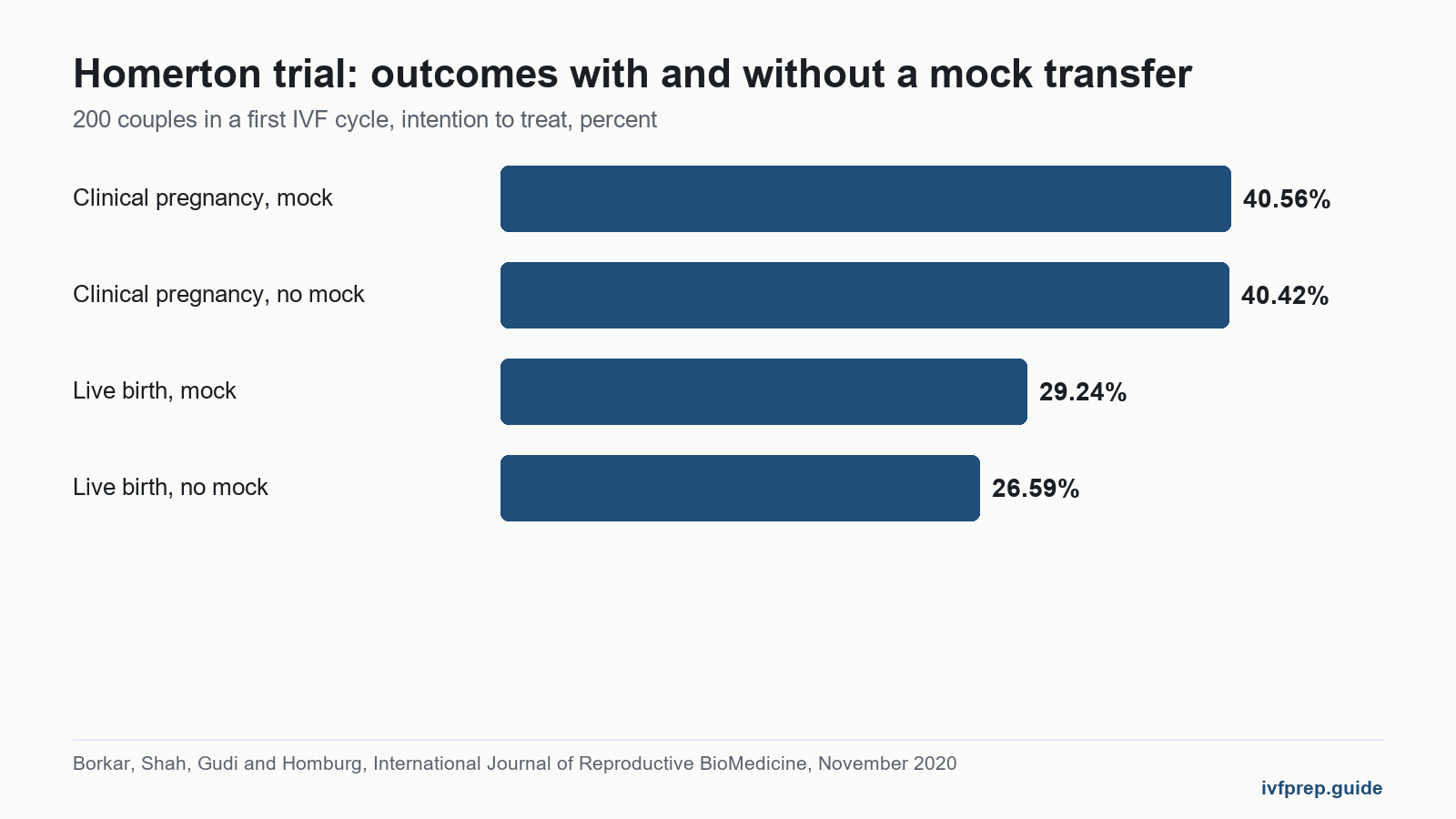
By intention to treat, Borkar and colleagues reported clinical pregnancy in 43 of 106 couples with a mock transfer, 40.56 percent, and 38 of 94 without, 40.42 percent, and live birth in 29.24 percent against 26.59 percent, neither difference statistically significant. Read the section
-
3. How does the HFEA’s treatment add ons page, last reviewed on 28 September 2026, rate the mock transfer?
The HFEA treatment add ons page rates seventeen add ons, from androgen supplementation to time lapse imaging, and does not mention a mock, trial or dummy transfer anywhere. Read the section
-
4. In the 2007 Taiwanese study of 386 cycles, what share of women with a backward tilted uterus at the mock had a forward tilted one at the real transfer?
The Taiwanese Journal of Obstetrics and Gynecology study found 24 of 132 retroverted uteruses, 18 percent, had become anteverted by the real transfer, while only 3 of 254 anteverted ones, 1.2 percent, had changed the other way. Read the section
-
5. What did the most useful reply in the October 2026 r/infertility treatment thread ask before describing a mock transfer?
In the October 2026 r/infertility thread the reply separated the two meanings first, describing the catheter check as fast and fine and the biopsy cycle as painful, which is the distinction no clinic page read for this article makes. Read the section
Clinic pages describe the mock transfer in one sentence, as routine, and move on. This page puts the clinic descriptions, the professional guideline and the one proper trial side by side, adds what people who have had one report, and says where practice varies rather than picking a side. Your own clinic knows your protocol and your anatomy, and this page does not.
What happens in the room during a mock embryo transfer?
It looks almost exactly like the real transfer, minus the part that matters. You lie on the same couch, a speculum is placed, and a thin soft catheter is passed through the cervix into the uterus. Some clinics ask for a full bladder and watch on an abdominal scan, others do it blind. The London trial at Homerton University Hospital spelled out what gets written down. Its mocks used a soft Wallace catheter without ultrasound guidance and recorded four things: the cavity length from the external os to the fundus in centimetres, which way the uterus pointed, what the cervical opening looked like, and whether the pass was easy or difficult. That is the whole map, and it is over in minutes.
The real thing is described step by step in our page on what happens in the egg transfer process, minute by minute. Timing varies: Reproductive Medicine and Infertility Associates in the United States says the mock is most commonly performed about a month before the real transfer, and may also be done under the anaesthetic at egg collection, which is the one version nobody remembers.

Why do clinics do a mock transfer at all?
The logic is older than most of the clinics offering it. In 1990 a Cairo team led by Ragaa Mansour published a paper in Fertility and Sterility whose title promised that a dummy embryo transfer minimizes the problems of embryo transfer and improves the pregnancy rate. The full paper is behind a paywall and could not be read for this article, so its figures are not quoted. Its premise survived: a transfer that needs force, a catheter change or a stiffer instrument tends to go worse than a smooth one, so find out in advance which kind yours is likely to be.
The reasons clinics give are practical rather than mystical. Fertility Plus in London wrote in June 2013 that the neck of the womb may be tightly closed or gaping open, that the cavity can tilt forwards or backwards, and that a fibroid or polyp nobody knew about can sit in the way. At Homerton, a difficult mock earned a senior consultant review or a hysteroscopy with cervical dilatation before the real transfer, a better moment to discover a tight cervix than the morning an embryo is waiting in the lab.
Does a mock embryo transfer improve the chance of pregnancy?
Here the brochures and the evidence part company, politely. Only one randomised trial has asked the direct question. Between November 2015 and October 2017, Borkar, Shah, Gudi and Homburg at Homerton randomised 200 couples starting their first IVF cycle to a mock transfer about three months beforehand, or to none. The clinical pregnancy rate was 40.56 percent with a mock and 40.42 percent without. The live birth rate was 29.24 percent against 26.59 percent. Neither gap came near statistical significance, and the authors concluded that a mock transfer should be reserved for people with risk factors for a difficult transfer. One caveat cuts both ways: very few difficult transfers happened in either group, so the trial cannot say what a mock does for someone whose cervix has already caused trouble, which is precisely the group clinics say they do it for.
The American Society for Reproductive Medicine reviewed every step of the transfer in its 2017 guideline and made no recommendation for or against a trial transfer, while giving abdominal ultrasound guidance a grade A on ten randomised trials. In the United Kingdom, the HFEA’s treatment add ons page, last reviewed on 28 September 2026, rates seventeen add ons from endometrial scratching to PGT-A and does not list the mock transfer at all. So when a page says the practice run boosts success, the fair question is which study. The one trial that measured it found a gap of 0.14 percentage points, which is roughly the margin by which nothing changed.
What do clinics and the professional bodies each say it is for?
The claims come from very different kinds of source, a clinic blog, a trial protocol, a professional guideline, a regulator, and on one table they agree on the mapping and on little else.
| Source | What it says the mock transfer is for | Routine or selective | Date |
|---|---|---|---|
| Fertility Plus, London | Learn the tilt of the uterus, how tight or open the cervix is, the cavity length, and whether a fibroid or polyp is in the way | Says many units now perform one; silent on its own patients | 17 June 2013 |
| Reproductive Medicine and Infertility Associates, US | Confirm the catheter passes the cervix and find the best path; says the science is still out on pregnancy rates | Selective: a specialist may recommend it | 12 June 2023 |
| Fertility Center of Las Vegas | Measure the distance from the cervix to the ideal placement site and assess the lining | For some patients as part of an IVF cycle | Undated page |
| Homerton University Hospital trial | Record cavity length, uterine position, the cervical opening and whether the pass was easy or difficult | Reserve it for people with risk factors for a difficult transfer | November 2020 |
| ASRM embryo transfer guideline | No recommendation for or against; grade A for abdominal ultrasound guidance during the real transfer | Silent | 2017 |
| HFEA treatment add ons | Not listed among the seventeen rated add ons | Not rated | Reviewed 28 September 2026 |
The one real disagreement there is the lining. The Las Vegas page says the mock also checks the lining’s thickness, while the Homerton protocol measured no lining at all. Both can be true: a mock at the start of a quiet cycle has no prepared lining to look at, and a mock with a scan a few days before transfer does. Which one your clinic means depends on when it books the appointment.
Can the findings change between the mock and the real transfer?
A map drawn three months early is only useful if the territory stays put, and the uterus does not always oblige. A Taiwanese study of 386 cycles published in 2007 compared the uterine position at the mock with the position at the real transfer. Of 254 women whose uterus pointed forwards at the mock, three, or 1.2 percent, pointed backwards on the day. Of 132 who pointed backwards at the mock, 24, or 18 percent, had swung forwards. A full bladder tips the uterus, and the hormones of a prepared cycle change its size and angle. A 2013 paper in the Journal of the Turkish German Gynecological Association said a mock done apart from the real one may not be reflective of the actual conditions encountered on the day, and traced to 1995 the idea of doing the trial pass immediately before the real one. Some clinics now do exactly that, threading an empty catheter first and loading the embryo once the route is confirmed. It is still a mock transfer. It just happens ninety seconds before the real one rather than ninety days.
Is a mock transfer the same thing as a mock cycle?
No, and the shared name causes real distress. A mock transfer is the catheter pass above, which takes minutes. A mock cycle is a full rehearsal of the lining preparation your clinic uses for a frozen transfer, with a biopsy of the lining on the day the embryo would have gone in, usually for a receptivity or infection test. It takes weeks and ends with a procedure people describe as considerably less comfortable than a catheter pass. The HFEA rates endometrial receptivity testing red on its add ons list, meaning the evidence shows it is not effective at improving the chance of a baby for most patients. When a clinic says mock transfer, the first thing worth establishing is which of the two it means, because one is an afternoon and the other is a month.
What do people who have had a mock transfer actually report?
Three r/IVF threads from 2026 and a search of r/infertility’s daily treatment threads gave about twenty dated accounts. They are what people report, not evidence, and none of them tells you what your own appointment will be like.
- In a January 2026 r/IVF thread, someone who had found four IUIs hard posted before their mock asking for moral support, then came back to say it was quick and painless. Four replies called their own mocks not painful, one said simply weird, one said the speculum was the least favourite part, and one reported a racing mind despite something their doctor had given them for anxiety.
- In a June 2026 r/IVF thread asking how long after the mock the real transfer happens, the answers clustered around a month, with one outlier of a December mock and a March transfer. The original poster’s mock found nothing unusual and the clinic cleared them to go ahead.
- In an October 2026 r/infertility treatment thread, someone whose first transfer had ended early asked what a mock feels like. The most useful reply asked which kind they meant, the catheter check or the medicated mock cycle with a biopsy, and described the first as fast and fine and the second as painful, with pain relief arranged by the clinic.
- In a July 2026 r/infertility thread, one person reported a mock the day before where all looked good, with the frozen transfer booked for the following cycle. That is the quietest kind of account and the most common.
- In a June 2026 r/IVF thread, someone who had done a mock cycle with a biopsy described the fortnight after it as very hard emotionally, and one reply reported the same. These concern the mock cycle, not the catheter pass. Anyone feeling like that is right to tell their clinic or their GP, and the thread said so too.

Where the accounts agree with the official picture: the catheter version is minutes long, smear test like, and over before the nerves have settled. Where they diverge: not one clinic page read for this article warns that mock transfer means two different procedures, and in every thread at least one person was answering a question about the other one.
What is worth asking your clinic about the trial transfer?
None of this says whether you need a mock transfer. That is your clinic’s call, made with your notes in front of them, and a clinic that does not do them routinely is in good company with the only trial. What this page can offer is the questions that turn a one line mention into an explanation: which kind of mock it is, when it happens, whether the map is redrawn on the day, whether a scan is used, what is written down, and what changes if the pass is difficult. The checklist below records answers rather than giving them. For the days after the real transfer, our pages on what happens each day of a frozen embryo transfer and on what the procedure itself explains about pain after a transfer pick up where this one stops.
Questions to ask the clinic about the trial transfer
A mock transfer is usually mentioned in one line. These questions turn the line into an explanation. The list records what you asked; whether a mock transfer belongs in your plan is your clinic’s call.
This checklist records questions and answers. It does not say whether a mock transfer is right for you, and it does not interpret anything the clinic finds.
Frequently asked questions
How long does a mock embryo transfer take?
The catheter pass itself is over in minutes, and clinic pages compare it to a smear test. Allow longer for the appointment, since you may be asked to arrive with a full bladder and to wait for the scan room.
Does a mock embryo transfer need a full bladder?
Only when the clinic is watching the catheter on an abdominal scan, which needs the bladder as a window. The Homerton trial did its mocks without ultrasound. Your clinic’s appointment letter is the authority on this, and the instructions vary.
Is a mock embryo transfer done under anaesthetic?
Not on its own. Some clinics do the mock while you are already under sedation for egg collection, in which case you will not remember it. A standalone mock is done awake, like the real transfer.
How long before the real transfer is the mock done?
It varies by clinic. One US clinic says about a month is most common, the Homerton trial did it about three months ahead, some clinics do it at egg collection, and some thread a trial catheter immediately before loading the embryo on the day.
Does a difficult mock transfer change the plan?
It can change how the real transfer is done, not whether it goes ahead. In the Homerton trial a difficult mock led to a senior consultant review or a hysteroscopy with cervical dilatation before the transfer. What your own clinic would do is a question for them.
Is a mock embryo transfer an HFEA add on?
No. The HFEA’s treatment add ons page, last reviewed on 28 September 2026, rates seventeen add ons and the mock transfer is not among them. It is treated as part of transfer technique, not as an optional extra with its own evidence rating.
Finished the page? The same five questions from the top, to see what stuck.
This article is general information, not medical advice, and is not a substitute for care from a qualified healthcare professional. Speak to your doctor about your own situation.
Leave a Reply