
Asked 2 weeks after embryo transfer how many weeks pregnant you would be, the dating arithmetic says 4 weeks and 5 days for a day 5 embryo and 4 weeks and 3 days for a day 3 embryo. That number is a counting convention measured from a notional last period, not a result. Only your clinic’s test can say whether there is a pregnancy to date.
Listen to this article, about 11 minutes. A synthetic voice reads the article and announces each section title as it begins; tables are read row by row and the questions at the end are left out.
Recorded 9 November 2026 from the article as published that day. Press a chapter to jump there; the highlighted line is what is playing. A play button sits beside every section heading, and once you scroll past this player a bar at the bottom of the screen keeps the controls in reach. Tap or click any sentence to hear the reading start from there.
On this page: the ACOG dating rule quoted with its 261 and 263 day figures, a worked table for a day 3 and a day 5 embryo, a dating only calculator, the Royal Berkshire NHS line on why apps disagree, and five forum accounts of the same arithmetic.
Think you already know this? Five questions, one minute.
Every answer is on this page. Answer from what you know now; the page fills in the rest.
-
1. By convention, how many days after the first day of the last period is the estimated due date?
ACOG Committee Opinion 700 states that by convention the EDD is 280 days after the first day of the LMP, which is 40 weeks counted from a day on which nobody was pregnant. Read the section
-
2. Under the ACOG rule, how many days after the transfer is the due date for a day 5 embryo?
ACOG Committee Opinion 700 gives 261 days from the embryo replacement date for a day 5 embryo and 263 days for a day 3 embryo: 266 days minus the embryo’s age. Read the section
-
3. On the day of a day 3 transfer, what gestational age does the dating convention give?
The notional last period sits 14 days before fertilisation and the embryo is three days old at transfer, so the count reads 2 weeks 3 days on transfer day under the ACOG method, and 4 weeks 3 days fourteen days later. Read the section
-
4. What does the Royal Berkshire NHS leaflet say most commercial pregnancy apps are based on?
The Royal Berkshire NHS leaflet of May 2026 says most commercial apps are based on this historic rule and so are somewhat inaccurate, which is why an app fed a real last period date disagrees with the clinic. Read the section
-
5. According to the Royal Berkshire NHS leaflet, what happens to IVF dates after the dating scan?
The Royal Berkshire NHS leaflet states that for IVF pregnancies dates are not changed based on scan measurements and the due dates given by the IVF clinic are adhered to. Read the section
Why does pregnancy dating start two weeks before conception?
The number that confuses everyone is the first two weeks, which happen before there is anything to count. The NHS week by week guide puts it in one line: “Pregnancy is dated from the first day of your last period.” The American College of Obstetricians and Gynecologists says the same thing with a number in its Committee Opinion 700 on estimating the due date: “By convention, the EDD is 280 days after the first day of the LMP.” Forty weeks, counted from a day on which nobody was pregnant.
So in a textbook 28 day cycle fertilisation happens around day 14, and by the time a period is missed the count already reads four weeks. Two of those weeks are a formality. A May 2026 patient leaflet from the Royal Berkshire NHS Foundation Trust is frank about it: the 280 day rule “assumes a woman has a very regular 28-day cycle and has correctly remembered the first day,” and it calls the result “a good guess.” That is the system IVF has to fit itself into.

How does a clinic date an IVF pregnancy from the transfer?
An IVF cycle does not have a useful last period. In a medicated frozen cycle you may not have ovulated at all. So the clinic works backwards from the one date it knows exactly: the day the embryo was created, and how old it was when it went in.
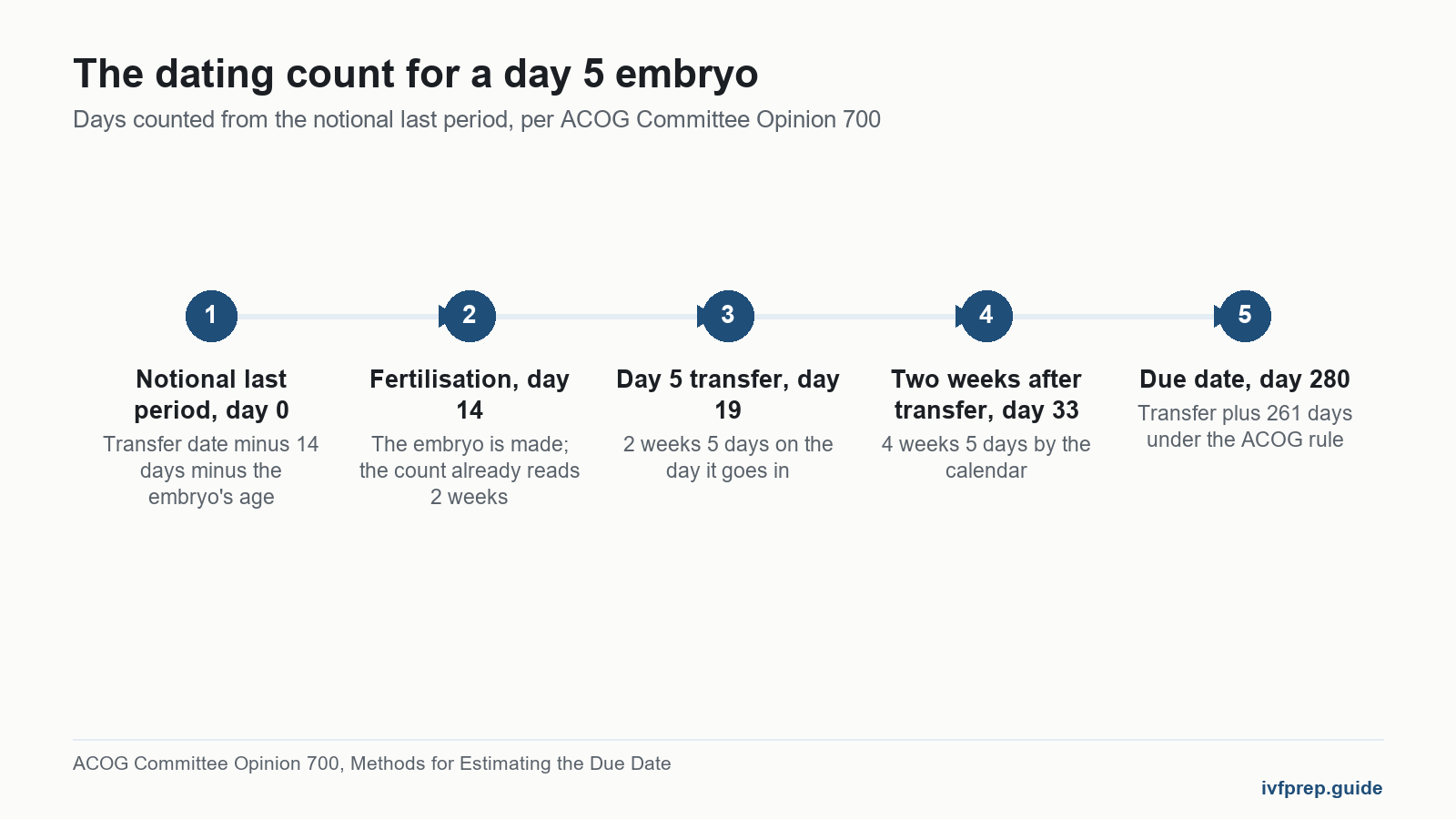
The rule is in the same ACOG committee opinion: for pregnancies from assisted reproduction, “the ART-derived gestational age should be used to assign the estimated due date,” and that date “should be assigned using the age of the embryo and the date of transfer.” It then gives the figures that every IVF due date calculator on the internet is quietly built on: “for a day-5 embryo, the EDD would be 261 days from the embryo replacement date,” and “the EDD for a day-3 embryo would be 263 days from the embryo replacement date.”
Read those two numbers together and the logic shows. A pregnancy is 280 days from the notional last period and fertilisation is taken as day 14, so the embryo’s own life is 266 days. A day 5 embryo has used five of them, 266 minus 5 is 261. A day 3 embryo has used three, 266 minus 3 is 263. On transfer day a day 5 embryo is therefore already “2 weeks and 5 days pregnant” by the calendar, which is the sentence that stops most people mid scroll.
| How the date is set | Counted from | What it assumes | Source |
|---|---|---|---|
| Last period rule, natural conception | First day of the last period, plus 280 days | A 28 day cycle with ovulation on day 14 | ACOG CO 700, NHS |
| IVF rule | Transfer date, plus 266 days minus the embryo’s age | Nothing about your cycle; the embryo’s age is known | ACOG CO 700 |
| Dating scan | Crown rump length measured at the scan | Growth is on the average curve, give or take 5 days | Royal Berkshire NHS, May 2026 |
What is the worked calculation for a day 3 and a day 5 embryo?
Here is the arithmetic for a transfer on 1 October, chosen because it is easy to count from. The notional last period is the transfer date minus 14 days minus the embryo’s age. Gestational age on any day is the days since that notional period, written as weeks plus days. The due date is the ACOG figure, and you can check it: it lands exactly 280 days after the notional period.
| Input or result | Day 3 embryo | Day 5 embryo |
|---|---|---|
| Transfer date (input) | 1 October | 1 October |
| Embryo age at transfer (input) | 3 days | 5 days |
| Notional last period: transfer minus 14 minus age | 14 September | 12 September |
| Gestational age on transfer day | 2 weeks 3 days | 2 weeks 5 days |
| Gestational age 9 days after transfer | 3 weeks 5 days | 4 weeks 0 days |
| Gestational age 14 days after transfer | 4 weeks 3 days | 4 weeks 5 days |
| Estimated due date: transfer plus 263 or 261 days | 21 June | 19 June |
Two things deserve a second look. Blastocysts are often frozen on day 6 or 7, and the ACOG wording is “the age of the embryo,” which would mean counting six or seven days rather than five. Whether your clinic does that, or treats every blastocyst as day 5, is a clinic decision this site cannot see, so ask them. And the table runs the same way whether or not the transfer has worked; the count is a calendar, not a verdict. The implantation timeline explains what the embryo is doing on those days, which is a different question. The day an embryo reached blastocyst is also part of how labs judge it, set out with the study numbers in our page on how day 5 blastocyst grades work.
Why does the pregnancy app disagree with the clinic?
Most apps ask one question, the first day of your last period, and apply the 280 day rule. The Royal Berkshire leaflet says exactly this: “Most of the commercial apps you can download are based on this historic rule, and so are somewhat inaccurate.” Type in the real date of your last bleed before a medicated frozen cycle and the app will cheerfully date a pregnancy from a cycle in which no egg was released. It is not lying. It just has no idea what a transfer is.
Two fixes. Some apps have an IVF option that asks for the transfer date and the embryo’s age, which is the ACOG method under a friendlier name. Where there is none, enter the notional last period from the table above and the app’s count will match the clinic’s. When they still disagree, the clinic’s date is the one on your notes, and the one the hospital will use.

Dating only calculator: transfer date to gestational age
Enter the transfer date and the embryo’s age on the day it went in. It applies the convention set out above: notional last period equals the transfer date minus 14 days minus the embryo’s age, and the due date equals the transfer date plus 266 days minus the embryo’s age. It is a calendar, not a result. It does not know whether a transfer has worked, and nothing it prints is a sign either way.
Day 6 and day 7: the written rule is the embryo’s age, but whether your clinic counts a day 6 blastocyst as day 6 or as day 5 is the clinic’s choice, so the figure on your notes wins. Nothing you enter is saved.
Will the dating scan change the date the clinic gave?
In a natural conception the answer is often yes. The ACOG opinion says that if an ultrasound before 14 weeks “differs by more than 7 days from LMP dating, the EDD should be changed,” and before 9 weeks a gap of more than 5 days is enough. The NICE antenatal schedule places the scan appointment at 11 weeks 2 days to 14 weeks 1 day. For IVF the rule runs the other way. The Royal Berkshire NHS leaflet states it plainly: “For IVF pregnancies dates are not changed based on scan measurements and the due dates given by the IVF clinic are adhered to.” The clinic knows the embryo’s age to the day; a scan estimates it with a margin the same leaflet puts at plus or minus 5 days up to 16 weeks. So a scan a few days off the count is a measurement, not a re-dating, and the person to ask about it is whoever ordered it.
What do people on the forums report about counting the weeks?
The forums have done this arithmetic thousands of times, and they mostly get it right. Across two threads and three stand alone comments read for this article, the count people give each other matches the ACOG rule exactly, which is worth saying because forum maths is not usually this reliable. This is what people report, not evidence about your cycle.
In a December 2024 thread on r/IVF, a poster with a day 5 transfer on 11 November asked how many weeks they were on 12 December, because the clinic said seven weeks and a scan read differently. One reply set out the sum: on transfer day the count was already 2 weeks and 5 days, then add the days since. Two replies disagreed by a day on the total, and the rest said a small gap between a scan and the count is normal and to ask the clinic. In a February 2025 comment the same convention is stated flat: when you transfer a day 5 embryo you are already two weeks and five days along on the day of transfer. Two more comments, from April 2024 and September 2024, give the matching milestone, that nine days past a day 5 transfer is four weeks exactly, and both point people to an IVF due date calculator rather than their app.
One account cuts the other way. In a September 2026 thread on r/pregnant a commenter said a day 7 blastocyst “is counted as a day-5” for the due date because that is when it reached blastocyst stage. That may be how some clinics do it, but it is not what the ACOG text says, which is the embryo’s age, and this article could not confirm either reading. It is the one place where the forum rule and the written rule part company, so it is worth a direct question to your own clinic.
What does two weeks after transfer actually tell you?
The number tells you where you are on a calendar drawn before the transfer. It does not tell you what has happened since. The count reads 4 weeks and 5 days on day 14 for every person who had a day 5 transfer on the same date, whatever the outcome, and nothing in the arithmetic changes with a symptom or its absence. Two in the morning is a bad time to forget that, so it is written here plainly.
What does carry information is the test your clinic has booked. The HFEA, the UK regulator, says “You’ll be given a date to do a pregnancy test” and asks you to “try not to do this early as you may get a false result.” When that date falls varies: one trial protocol describes testing 9 to 14 days after transfer “depending on the stage of development of the embryos replaced and the preferences of the fertility clinic,” and a 2025 review in Frontiers in Reproductive Health describes clinics measuring the hormone 12 to 18 days after transfer. Your clinic’s date is the one that applies to you; the page on what happens after the blood test covers the step beyond it, and the 7 days after transfer page explains why an early home test is hard to read.
Nothing on this page should be used to interpret a symptom, a scan or a test, and it does not replace your clinic, which knows your protocol and this site does not. If you are bleeding, in pain, or unsure whether to call, call.
Frequently asked questions
How many weeks pregnant are you on the day of a day 5 embryo transfer?
By the dating convention, 2 weeks and 5 days. The count starts from a notional last period 14 days before fertilisation, and the embryo is already five days old when it is transferred. It is a calendar position, not a statement about whether the transfer has worked.
What is the due date formula for an IVF pregnancy?
ACOG Committee Opinion 700 gives 261 days from the transfer date for a day 5 embryo and 263 days for a day 3 embryo. Both equal 266 days minus the embryo’s age, which is the same as 280 days from the notional last period.
Does the clinic date from egg collection or from the transfer?
Both routes give the same answer for a fresh cycle, because the transfer date minus the embryo’s age is the collection date. For a frozen transfer only the transfer date and the embryo’s age at freezing matter, which is why ACOG words the rule around those two inputs.
What date do I enter in a pregnancy app after IVF?
If the app has an IVF option, enter the transfer date and the embryo’s age. If it only asks for a last period, enter the transfer date minus 14 days minus the embryo’s age. The real date of your last bleed will give the wrong count in a medicated cycle.
Why is the two week wait called two weeks when the count moves by more than that?
Because the two weeks are measured from the transfer to the clinic’s test, while the gestational count had a two week head start plus the embryo’s age before the transfer happened. The two numbers measure different things from different starting points.
Will the hospital re-date an IVF pregnancy at the 12 week scan?
In the UK trusts whose leaflets this article read, no: Royal Berkshire’s May 2026 leaflet says IVF dates are not changed on scan measurements. ACOG also says to use the ART derived date. A scan a few days off the count is a measurement with a margin, so ask the person who ordered it.
Finished the page? The same five questions from the top, to see what stuck.
This article is general information, not medical advice, and is not a substitute for care from a qualified healthcare professional. Speak to your doctor about your own situation.
Leave a Reply