
A beta hCG negative result means the hormone was not detected in your blood, usually below 5 mIU per mL, so this cycle has not produced a pregnancy. It predicts nothing about the next cycle. Clinics stop luteal support, review what happened, and book a follow up before any next step is decided.
Listen to this article, about 14 minutes. A synthetic voice reads the article and announces each section title as it begins; tables are read row by row and the questions at the end are left out.
Recorded 8 November 2026 from the article as published that day. Press a chapter to jump there; the highlighted line is what is playing. A play button sits beside every section heading, and once you scroll past this player a bar at the bottom of the screen keeps the controls in reach. Tap or click any sentence to hear the reading start from there.
On this page: the NHS lab threshold for a negative blood result, why clinics anchor to that result rather than to how you feel, what a review appointment usually covers, the JAMA linked study of 156,947 UK women across repeat cycles, and five dated Trustpilot accounts of what happened next.
Think you already know this? Five questions, one minute.
Every answer is on this page. Answer from what you know now; the page fills in the rest.
-
1. Most UK hospital laboratories treat a blood hCG result below which level as negative?
Most NHS labs, including Gateshead Health NHS Foundation Trust, report a result below 5 IU per litre as negative, though the exact cutoff is set by the lab doing the test. Read the section
-
2. Why do clinics wait for the confirmed blood result before advising on stopping luteal support?
Progesterone support delays the withdrawal bleed, so stopping before the blood result is back can muddy the one signal a clinic relies on. A trial in Human Reproduction Open anchored its own protocol to the confirmed blood result rather than to an earlier sign. Read the section
-
3. Under NICE’s current access criteria, what counts toward the three full IVF cycles offered to eligible women under 40?
NICE’s current access criteria count any previous full cycle, NHS or self funded, toward the total of three, so a negative result does not reset the count to zero. Read the section
-
4. In the largest linked UK study of repeat IVF cycles, what was the live birth rate within the very first cycle, across all 156,947 women?
Smith and colleagues, JAMA 2015, found a 29.5 percent live birth rate within the first cycle, rising with each additional cycle attempted, at least up to the sixth or seventh. Read the section
-
5. Across the five dated Trustpilot reviews read for this article, what did people write about most after a failed cycle?
The recurring complaint across the five accounts was about aftercare and communication, being chased for payment or left without a clear follow up, rather than about the clinical explanation itself. Read the section
Your clinic has your protocol, your embryo and your actual numbers, and this article has none of that, so nothing here reads your case. What follows is what the blood test means, what a review appointment usually covers, and what the published data on repeat cycles says.
What does a beta hCG negative result actually mean?
A beta hCG test measures the pregnancy hormone directly in blood, which is why clinics use it rather than a home urine strip to confirm a cycle outcome. Most UK hospital laboratories report anything below 5 IU per litre as negative, including Gateshead Health NHS Foundation Trust and Newcastle Hospitals Laboratories, though the exact cutoff is set by the lab doing the test, not by a single national rule. A result sitting between roughly 5 and 25 is often called equivocal rather than negative or positive, and clinics typically ask for a second draw a few days later before saying anything final, which is also why some clinics run the blood test twice in a row even on a clearly positive result, a pattern covered in why your clinic draws it twice.
This is a different question from the one covered in 7 days after embryo transfer negative pregnancy test, which is about a home test taken before the blood draw, when the hormone may simply not have risen far enough yet to register. A negative blood result taken on your clinic’s scheduled day is a different kind of answer: the test is sensitive enough that timing is no longer the main uncertainty. If your clinic used a trigger injection, it is also worth reading the trigger shot problem before your blood test day, since the injection itself can produce a false early positive on a home test that later resolves to a genuine negative. This result still is not a comment on your embryo, your protocol or your body, and this site will not turn it into one.
Why do clinics say not to stop medication until they tell you?

Progesterone support keeps the uterine lining from shedding, which is exactly the mechanism that would otherwise trigger a period. Stop it early and the withdrawal bleed can arrive before the blood test does, which muddies the one signal the clinic is trying to read cleanly. Waiting for a confirmed result, rather than for how you feel or what a home test shows, is why the instruction exists.
A 2018 trial in poor responders, published in Human Reproduction Open, stopped hCG based luteal support the day a blood test came back positive and found no difference in clinical pregnancy or live birth rates against continuing it for weeks longer. The finding is about a positive result, not a negative one, but it makes the same point from the other side: what matters to the protocol is the confirmed blood number, not an earlier guess at it. Your own clinic’s instruction reflects your specific medication and protocol, so it is the one to follow, and this article will not offer a substitute for it.
What happens at the review appointment?

Clinics vary, but a follow up after a negative cycle usually works through the same short list: how the uterine lining measured on the day of transfer, the grade of the embryo or embryos used, whether hormone levels during the cycle sat where the clinic expected, and anything in the lab notes worth flagging. If those notes record the embryo being passed a second time, what the studies on retained embryos do and do not show is laid out in our guide to the egg transfer process. After one unsuccessful transfer, most clinics do not change course. After two or three, some will suggest further tests, such as a hysteroscopy to look at the uterine cavity, or screening for clotting or immune factors, though how readily any of that is offered varies a great deal between clinics. If the embryo report you are handed uses grading or thaw terms nobody explained, our guide to what an embryo hatching note on the lab report means walks through that vocabulary, without reading anything into your own result.
Timing for another attempt is a clinical decision, not a fixed rule this site can hand you. What is broadly true is that hormone levels and the uterine lining need time to return to baseline after a medicated cycle, which is why a gap of one full menstrual cycle before the next frozen transfer is common practice rather than an arbitrary delay. If you are in England, Wales or Scotland and NHS funded, it is worth knowing that NICE’s current access criteria count any full cycle you have already had, NHS or self funded, toward the three full cycles that eligible women under 40 should be offered, so a negative result does not reset that count to zero. The clinical schedule for whichever protocol comes next, day by day, is set out in the frozen embryo transfer timeline, and the activity questions that come up around a transfer itself are covered in what to do after a FET.
One question worth asking regardless of your clinic’s approach: what specifically will change, if anything, before the next transfer, and why. “Nothing needs to change, this happens” is a legitimate answer. So is a specific one. Hearing the reasoning either way beats a number alone. Where a frozen embryo is waiting, the timing of the next transfer is a fair question too, and the trials comparing a frozen transfer in the very next cycle with one after waiting a month found no live birth advantage to waiting.
Questions to bring to your review appointment
A list to raise with your own clinic. It logs what you plan to ask, not what the answers will be, and it never predicts an outcome.
Ticks are saved on this device only. This is a list of questions, not a scorecard, and it does not read your case.
What do the numbers say about trying again?
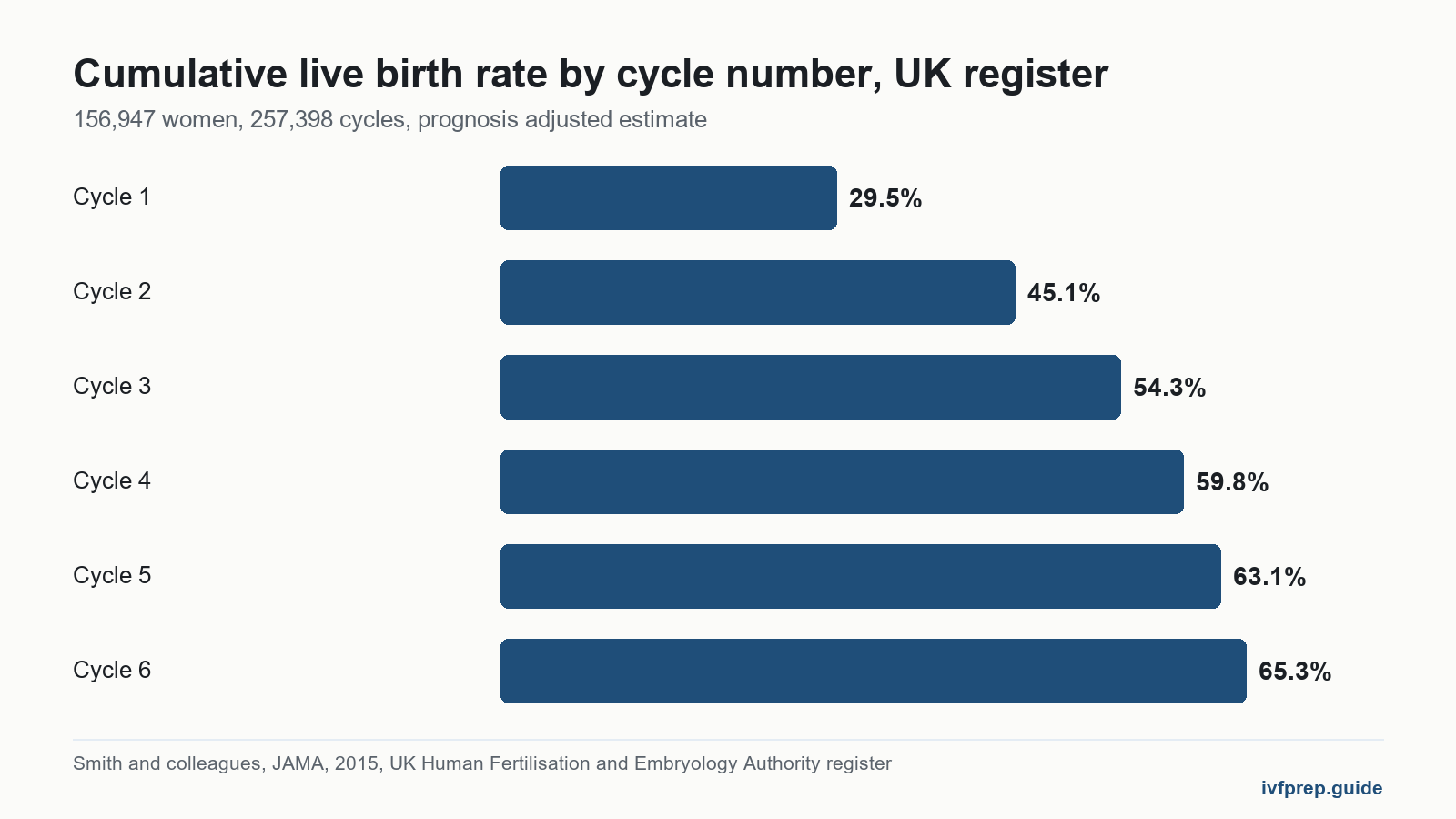
The most detailed answer to this comes from a study built on the UK’s own fertility register. Smith and colleagues, in JAMA in 2015, linked every ovarian stimulation cycle recorded by the Human Fertilisation and Embryology Authority between 2003 and 2010, following outcomes through June 2012: 156,947 women across 257,398 cycles. It remains the largest linked analysis of its kind, and it answers a specific question: given a stimulation and every fresh and frozen transfer that comes from it, what is the chance of a live birth by a given cycle number, across everyone who kept going.
In the first cycle, 29.5 percent of women had a live birth. That is one number, not a verdict on any individual cycle, and it says nothing about why a particular attempt did or did not work. The more useful figure for the question this page is about is what happens across repeat cycles among women who continue treatment. Because some women stop for reasons that have nothing to do with their odds, such as cost or the emotional weight of it, the authors published three different estimates rather than one.
| Estimate | What it assumes about women who stopped treatment | Cumulative live birth rate by cycle 6, all women |
|---|---|---|
| Conservative | Every woman who stopped would have had no chance had she continued | 46.8 percent |
| Prognosis adjusted | About 30 percent of those who stopped did so for reasons linked to a poorer outlook | 65.3 percent |
| Optimal | Everyone who stopped would have matched the results of those who kept going | 78.0 percent |
The true figure sits somewhere inside that range, and the authors treat the prognosis adjusted estimate as the most realistic of the three. Age changes the picture considerably: among the 133,379 women under 40 using their own eggs, the cumulative prognosis adjusted rate reached 68.4 percent by the sixth cycle, against 31.5 percent for the 15,561 women aged 40 to 42. Neither number is a prediction for any one person’s next cycle. What the study does show plainly is that a single negative result is not the end of the data: within this cohort, the chance of an eventual live birth kept rising with each additional cycle attempted, at least up to the sixth or seventh.
None of this tells you what your own next cycle will do. It tells you what happened, on average, to a very large group of women who each had their own version of the appointment you may be about to have.
What do people say the review appointment was actually like?
The clinical content of a review appointment is fairly standard across clinics, which is part of why it is hard to find much written about it. What people do write about, in public reviews of individual clinics, is the experience around it: how they were treated in the weeks after a cycle failed, and whether anyone from the clinic was actually available. Five accounts from public Trustpilot reviews of two UK clinics, four of them dated, give a sense of the range. We describe the reviewers without their names, because a display name on a review site can be a real one.
One reviewer on TFP Fertility’s Trustpilot page, writing on 30 January 2026, described a miscarriage after transfer followed by what the reviewer called no aftercare from the clinic, saying they were left to deal with it alone, both physically and mentally, with a suggestion to simply book another cycle. Another, on 17 April 2026, wrote that within three days of a failed round they received seven calls in two weeks about paying for the next one, which they read as pressure dressed up as support. A third, describing several years as a patient in a review whose date we did not record, described repeated incorrect and inconsistent communication and said the overall tone felt transactional rather than supportive.
A reviewer on Care Fertility’s Trustpilot page, in a review updated 5 May 2026, described a failed NHS funded cycle and said their concerns, including a missed diagnosis of adenomyosis, were initially dismissed rather than acknowledged when they raised them. Against that, another Care Fertility reviewer, in a review updated 13 May 2026, wrote that after a cycle that did not produce a positive test, the clinic moved them onto a different treatment plan and that they felt supported through what they called a long process.
Five accounts from two clinics is not a survey, and this article is not treating it as one. What it suggests, reading it plainly, is that when people write publicly about the period after a failed cycle, the complaint is rarely about the clinical explanation itself. It is about being left to chase the clinic for it, or about the timing and tone of being asked to pay for the next attempt. That is worth knowing before your own appointment, not as a prediction of how yours will go, but as a reason to ask directly when and how the clinic will follow up, rather than assuming it will happen on its own.
Who can you talk to after a beta hCG negative?
Most of the reviews above were not about the biology. They were about being alone with it. So it is worth knowing that counselling after a cycle that did not work is not a favour you have to ask for. The UK regulator expects clinics to offer it, and NICE says the same to the NHS. A Trustpilot review is not a support plan, and nobody should have to write one to get noticed.
| Where to turn | What the source actually says | Cost |
|---|---|---|
| Your clinic’s own counsellor | Paragraph 3.5 of the HFEA Code of Practice, edition 9.4, says counselling "should routinely be offered following adverse events and/or unsuccessful outcomes", and a negative cycle is an unsuccessful outcome | Free or for a fee, depending on the clinic, says the HFEA coping if treatment does not work page |
| NHS funded care | NICE guideline NG257 tells clinicians to offer counselling before, during and after treatment, whatever the outcome, from someone not directly involved in managing the fertility problem | Ask your clinic or NHS trust what is included |
| An independent fertility counsellor | The British Infertility Counselling Association keeps a directory of accredited infertility counsellors, and the HFEA points to it | Most work privately, so the price is on each counsellor’s listing |
| Peer support from people who have been there | Fertility Action, registered with the Charity Commission on 21 February 2025 as charity 1212260, runs peer groups and was named as a signpost when Fertility Network UK closed | Not stated in the charity record |
| Tonight, if it feels like too much | Samaritans on 116 123, any hour, or NHS 111; 999 if you are in danger | Free |
One change since many older guides were written: the charity most of them send you to has gone. Fertility Network UK moved into managed closure and stopped taking new requests for direct support on 21 May 2026, so its old support line number now leads nowhere useful. Its closure notice points people to the British Infertility Counselling Association, Fertility Action and Samaritans, among others.
If you have thoughts of harming yourself, or you cannot keep yourself safe, call 999 or go to A&E. If it is not an emergency but you need someone now, Samaritans answer on 116 123 at any hour.
Asking the clinic is a fair first step, and a short question does the job: is counselling included, how soon can I book, and is the counsellor separate from my clinical team? That last part matters because NICE asks for someone not involved in your treatment, which is what makes it possible to say things about the clinic out loud.
What has changed since this was first published?
- Corrected in October 2026: the review section named two Trustpilot reviewers in full and linked none of the five accounts. The names are gone, each clinic’s public review page is now linked, and one account is marked undated because we did not record its date when it was read.
- Rechecked on 18 October 2026: NICE still says any previous full cycle, NHS or self funded, counts toward the cycles the NHS should offer, in quality statement 5 of QS73, which matches the NG257 access criteria cited above. No change.
Updated on 29 October 2026: added the section on who to talk to after a negative result, checked against the HFEA Code of Practice, NICE NG257 and the Fertility Network UK closure notice of 21 May 2026, and changed the reviewer accounts to neutral pronouns because the reviews do not say who wrote them.
Frequently asked questions
Can a negative beta hCG later turn positive?
It can if the blood draw happened unusually early relative to your own implantation timing, which is why clinics sometimes ask for a repeat test a few days on. A result on your clinic’s scheduled day, using the threshold your lab sets, is treated as reliable. Your clinic will tell you whether a repeat applies to your case.
How soon can I try another transfer after a negative beta?
There is no single number that applies to everyone. Clinics commonly wait for at least one full menstrual cycle so hormone levels and the uterine lining return to baseline, and some wait longer if further tests are planned. Your clinic will set this based on your protocol.
Does a negative beta mean something is wrong with my embryo?
Not necessarily. A single negative result does not identify a cause, and most clinics do not change protocol after one unsuccessful transfer. Repeated negative results are more often what prompts further investigation, such as a hysteroscopy or additional testing.
Why does my clinic trust a blood test over the home test I already took?
A blood test measures the actual hormone concentration rather than giving a line or no line, and most UK laboratories report a result below 5 IU per litre as negative. It removes the guesswork of reading a faint line on a strip that was designed for a different kind of pregnancy test.
What is an equivocal beta hCG result?
A result that falls in a middle band, roughly 5 to 25 IU per litre depending on the lab, that is neither clearly negative nor clearly positive. Clinics typically repeat the blood test after a few days rather than calling it either way from a single number.
If I am NHS funded, does a negative cycle cost me one of my funded attempts?
Yes. Under NICE’s current access criteria, a full cycle, whether it results in a live birth or not, counts toward the total of up to three full cycles that eligible women under 40 should be offered, and this applies whether the cycle was NHS or self funded.
Finished the page? The same five questions from the top, to see what stuck.
This article is general information, not medical advice, and is not a substitute for care from a qualified healthcare professional. Speak to your doctor about your own situation.
Leave a Reply