
What to do after a FET depends on which clinic page you read, and they contradict each other. Four of the pages ranking for this question disagree on rest, sex, swimming and exercise. Only bed rest has been properly tested, and the evidence says not to do it. Your own clinic’s instructions still come first.
Listen to this article, about 11 minutes. A synthetic voice reads the article and announces each section title as it begins; tables are read row by row and the questions at the end are left out.
Recorded 15 October 2026 from the article as published that day. Press a chapter to jump there; the highlighted line is what is playing. A play button sits beside every section heading, and once you scroll past this player a bar at the bottom of the screen keeps the controls in reach. Tap or click any sentence to hear the reading start from there.
On this page: a clinic comparison table, clinical trial statistics on post-transfer rest, and a checklist of questions to ask your doctor.
Think you already know this? Five questions, one minute.
Every answer is on this page. Answer from what you know now; the page fills in the rest.
-
1. According to the comparison of major clinic pages, which of these instructions is explicitly banned by only one of the four sources?
Only New Life Fertility explicitly bans swimming, particularly in public pools, while the other reviewed clinic pages do not mention it or restrict it. Read the section
-
2. What is the American Society for Reproductive Medicine (ASRM) grade for its recommendation against bed rest after embryo transfer?
The ASRM issued a Grade A recommendation against bed rest after embryo transfer, finding no evidence of its benefit. Read the section
-
3. What did the 2016 review by Craciunas and Tsampras find regarding the clinical pregnancy rate for women who underwent bed rest?
The review by Craciunas and Tsampras, writing in Human Fertility in 2016 pooled five trials and found no improvement in pregnancy rates, alongside a possible reduction in implantation. Read the section
-
4. What did a 2023 randomized controlled trial find regarding intercourse the night before a frozen embryo transfer?
The 2023 randomised controlled trial in Contraception and Reproductive Medicine reported a 51.7 percent clinical pregnancy rate for the intercourse group compared to 38.3 percent for the abstinence group. Read the section
-
5. What is the primary instruction given to patients by the UK fertility regulator, the HFEA, for the post-transfer period?
The HFEA advises patients only to try not to test before the given test date. Read the section
Where do the clinic pages actually disagree?
Read one page and you come away thinking you should spend three days horizontal. Read the next and a gentle walk is the better idea. Read a third and swimming is off the list, which will be news to the first two, neither of which mentions it. This is not a comprehension failure on your part at two in the morning. The pages genuinely say different things, so here are four of them side by side, read on 17 September 2026. Every cell is what that page tells patients, not what this site thinks you should do.
| After a transfer | Fertility Answers | PFCLA | New Life Fertility | Healthline |
|---|---|---|---|---|
| Rest | Rest as much as possible for 2 to 3 days, but not complete bed rest | Not addressed | Strict bed rest is generally not recommended | Take time off if you can, but the embryo will not fall out |
| Exercise | Light walks and prenatal yoga fine, nothing over 10 pounds | Not addressed | Walking, stretching, slow yoga fine; no running, HIIT or heavy lifting | Skip the vigorous workouts |
| Sex | Nothing in the vagina until after the pregnancy test | Avoid intercourse, on the grounds it triggers uterine contractions | Not addressed | Pelvic rest, on the same contractions grounds |
| Water and heat | No hot baths, saunas or hot tubs; warm showers only | No saunas, hot tubs or extreme heat against the abdomen | No swimming, especially public pools; showers fine | Not addressed |
| Home testing | Resist the urge, it can take two weeks or more | Not addressed | Early testing gives confusing results | Resist the urge |
Two things stand out. The first is how much of that grid is empty: on most of these questions most pages say nothing at all, which is worth remembering when one of them says something with great confidence. The second is that where two pages do both speak they often disagree, and not one of them cites a source. Swimming is banned on exactly one page out of four. There is, though, one question here where the argument is settled, and it is the big one.
What does the evidence say about bed rest after a transfer?
It says do not do it, in unusually plain language. The American Society for Reproductive Medicine embryo transfer guideline reviewed 14 studies and reported that none showed a benefit from bed rest of any duration. Its recommendation reads: there is good evidence not to recommend bed rest after embryo transfer, graded A, the strongest grade it issues.
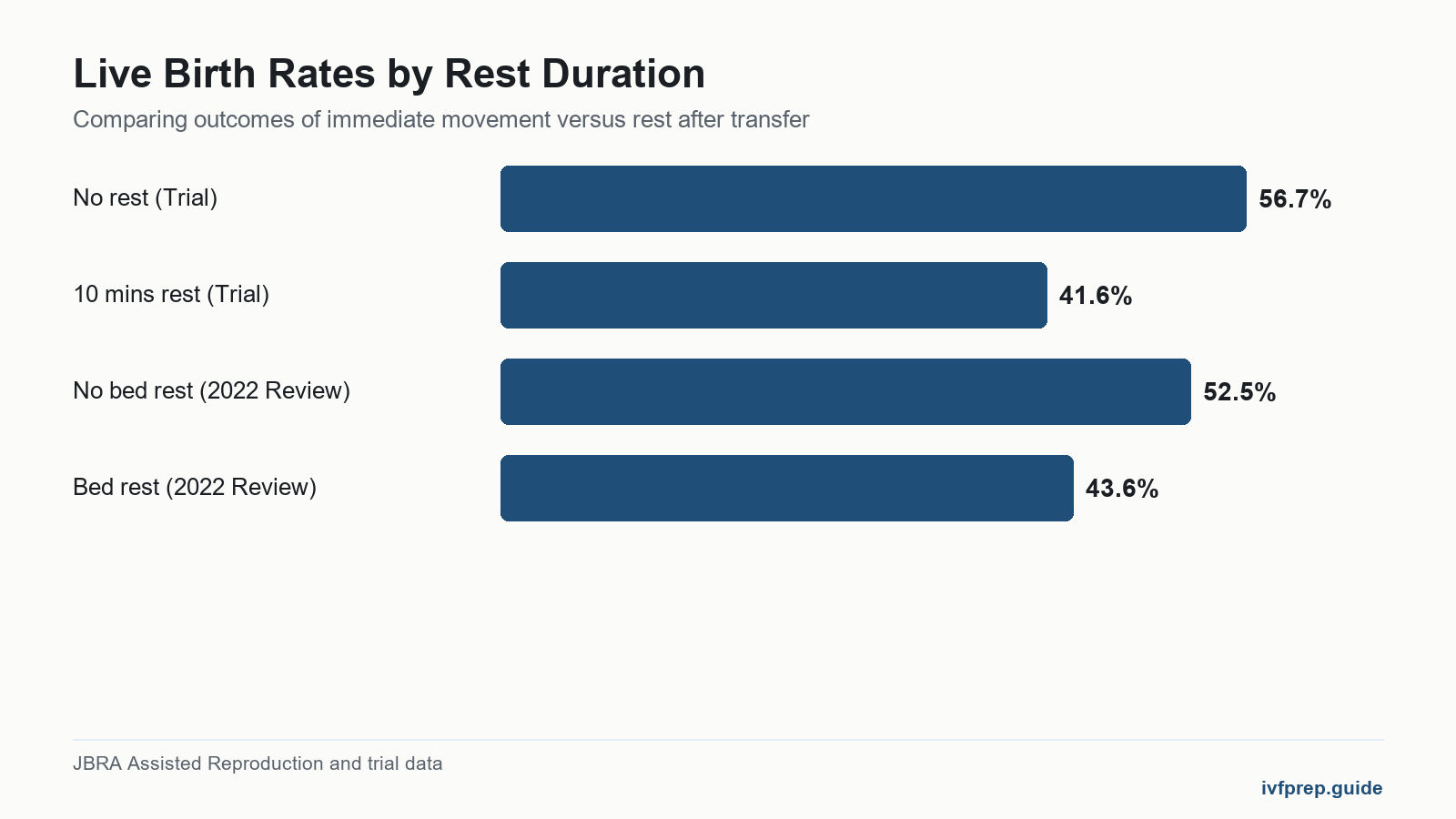
The trials behind it are small but consistent. Three randomised trials covering 712 patients compared one hour of rest with 24 hours, 20 minutes with 24 hours, and getting straight up with 30 minutes, and found nothing to choose between them. A later trial of 240 first time IVF patients reported live birth in 56.7 per cent with no rest against 41.6 per cent with ten minutes of it, at P equals 0.02.

Two reviews since have come to the same place from different directions. Craciunas and Tsampras, writing in Human Fertility in 2016, pooled five randomised trials covering 1,002 women and found no improvement in clinical pregnancy rate, with a possible reduction in implantation. A 2022 meta analysis in JBRA Assisted Reproduction could find only two trials reporting live birth, 202 women in total: 43.6 per cent with bed rest against 52.5 per cent without, an odds ratio of 0.77 with a confidence interval from 0.5 to 1.2, which crosses one and so settles nothing on its own. Its authors still concluded there is no evidence to recommend bed rest.
If you spent two days flat on your back after a transfer, none of this is a finding about you. These are averages across a few hundred women, and no trial has ever shown that one person’s afternoon on the sofa changed one person’s result. The guideline is an argument about what clinics print on their leaflets, not a verdict on your fortnight.
Has anything else on the list been tested at all?
Mostly not, and that is the part the dos and donts pages never tell you. Here is the same list again, sorted by whether anyone has actually run a trial.
| Instruction | Tested in randomised trials? | What the evidence shows |
|---|---|---|
| Bed rest after transfer | Yes, 14 studies reviewed by ASRM | Grade A: do not recommend it |
| Getting straight up and walking | Yes, within the same guideline reviews | No adverse effect found |
| Sex after transfer | No | Untested. The one FET trial tested sex the night before transfer |
| Swimming or baths | No | No trial either way |
| Saunas and hot tubs | No | No trial; the caution is general pregnancy advice |
| Days off work | No | No trial; every clinic is guessing, including the confident ones |
The sex row surprises people, because abstaining is close to a universal instruction. The two trials that exist point the other way, and neither asks the question the leaflets answer. A 2023 randomised controlled trial in Contraception and Reproductive Medicine gave 223 women in frozen transfer cycles either intercourse the night before transfer or abstinence, and reported clinical pregnancy in 51.7 per cent against 38.3 per cent, P equals 0.045. Twenty three years earlier, a multicentre randomised trial in Human Reproduction covering 478 cycles found no difference in pregnancy rate but more embryos still viable at six to eight weeks in the group exposed to semen.
Both trials are about the hours around and before the transfer. Nobody has run one on abstaining for the fortnight after it. That does not make the instruction wrong, and it is certainly not permission: your clinic may have a specific reason, and bleeding or cervical issues are real ones. It means only that the confidence in the instruction is borrowed rather than earned.
What do people who have done this actually report?
Because the pages disagree, patients compare notes. I read roughly 90 comments across three r/IVF threads, of which about 28 named what their own clinic had told them. The range was not subtle.
In an October 2025 thread asking for bed rest stories, one poster reported her clinic asked for three days of couch rest with feet up, no walks and no working. A few comments below, another was told to resume everything the next day, running included. A third was told to walk only, for eight weeks. A fourth said her clinic had advised no behavioural changes at all. Same procedure, same year, four different sets of rules.
The February 2026 thread from a teacher asking how many days to take off has the sharpest example: one poster wrote that her first clinic required 48 hours of rest and her second advised regular movement. In the same thread a poster in Finland reported that routine rest is not standard there, while a poster in the United States was told to take 48 hours of bed rest that same week. Another had been cleared to work 12 hour nursing shifts, up to and including performing CPR.

A December 2025 thread shows how far the question spreads once nobody will give a straight answer: the original post asks about makeup, self tanner and red meat. One commenter in the October thread identified themselves as a reproductive endocrinologist and simply linked the ASRM guideline, which is the only citation any of the three threads produced.
I am deliberately not telling you what happened to any of them. All three threads are full of outcomes, on both sides of every choice, and lining them up would look like evidence while being nothing of the kind. Forums are assembled from the people who came back to post, an asymmetry that no amount of reading fixes and that runs through every symptom list you have been comparing yourself against. What the threads are good evidence of is the spread of instructions. Where they agree with the official guidance: most people describing a 2025 or 2026 cycle were told to move normally. Where they part company: a visible minority were still asked for 48 hours or more of rest, nine years after the guideline said not to.
Which instructions are worth following anyway?
Plenty, just not for the reason the pages imply. Avoiding saunas, hot tubs and very hot baths is ordinary early pregnancy caution about core temperature and does not need a transfer trial behind it. Skipping contact sports and anything with a real chance of a broken bone avoids a fortnight in which an X ray becomes a complicated conversation.
And there is an honest reason for several of the rest that has nothing to do with biology: regret. If not swimming for two weeks means you never spend a bad evening wondering about the swimming, that is a real benefit to a real person, and it is allowed to be the reason. It stops being a benefit at the point where the list gets so long that you are afraid to stand up.
What do you do when two sources contradict each other?
Your clinic wins, every time, including against this page. They know your lining, your history, whether the transfer itself was straightforward, and whether you are on a medicated or a modified natural cycle. A web page knows none of that. If their instructions differ from what you have read here, that difference is not an error to correct. It is the one instruction written about you.
It is also entirely reasonable to ask them why. A good clinic answers that without getting defensive, and knowing whether an instruction is about you or is departmental habit makes the fortnight easier to carry. The HFEA, the United Kingdom fertility regulator, gives patients only one instruction for this period: you will be given a date to test, and try not to test before it. The NHS fertility unit in Glasgow is similarly sparse, noting that the transfer needs no anaesthetic and no recovery time and that the test comes about two weeks later. Regulators being quiet where clinic blogs are loud is worth noticing.
The rest of it, the part nobody can instruct you out of, is the waiting. If you are trying to read your body for information, it may help to know why that cramping and soreness has ordinary explanations, and why testing early at home produces the results it does. The same goes for the swollen belly the medicines bring, which the page on bloating and implantation, and the one kind of bloating to report separates from the OHSS warning signs.
Post-FET Discussion Checklist
Use these points to clarify instructions with your own clinic, especially where online guides contradict each other.
Ticks are saved on this device only.
Frequently asked questions
How long after a FET should I wait to take a pregnancy test?
Whatever date your clinic gave you, which usually falls somewhere between nine and 14 days after transfer. The HFEA’s single piece of post transfer advice is not to test before that date, because you may get a false result. Our page on home testing after IVF explains why the trigger shot makes early home tests so hard to read.
Can I go back to work the day after a frozen embryo transfer?
That is a question for your clinic, and answers vary widely, from no restrictions at all to several days at home. No trial has tested time off work as such. What is known is that the transfer itself needs no anaesthetic and no recovery time.
Does lying down straight after the transfer help keep the embryo in place?
No, and the uterus is not a container that tips. This is the one question in the list that has been tested properly, in trials comparing immediate walking with 20 minutes, one hour and 24 hours of lying flat, and the reviews found no benefit at any duration.
Is it normal to feel absolutely nothing after a FET?
Yes, and it is one of the most common things people describe. Feeling nothing is not a signal in either direction, and neither is feeling a great deal, which is mostly what progesterone does to a body. Our page on signs of implantation sets out why the symptom lists cannot deliver what they promise.
Should I stop my progesterone if I start bleeding?
This page is not going to answer that, and no website should. Bleeding during the two week wait needs your own clinic, who prescribed the medication and know your cycle, and they would far rather hear from you on a quiet afternoon than not hear from you at all. Call them, including out of hours if the bleeding is heavy or you are in pain.
Why do some clinics still recommend bed rest when the guideline says not to?
Partly inherited protocol, partly patient expectation. Instruction sheets are rarely rewritten, and there is an awkward incentive underneath: a clinic that says do nothing differently can sound as though it is not taking your cycle seriously, while a list of rules sounds like care.
Finished the page? The same five questions from the top, to see what stuck.
This article is general information, not medical advice, and is not a substitute for care from a qualified healthcare professional. Speak to your doctor about your own situation.
Leave a Reply