
There are no conception symptoms before implantation. An embryo makes a little hCG before it implants, but only into the uterine cavity. It reaches your circulation after implantation, first measurable six to twelve days after ovulation. Anything felt before then has other causes, most often progesterone, present whether or not a pregnancy follows.
Listen to this article, about 12 minutes. A synthetic voice reads the article and announces each section title as it begins; tables are read row by row and the questions at the end are left out.
Recorded 11 October 2026 from the article as published that day. Press a chapter to jump there; the highlighted line is what is playing. A play button sits beside every section heading, and once you scroll past this player a bar at the bottom of the screen keeps the controls in reach. Tap or click any sentence to hear the reading start from there.
On this page: the stage by stage timeline of when hCG first exists and when it can reach your blood, the arithmetic for a five day transfer, why progesterone matches the early pregnancy symptom lists almost line for line, and what four Mumsnet threads actually reported.
Think you already know this? Five questions, one minute.
Every answer is on this page. Answer from what you know now; the page fills in the rest.
-
1. Where does the blastocyst secrete hCG on days five and six of development?
Per the 2022 review in the International Journal of Molecular Sciences, the hormone exists before implantation but does not reach the circulation in any measurable amount until the embryo has attached. Read the section
-
2. In the study of 221 women by Wilcox and colleagues, on which days after ovulation did 84 percent of implantations occur?
Wilcox and colleagues, NEJM 1999 defined implantation as the moment hCG first appeared in daily urine, six to twelve days after ovulation across the pregnancies that continued. Read the section
-
3. Carrying that window across, when would hCG first become measurable on a research assay after a five day transfer?
A rough mapping borrowed from natural cycle data, which is why the clinic’s test date, the one the HFEA asks you not to jump ahead of, is the date that means something. Read the section
-
4. Which effects does the Gateshead NHS trust’s fertility drug information list for progesterone?
Per the NHS Gateshead fertility drugs page; a 2025 study in PLOS One following 720 cycles also found breast tenderness before a period an expected feature of normal ovulatory cycles. Read the section
-
5. What did the Mumsnet poster who felt absolutely no symptoms three days after transfer later report?
In the May 2023 thread their own history ran the other way, with symptoms in the cycle that had worked and none in two that had not. Read the section
That sentence says nothing about whether this cycle will work. It only takes one false signal off the table, which at two in the morning is sometimes the most useful thing a page can do.
Can your body notice conception before the embryo implants?
Not in any way anyone has been able to measure. For several days the embryo is a small cluster of cells living on its own resources, and nothing in that arrangement sends a message to the rest of you. The pages ranking for this question mostly answer a neighbouring one, what early pregnancy feels like. One is run by a company that sells pregnancy tests, an interesting place to ask about the days before a test can work.
There is one honest complication the usual pages skip. A 2022 review in the International Journal of Molecular Sciences reports that the embryo transcribes the gene for hCG from the eight cell stage, and that on the fifth and sixth days the blastocyst secretes hCG into the uterine cavity, where it prepares the lining. So the hormone exists before implantation. It is talking to the lining, not to your breasts or your stomach, and it does not reach your circulation in any measurable amount until the embryo has attached.
When does the hormone behind pregnancy symptoms first exist?
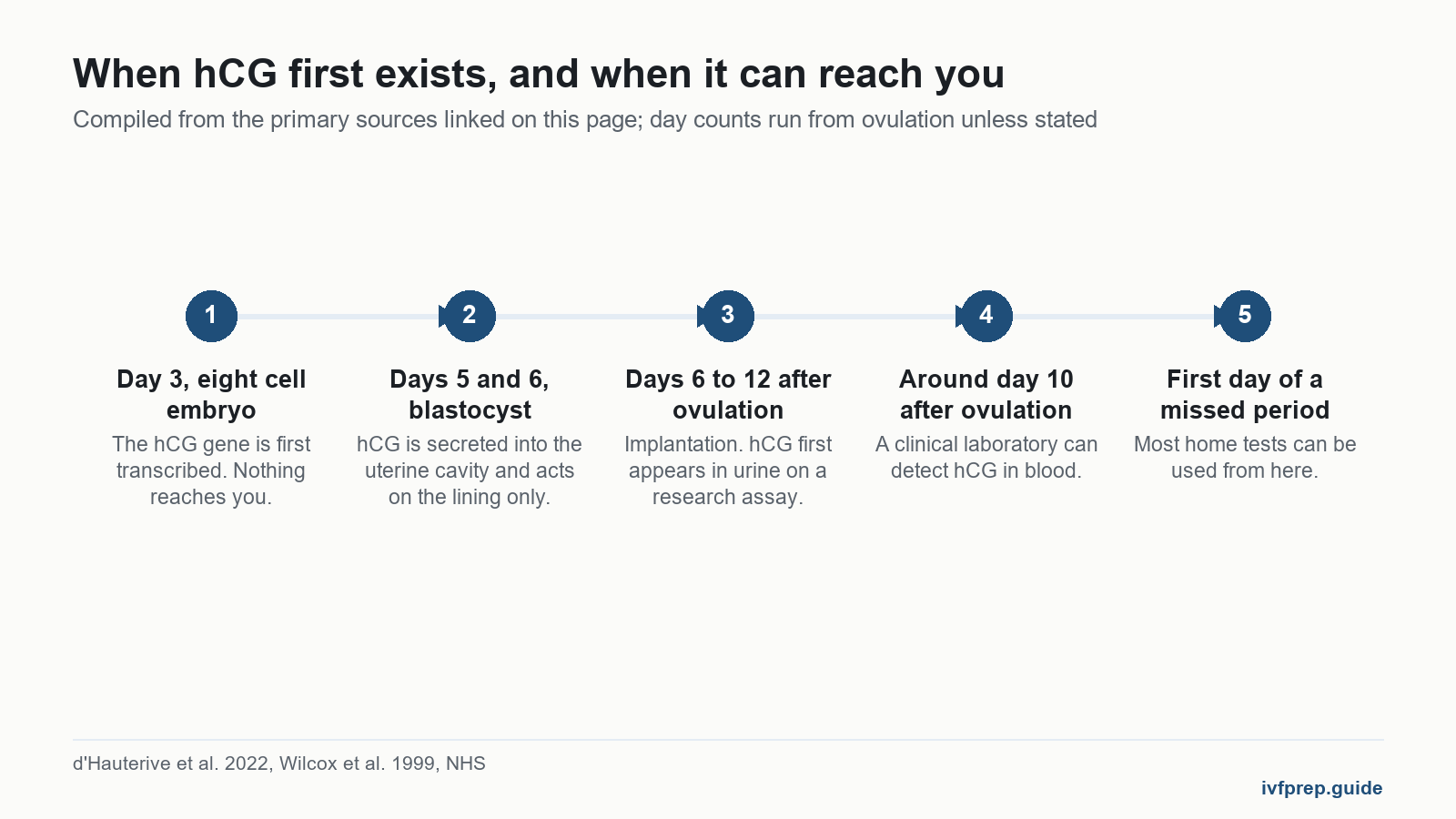
This is the timeline the symptom lists leave out, compiled from the primary sources, checked on 21 September 2026 and rechecked on 11 October 2026. Day counts run from ovulation unless a row says otherwise.
| Stage | What happens to hCG | Can it reach you? | Source |
|---|---|---|---|
| Eight cell embryo, around day 3 after fertilisation | The gene for hCG is first transcribed | No | d’Hauterive et al., IJMS 2022 |
| Blastocyst, days 5 and 6 of development | hCG secreted into the uterine cavity to prepare the lining | No, it acts locally | d’Hauterive et al., IJMS 2022 |
| Implantation, days 6 to 12 after ovulation (84% on days 8 to 10) | hCG first appears in urine on a sensitive research assay | Yes, from here | Wilcox et al., NEJM 1999 |
| Around 6 days after fertilisation | The NHS dates the start of hCG production here | Only once implanted | NHS, doing a pregnancy test |
| Around day 10 after ovulation | A clinical laboratory can detect hCG in blood | Yes | d’Hauterive et al., IJMS 2022 |
| First day of a missed period | Most home tests can be used from here; very sensitive ones slightly earlier | Yes | NHS, doing a pregnancy test |
Allen Wilcox and colleagues collected daily urine from 221 women trying to conceive and defined implantation as the moment hCG first appeared: six to twelve days after ovulation in the pregnancies that continued, and day 8, 9 or 10 for 84 percent of them. That is research grade detection. A home test sees nothing for several days more.
What does that timeline mean after a five day transfer?
Here is the arithmetic, shown so you can check it. A blastocyst transferred on day five is, in developmental terms, about five days past fertilisation, which is roughly where a natural cycle embryo would be around five or six days after ovulation. Carry the Wilcox window across and hCG would first become measurable, on a research assay, somewhere around one to seven days after the transfer, and most often about two to five days after it. Before that, nothing from the embryo is in your bloodstream to cause anything.
Treat that as a rough mapping, not a schedule. The day by day version of the same arithmetic, for day 3 as well as day 5 transfers, is in the implantation timeline after a day 3 or day 5 transfer. It borrows natural cycle data, frozen cycles are timed by the clinic rather than by ovulation, and the Wilcox study did not involve transfers. Your clinic knows your protocol and this page does not, which is why their test date, the one the HFEA asks you not to jump ahead of, is the date that means something. Our page on what the beta hCG number measures explains why that blood test is set when it is.
So what is causing what you feel right now?
Mostly progesterone, and it is doing its job. After ovulation the body makes progesterone to prepare the lining, and in treatment cycles more is usually prescribed. It produces a list of sensations that happens to match the internet’s list of early pregnancy signs almost line for line. A 2025 prospective study in PLOS One, following 53 women through 720 cycles, found mild breast tenderness and swelling before a period were an expected feature of normal ovulatory cycles. The fertility drug information from an NHS trust in Gateshead lists bloating, breast tenderness, nausea, dizziness and headaches among progesterone’s side effects.

| What people commonly notice | What produces it before implantation | Also happens in cycles that end without a pregnancy? |
|---|---|---|
| Tender or swollen breasts | Progesterone after ovulation, or given in treatment (PLOS One 2025, NHS Gateshead) | Yes |
| Bloating | Progesterone (NHS Gateshead) | Yes |
| Nausea | Progesterone (NHS Gateshead) | Yes |
| Headaches or dizziness | Progesterone (NHS Gateshead) | Yes |
| Extra discharge | Progesterone, and pessaries themselves, as our page on discharge in the two week wait explains | Yes |
| Nothing at all | A body going about its business | Yes, and in cycles that work too |
The last row is the one forums never show you. People with a successful cycle and no symptoms rarely start a thread to say nothing happened, so the silent successes are missing from the record. We go through that asymmetry in why an absence of symptoms is not evidence either way.
What do people on fertility forums actually report?
For this article five Mumsnet threads were read, dated May 2021 to September 2024; the 2021 one is left out as too old. What follows is what people report, paraphrased. It is testimony, not evidence, and none of it shows what any sensation meant.
In a January 2024 conception thread, the opening poster described an eye twitch from a day after ovulation in both of their pregnancies. Replies split: two recalled early nausea or vivid dreams, others said there is no mechanism, one noting so called symptoms every single cycle, and the person with the dreams added that the same dreams had come in pregnancies that went differently.
In an April 2023 thread started two days after a five day transfer, posters listed cramping, a trace of pink discharge, a temperature, thirst, a spot of blood and breakouts, which one put down to progesterone. Two tested at home the next morning and both called the negative obvious, knowing it was far too early. By the timeline above, every one of those sensations arrived before any hCG could have.
In a May 2023 thread, the opening poster was worried by feeling nothing, because their own history ran the other way: symptoms in the cycle that had worked, none in two that had not. They later updated that a test had turned positive while they still felt, in their words, absolutely no symptoms. In a September 2024 thread, a poster five days after transfer with cramping, back pain and vivid dreams asked outright whether this was the pessaries or implantation, and others at the same stage described nearly the same list.
The range ran from nothing at all to a daily inventory, with the same sensations in accounts that ended differently. The accounts agree with the physiology that early sensations after transfer are progesterone, and many posters say so themselves. Where they part company is the lingering sense, in hindsight, that one particular twinge was different. No study supports that, and the timeline explains why.
Why do symptom lists keep promising otherwise?
Because a list sells better than a shrug. The day by day symptom calendars share a structure: a sensation, a day number and an implied meaning. The honest calendar has one entry, the blood test, and nobody builds a content strategy around that.
Memory helps the lists along. When a cycle works, the sensations from the days before become part of the story and get retold. When it does not, the same sensations are filed as progesterone and forgotten. Nobody is being careless; only one version gets written down. Our page on signs of implantation after a transfer goes through the usual ones individually, and the page on feeling fertilisation covers the step before this one.
What can you actually do with this in the meantime?
Mostly, permission to stop auditing. If the embryo cannot yet reach your bloodstream, there is nothing in the first days after transfer for your body to report, and so nothing to miss. Testing early at home adds its own problems after IVF, which our page on home pregnancy tests after IVF sets out.

If you have bleeding, significant pain, or any question about your medication, contact your clinic. They know your protocol, your history and your dates, and they would rather hear from you than have you wait it out with a search engine. If the bleeding is heavy or the pain is severe, use the out of hours number they gave you or seek urgent care.
A note for your clinic, not a reading
If something is on your mind at two in the morning, write it here with the date and the day after transfer. It moves the question to the people who can answer it, and it scores nothing.
A diary to take to your clinic. It cannot tell you what any sensation means, and nothing here changes your medication. Kept on this device only.
What has changed since this was first published?
Nothing in the physiology has moved, which is what you would expect of a 1999 study and a hormone. The page is still rechecked on the weekly refresh, and the entries below say what was looked at and when.
- 11 October 2026: the NHS pregnancy test page re-read. It still says hCG starts to be produced around six days after fertilisation and that most tests work from the first day of a missed period, and it still carries its 9 February 2022 review date with a February 2025 review overdue. The timeline table is unchanged.
- 11 October 2026: Wilcox and colleagues 1999, d’Hauterive and colleagues 2022 and the 2025 PLOS One study are fixed publications and were not re-read; their links were checked and are live. The four Mumsnet threads were not re-read, so the accounts stand as read on 21 September 2026.
Frequently asked questions
Can you feel sick before implantation?
Some people report nausea in the days after ovulation or transfer, but it cannot come from a pregnancy hormone that has not yet reached the bloodstream. Progesterone, whether made by the body or prescribed, lists nausea among its known effects, and it is present in cycles that end in a pregnancy and cycles that do not.
Does hCG exist before implantation?
Yes, in a limited sense. The blastocyst produces hCG before it implants and secretes it into the uterine cavity on about days five and six, where it acts on the lining. It does not reach the mother’s circulation in a measurable amount until after the embryo attaches.
How many days after ovulation can a blood test find hCG?
A clinical laboratory can detect hCG in blood from around ten days after ovulation, according to a 2022 review, and a very sensitive research assay picked it up in urine as early as six days after ovulation in one well known study. Home urine tests need longer.
Is it a bad sign to feel nothing at all in the first week after transfer?
No. Feeling nothing is not a signal in either direction. In the first days after a five day transfer nothing from the embryo is in the bloodstream yet, so an absence of sensations is exactly what the physiology would lead you to expect, whatever the outcome.
Can stress cause symptoms that feel like early pregnancy?
Stress can affect sleep, appetite and digestion, and people in the two week wait describe all three. That is part of why the list of possible early signs overlaps so heavily with the list of things any anxious fortnight can produce. It is not something a symptom can be sorted by.
Why do some people say they just knew before testing?
Hindsight gives a real sensation a meaning it did not have at the time. The same feelings are reported in cycles that did not work, but those accounts are rarely retold, so the ones that reach a forum lean heavily towards the cycles that did.
Finished the page? The same five questions from the top, to see what stuck.
This article is general information, not medical advice, and is not a substitute for care from a qualified healthcare professional. Speak to your doctor about your own situation.
Leave a Reply