
Frozen egg transfer cost depends on which procedure you actually mean. Moving an already frozen embryo is one bill, published between roughly $2,294 and $7,500 at the United States clinics checked here. Thawing frozen eggs is a different and larger bill, because those eggs must still be fertilised and grown before any transfer can happen.
Listen to this article, about 14 minutes. A synthetic voice reads the article and announces each section title as it begins; tables are read row by row and the questions at the end are left out.
Recorded 10 October 2026 from the article as published that day. Press a chapter to jump there; the highlighted line is what is playing. A play button sits beside every section heading, and once you scroll past this player a bar at the bottom of the screen keeps the controls in reach. Tap or click any sentence to hear the reading start from there.
On this page: a comparison of five clinic price sheets, real storage costs reported by patients, and a checklist of questions to ask your doctor.
Think you already know this? Five questions, one minute.
Every answer is on this page. Answer from what you know now; the page fills in the rest.
-
1. Why must eggs that have been frozen and thawed be fertilised using ICSI?
According to the HFEA, eggs that have been frozen and thawed must be fertilised using ICSI because freezing toughens the outer coating. Read the section
-
2. How many of the five clinics checked published a clear price for thawing and using frozen eggs?
Only CNY Fertility published a price for thawing and using frozen eggs, as noted in their egg freezing page. Read the section
-
3. Which fee was completely unpublished by all five of the reviewed clinics?
None of the five clinics published what they charge to release and ship specimens to another clinic. Read the section
-
4. What range of annual storage fees did forum users in the United States report paying?
While clinic pages quoted $500 to $1,000, forum reports on r/IVF clustered higher, mostly between $600 and $1,500. Read the section
-
5. Which figure was removed from CNY Fertility’s frozen embryo transfer page when rechecked on September 27, 2026?
The ‘as low as $995’ figure was no longer visible on the frozen embryo transfer page during the September 27 recheck. Read the section
What is the difference between a frozen embryo transfer and using frozen eggs?
Some of it prices a frozen embryo transfer, where an embryo made months or years ago is warmed and placed in the uterus. Some of it prices egg freezing, which is the retrieval at the beginning of the story, not the transfer at the end.
A frozen embryo transfer has one laboratory step before the appointment: warm the embryo. Using frozen eggs has at least three. The eggs are warmed, they are fertilised, and whatever fertilises is grown for five or six days until there is something worth transferring. Only then does a transfer happen, and that transfer is itself the frozen embryo transfer you were reading about in the first place. The day by day version of that final stretch is in the frozen embryo transfer timeline.
The extra steps are not optional. The HFEA, the United Kingdom fertility regulator, states plainly that eggs which have been frozen and thawed must be fertilised using ICSI rather than conventional insemination, because freezing toughens the coating around the egg and sperm may not get through it unaided. So an ICSI fee that a frozen embryo transfer never incurs is compulsory on the egg route, and at the clinics below that single line runs about $1,990 to $2,000.
There is a second reason the egg route is billed as a sequence rather than a price. ASRM pooled the published outcomes for vitrified eggs in its 2021 guideline and put survival after warming at 85 percent and fertilisation at 79 percent. Those are averages across many laboratories, not a forecast for any particular batch, and your own clinic is the only place that can tell you what it sees. The cost point is the narrow one: because some attrition is expected at every step, a laboratory warms a batch rather than one egg, and the invoice follows the steps.
What do clinics actually publish for each procedure?
Here is what five named United States clinics had on their own pricing pages, all read on 16 September 2026. The interesting column is the right hand one, and what is interesting about it is how empty it is.

| Clinic, price page read 16 September 2026 | Frozen embryo transfer | Thawing and using frozen eggs |
|---|---|---|
| CNY Fertility (New York) | About $2,294 including medications and monitoring | About $5,140 for frozen egg IVF, with the transfer charged on top |
| UCSF Center for Reproductive Health | $4,000 to $6,000 for the cycle plus $1,000 to $1,500 medications, after a stated 50 percent cash pay discount | Not published |
| Washington Fertility Center (Virginia) | Not priced separately, folded into a $20,900 single cycle IVF package | Not published |
| NYU Langone Fertility Center | Not published | An IVF cycle using frozen eggs with genetic testing starts at $21,200, against $17,600 using fresh eggs |
| Advanced Fertility Center of Chicago | Not published | Not published; egg freezing itself is $8,000 plus medications |
One clinic out of five publishes a number for thawing and using frozen eggs. That is the finding, and it is the reason the ranking pages all reach for a national average instead: there is very little published price to average.
CNY Fertility is the exception on transparency and also an outlier on price. It is a low cost clinic and its pages are written to win on price, so read its figures as the floor of the market rather than the middle of it. It is also not quite consistent with itself. Its frozen embryo transfer page says a full FET cycle runs around $1,940 and that FETs are available from as low as $995, while its egg freezing page quotes about $2,294 for an FET including medications and monitoring. Both pages were live on the same morning. If one clinic cannot hold a single number still across two of its own pages, a national average assembled from dozens of them is not going to be precise either.
NYU Langone carries the only same clinic comparison in the set, and it is not a clean one. A cycle using fresh eggs starts at $17,600 and a cycle using frozen eggs with genetic testing starts at $21,200. The $3,600 gap includes that testing, so it is not a thaw premium, and NYU does not break it down. A direction of travel, not a measurement.
For scale outside the dollar market, the HFEA puts the average United Kingdom cost of thawing frozen eggs and transferring at about 2,500 pounds, with storage between 125 and 350 pounds a year. It also gives the figure people actually need, the whole journey: collection and freezing at an average of 3,350 pounds plus 500 to 1,500 pounds of medication, and freezing through to thawing at an average of 7,000 to 8,000 pounds in total. Different health system, same shape: the thaw is its own event with its own price, and it is roughly a third of the bill rather than a rounding error.
Which costs are missing from the headline number?
The headline price is the part the clinic can control. The total is made of the lines underneath it, and those are published far more readily than the procedure prices are. Every figure here comes from the same five pages, read on the same day.
| Line item | What the pages published | Where |
|---|---|---|
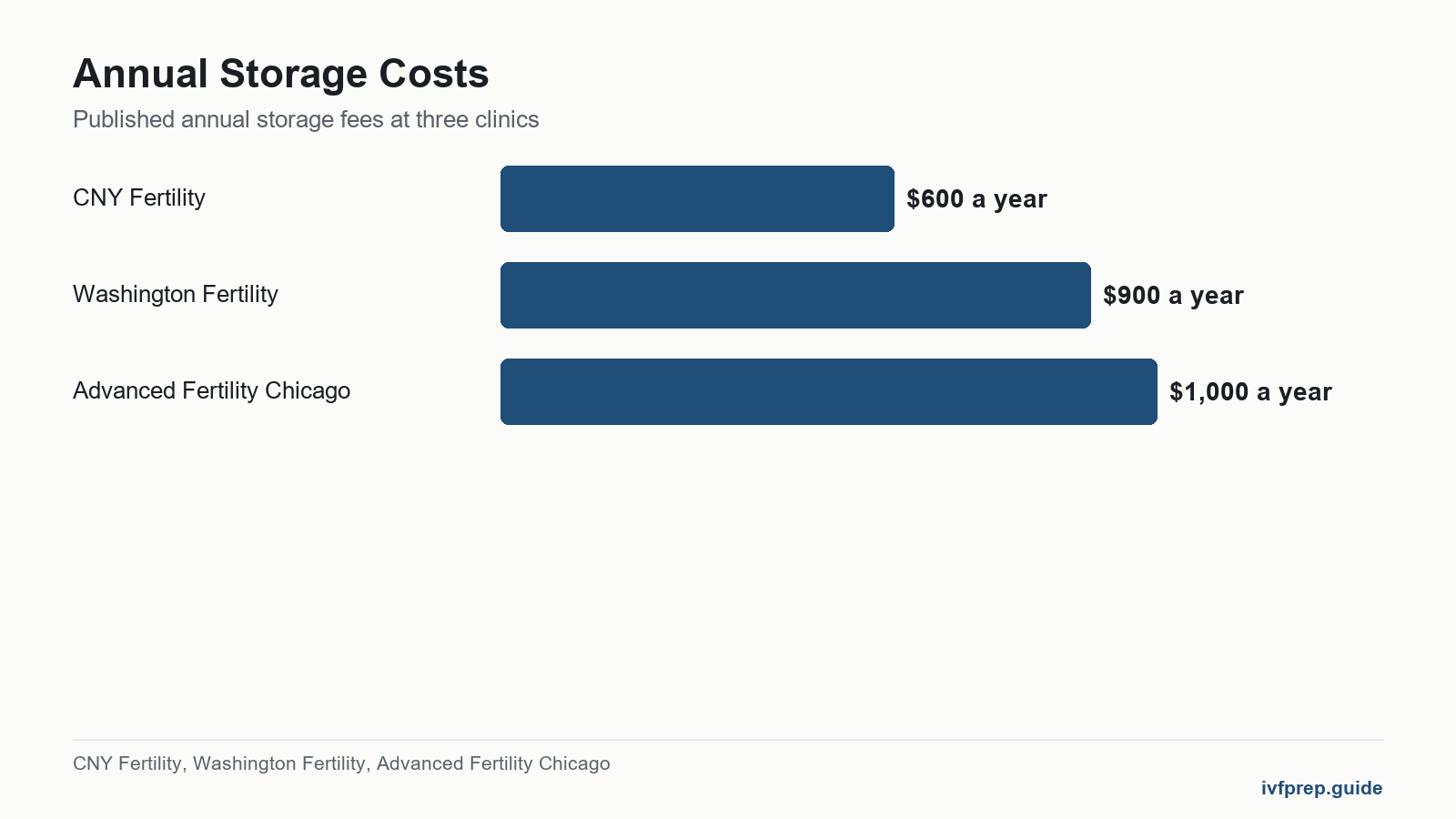
| Annual storage | $600 a year, $900 a year, and $1,000 a year after a free first year | CNY, Washington Fertility, Advanced Fertility Chicago |
| ICSI, compulsory on the egg route | $1,990 and $2,000 | Washington Fertility, PFCLA |
| Genetic testing of embryos | $2,900, about $3,899, and $6,000 for eight embryos | Washington Fertility, CNY, PFCLA |
| Medications | $1,000 to $1,500 for a transfer cycle, $3,000 to $6,000 for a full IVF cycle | UCSF, Washington Fertility |
| Anaesthesia | $690 per retrieval | Washington Fertility |
| Embryo freezing after the cycle | $1,900 | Washington Fertility |
| Releasing and shipping specimens to another clinic | Not published by any of the five | None of them |
Two things stand out. Storage is the only fee here that arrives every year whether or not anything is happening. And the bottom row is empty: not one of the five publishes what it charges to release specimens to another clinic, which is exactly the fee that lands on anyone who moves house or changes doctor.
Medication appears here as a cost line and nothing more. Which drugs, at what dose, for how long, is a conversation with your own clinic and this page has no business in it. It is worth knowing that protocol choice moves the number, though: a modified natural FET cycle and a fully medicated one do not produce the same pharmacy bill.
What do people who have paid these bills report?
Published prices are half the picture, so I read two threads in the r/IVF forum asking people outright what they pay to store eggs and embryos, roughly 65 replies between them, read on 16 September 2026. These are accounts rather than a price survey, and they are not evidence of what any clinic charges. They are useful anyway, because storage is the line the marketing pages round down.

- In a thread from around March 2026, the person who started it said their clinic charged $1,200 a year and that they had moved their embryos to an outside cryobank for $300 a year, saving $900 (r/IVF).
- In that same thread, another poster said their own clinic wanted about $3,000 simply to prepare and transport the specimens out, which made the cheaper storage pointless. The exit fee, not the storage fee, was the deciding number.
- A thread from around May 2026 was started by someone paying $500 a year who had heard others paid far less. The replies went the other way almost unanimously: $1,200 a year, $1,300, $1,500 after the first year, several noting a recent increase (r/IVF).
- The low end was real but rare. One poster reported $375 for five years on a cancer discount, and another reported paying $350 in 2024 and $377 in 2025 at a single United States clinic.
- Outside the United States the numbers stop being comparable at all: about 150 euros a year in one European country, about 180 Australian dollars a year, and storage at no charge until age 46 in Denmark.
Set that against the clinic pages, which quote annual storage at $500 to $1,000. The reported figures cluster higher, mostly $600 to $1,500 in the United States, and that is the one place where the accounts and the published guidance genuinely disagree. On the procedure prices themselves they do not disagree, mostly because there is nothing published to disagree with.
One further account, posted in September 2026, put the warming of frozen eggs at $4,000 as a standalone charge, separate from fertilisation and separate from the transfer (r/IVF). In that same thread the outcomes people described ranged from every egg surviving the warm to most of a batch not surviving. That range matters here for one narrow financial reason: the laboratory is paid for the work, and the invoice does not move either way.
Two caveats, honestly. Forums are where people go when a bill was worse than expected, so the loudest numbers in any thread are the highest ones, and the person whose invoice matched the estimate has no reason to post at all. And none of this is your price list. It is a sense of what the storage line looks like when it is a real invoice rather than a footnote.
What has changed since this was first published?
- Rechecked on 27 September 2026, eleven days after the first read: CNY Fertility’s egg freezing page, updated 7 July 2026, still gives about $2,294 for a frozen embryo transfer, $5,140 for frozen egg IVF, $600 a year storage and $3,899 for genetic testing. UCSF still shows $4,000 to $6,000 plus $1,000 to $1,500 medications after its 50 percent cash pay discount. NYU Langone still starts at $17,600 fresh and $21,200 frozen with testing. Washington Fertility still lists $20,900, $1,990 ICSI, $2,900 testing, $1,900 embryo freezing, $900 a year storage and $690 anaesthesia.
- One number moved, or at least stopped showing. CNY’s frozen embryo transfer page, which carries an update date of 3 January 2026, still gives around $1,940 for a full cycle and now sets it against a national average of $4,000 to $6,900, but the “as low as $995” figure quoted above did not appear when the page was read on 27 September 2026. Treat the $995 as a figure seen on 16 September, not a current offer.
- Washington Fertility’s page also carries a discounted single cycle of $9,985 for eligible uninsured patients under 43, marked as running through 1 June 2026. That date has passed while the offer is still on the page, which is exactly why a price is worth confirming in writing before it is budgeted.
Once the invoice is settled, the next question is usually what the days after the transfer should look like, and what clinics actually disagree about after a FET sets the published advice side by side.
How do you get a number you can trust from your own clinic?
Ask for the estimate as line items rather than a package price, and ask the questions that decide the total rather than the ones that decide the headline.
- Which procedure is this quote for: warming an existing embryo, or warming eggs that still have to be fertilised and grown?
- Is the warming charged separately from the transfer, and is fertilisation separate again?
- Is ICSI inside this number or billed on its own?
- Are medications and monitoring inside the number, or invoiced somewhere else entirely?
- What does storage cost per year, and when does the next invoice land?
- What does the clinic charge to release and ship specimens if I ever move?
- What happens to the fee if fewer eggs survive the warming than expected?
That last one is worth asking out loud before anything is scheduled, because the answer is usually that the laboratory work has been done either way. The same applies further along the chain: embryo grading and the transfer appointment itself are separate events with separate costs, and knowing what actually happens in the room is easier to take in now than on the day.
And the sentence this article exists to underline: your clinic knows your protocol, your storage contract and your history, and this page knows none of it. Every number above is somebody else’s published figure, read on one day in September 2026, offered so you have something to hold up against your own estimate.
Clinic Cost Estimate Checklist
Use this checklist of questions when speaking to your clinic to ensure you receive a comprehensive cost estimate with no hidden fees.
Ticks are saved on this device only.
Frequently asked questions
Is a frozen egg transfer the same thing as a frozen embryo transfer?
No, though the phrase gets used for both. A frozen embryo transfer warms an embryo that already exists and places it in the uterus. Using frozen eggs means warming eggs, fertilising them, and growing them for several days first, and only then doing a transfer. The second route carries the first route’s cost inside it.
Does using frozen eggs always need ICSI?
The HFEA states that eggs which have been frozen and thawed have to be fertilised by ICSI, because freezing makes the outer coating of the egg tougher and sperm may not be able to get through it on their own. That makes ICSI a compulsory line on the egg route, commonly published at around $1,990 to $2,000, where a frozen embryo transfer never incurs it.
Do I still pay if fewer eggs survive the warming than expected?
The published fees are for the laboratory work rather than for a result, so the charge does not usually move with how many eggs survive. The only way to know how your clinic handles it is to ask before the cycle is scheduled, in writing, and to ask what happens to the rest of the plan if there is nothing to transfer.
How much is annual storage, really?
Clinic pages in this article published $600, $900 and $1,000 a year, and one widely quoted range is $500 to $1,000. People posting in r/IVF in early and mid 2026 reported mostly $600 to $1,500 a year in the United States, with a few paying under $400. Storage is also the one fee that arrives every year regardless of whether treatment is happening.
Is moving eggs or embryos to cheaper storage worth it?
It depends entirely on the exit fee, which none of the five clinic pages publishes. One person posting in r/IVF saved $900 a year by moving to an outside cryobank; another was quoted about $3,000 by their clinic just to prepare and transport the specimens, which cancelled the saving. Ask for the release fee before the storage quote.
Why do two pages from the same clinic quote different prices?
Because pricing pages are written at different times by different people for different searches, and they are rarely reconciled. CNY Fertility quoted around $1,940 on one page and about $2,294 on another for a frozen embryo transfer on the same day in September 2026. The figure that matters is the written estimate from your own clinic’s finance office, not either web page.
Finished the page? The same five questions from the top, to see what stuck.
This article is general information, not medical advice, and is not a substitute for care from a qualified healthcare professional. Speak to your doctor about your own situation.
Leave a Reply