
Implantation cramps: how long do they last? Pages quote anything from a few hours to three days, but no study has ever timed them, because implantation cannot be watched as it happens. Cramping in the two week wait is common, often from progesterone, and its length says nothing about your result. Your clinic knows your protocol.
Listen to this article, about 12 minutes. A synthetic voice reads the article and announces each section title as it begins; tables are read row by row and the questions at the end are left out.
Recorded 27 September 2026 from the article as published that day. Press a chapter to jump there; the highlighted line is what is playing. A play button sits beside every section heading, and once you scroll past this player a bar at the bottom of the screen keeps the controls in reach. Tap or click any sentence to hear the reading start from there.
On this page: the three ranking pages that give implantation cramps a duration and cite nothing for it, a dated PubMed search that returns zero records, the Wilcox study that timed implantation itself, and six dated forum accounts of how long cramping really ran.
Think you already know this? Five questions, one minute.
Every answer is on this page. Answer from what you know now; the page fills in the rest.
-
1. Of the three ranking pages read for this article, how many attached a study to the duration they gave for implantation cramps?
Each of the three gave a duration in hours or days, and none linked that figure to a study, checked on 27 September 2026. Read the section
-
2. What did a PubMed search for the phrase implantation cramping in titles and abstracts return on 27 September 2026?
The PubMed search returned nothing, because implantation cannot be watched as it happens and so no sensation can be timed against it. Read the section
-
3. In the 1999 Wilcox study, when did the pregnancy hormone first appear in pregnancies that lasted at least six weeks?
Wilcox, Baird and Weinberg found 84 percent implanted on day 8, 9 or 10, a measure of timing that recorded no sensations at all. Read the section
-
4. What does the product information for Cyclogest pessaries list as common during luteal support in assisted reproduction?
Per the Cyclogest 400mg product information, common means 1 in 100 to 1 in 10 people, and it can run for as long as the medication is taken. Read the section
-
5. Of the seven forum posters in this article’s threads who gave a duration, how many described something that fits the one to three days the ranking pages quote?
The rest described about a week, the whole fortnight, or weeks longer, with outcomes on both sides, which is testimony and not a finding. Read the section
If you are reading this with a mug of tea and a stopwatch, counting how many hours the ache has lasted so far, the pages at the top of the search results have an answer ready for you. It is a confident answer. It is also, as far as anyone can find, an answer that nobody ever measured.
This page does not tell you what your cramps mean, because nobody can. It does something narrower and more useful: it traces the number to its source, shows that the source is missing, and sets out what the research does establish about the days around implantation. Your clinic knows your transfer date, your medication and your history. This site knows none of them.
Where does the one to three days figure come from?
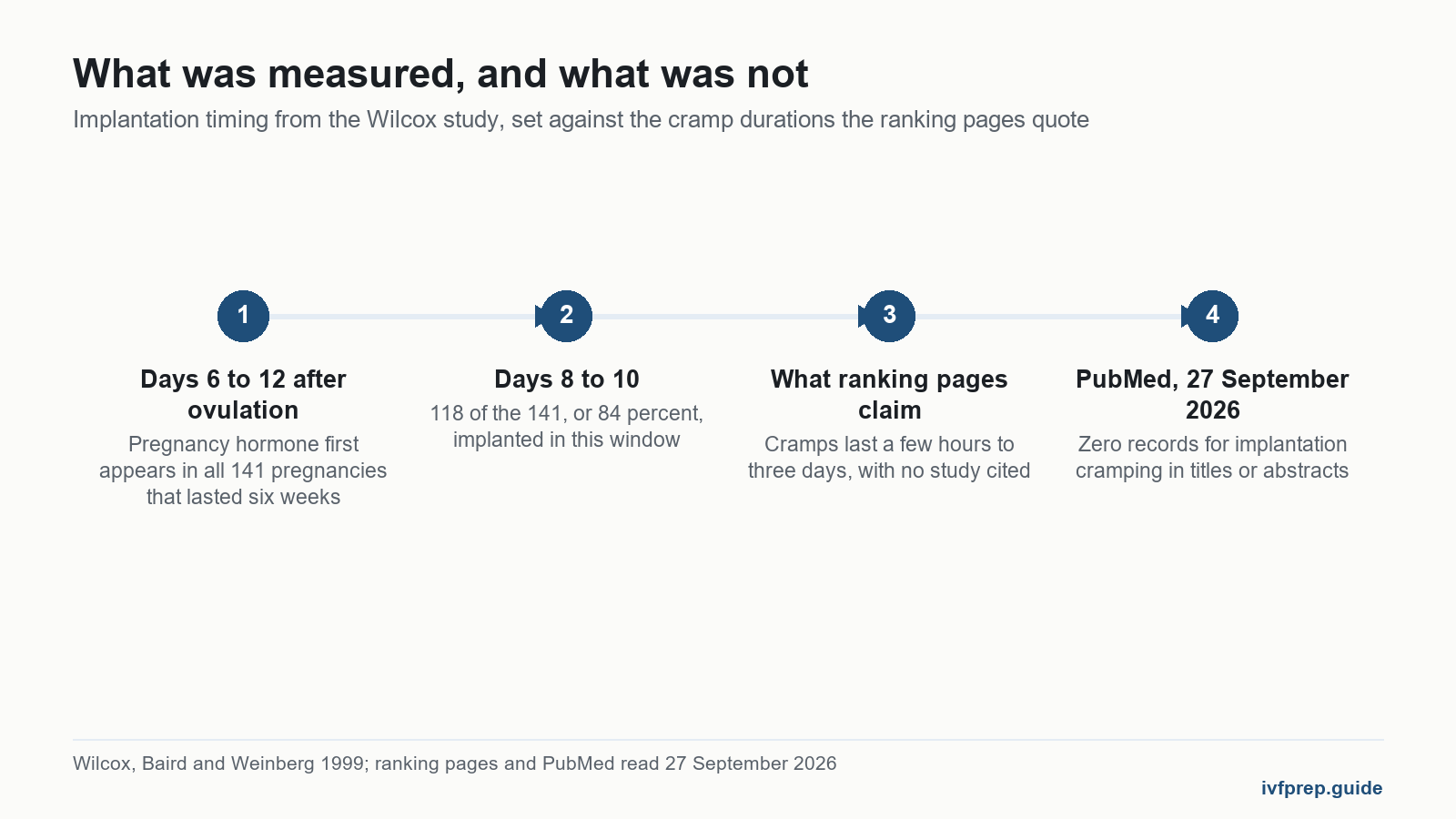
From each other, as far as can be told. We read the pages ranking for this question on 27 September 2026. They agree with each other remarkably well, which would be reassuring if any of them said where the figure came from.
| Page | What it says about duration | Source given for the duration |
|---|---|---|
| Pampers India, updated November 2024 | A few hours to a few days | None; the page carries no references at all |
| Enfamil | Intermittent cramping lasting one to three days | None; no references listed |
| Mira fertility shop, updated February 2026 | A few hours to two days | None attached to the duration; its references cover timing and general pregnancy symptoms |
A nappy brand, a formula brand and a hormone monitor shop, with a pregnancy app and a DNA test seller close behind them in the results. Four further ranking pages refused our reader, so we cannot say what they cite. What we can say is that the three we could read state a duration in hours or days, and not one of them attaches that duration to a study. When numbers agree this closely without a shared source, the likeliest explanation is that they were copied, and copying a number does not make it more true.
Has any study measured how long implantation cramping lasts?
Not that we could find, and we looked in the place such a study would be. On 27 September 2026 a PubMed search for the phrase implantation cramping in titles and abstracts returned zero records. The phrases implantation cramps and implantation pain returned 21 records between them, every one about implanted devices and procedures, from spinal stimulators to cochlear implants. A broader search for implantation alongside any word beginning with cramp returned 36 records, none of which timed a sensation during embryo implantation.
The reason is not neglect. Implantation happens inside the uterine lining, over days, in a structure a fraction of a millimetre across, and nothing can watch it happen in a living person. The best anyone has done is detect it afterwards, from the hormone it releases. You cannot time a sensation against an event whose start you cannot see.
The closest thing to evidence comes from the North Carolina study that asked 221 women trying to conceive to keep daily diaries. From those diaries, Sayle and colleagues reported in 2002 that among 136 women who had live births, half had noticed any pregnancy symptom by day 36 after their last period and 89 percent by the end of week eight. In a typical cycle, day 36 falls about two weeks after the implantation window that the same research group measured. The abstract does not separate cramping from other symptoms, so it cannot give a duration either. A companion paper from the same diaries found bleeding rarely fell on the day of implantation, and found no support for the idea that implantation causes bleeding at all.
What is actually known about when implantation happens?
The timing, at least in natural conceptions, has been measured properly. Wilcox, Baird and Weinberg, in the New England Journal of Medicine in 1999, collected daily urine from the same 221 women and used the first appearance of chorionic gonadotrophin, the pregnancy hormone, to mark implantation. Among the 141 pregnancies that lasted at least six weeks, the hormone first appeared 6 to 12 days after ovulation, and 118 of them, 84 percent, implanted on day 8, 9 or 10.
That is a window of days for when implantation becomes detectable. It says nothing about sensation, because nobody in the study was asked to match a feeling to a urine sample, and it is counted from ovulation, which is not your calendar. After a transfer the embryo arrives already several days old, so the natural cycle figures shift. As rough arithmetic only, a day five blastocyst sits at about day five of that timeline on the day it is transferred, but nobody has shown the natural cycle figures carry over exactly, and the frozen transfer timeline sets out the dates that do apply. Your clinic can place your own cycle on it and this site cannot.
What else causes cramping in the two week wait, and for how long?
Here, unlike implantation, there are documented causes with documented time courses, and several of them run for far longer than three days.
| Possible cause | What the source says | How long it tends to run |
|---|---|---|
| Progesterone support | The Cyclogest 400mg product information lists abdominal pain, abdominal distension and constipation as common in luteal support for assisted reproduction, meaning 1 in 100 to 1 in 10 people | For as long as the medication is taken, which your clinic decides |
| Ovarian hyperstimulation, fresh cycles only | The HFEA page on the risks of fertility treatment describes ovaries that become very large and painful after stimulation drugs | Usually the week after egg collection; severe cases are rare |
| The transfer itself | A catheter passed through the cervix, with a full bladder for the scan | Commonly described as the day of transfer and the day after |
| Implantation | Possible, but no study has separated it from the causes above | Unknown; never measured |

Two of those causes have a documented start and end, one has a plausible one, and the cause people most want to identify is the one with no measurement at all. More on the soreness in the days straight after transfer is in its own article, and why the side you feel it on carries no information is in another.
How long did cramping last for people who wrote it down?
If the measured answer is nothing, the only other answer is testimony, so we read two public Mumsnet infertility threads about cramping after transfer: 14 posts, 12 of which described cramping. These are what people report, not findings, and a thread about cramping collects people who cramped. Here are six, with the thread linked so you can read them in full.
| Poster | Thread and date | How long she described it lasting | How the cycle ended |
|---|---|---|---|
| xMrsxHx87x | Mumsnet, December 2024 | Near constant, period like, from a fresh transfer until progesterone stopped at eight weeks | Positive, ongoing when she posted |
| CEllenx | Mumsnet, December 2024 | Significant cramping for the whole two weeks after a frozen transfer | Positive, 12 weeks when she posted |
| Autumn245 | Mumsnet, December 2024 | On and off, worse when she needed the toilet | Positive |
| Mseddy | Mumsnet, December 2024 | Cramped in two cycles, not in a third | One positive, one positive that ended in a miscarriage, one negative with no cramping |
| Rachae | Mumsnet, August 2021 | Woke with severe back pain and period cramps at six days past transfer | Negative on test day |
| lucymills1234 | Mumsnet, September 2021 | Quite intense cramping on days nine and ten after transfer | A positive that turned negative five days later |
Across the twelve, seven gave a duration, and only one of those seven fits the one to three days the ranking pages quote. The rest ran for about a week, the whole fortnight, or until the progesterone stopped weeks later. Outcomes ran from ongoing pregnancy to a negative on test day, with long cramping on both sides. Mseddy’s cycles might look like a pattern until you set them beside the May 2021 thread in which one poster described severe cramps on both sides and tested negative twice, while another in the same thread had no cramping and a positive.
Where the accounts agree with the documented sources is on the progesterone. Several posters blamed the pessaries themselves, and the product information supports them on how common that is. Where they disagree with the ranking pages is on the number: people who wrote down how long their cramping lasted mostly described something much longer than three days, and none of that length pointed to an outcome. We gathered 38 more accounts on what forum posters describe during the wait, and they show the same absence of a pattern.

When is cramping a reason to ring the clinic today?
This is the one question about cramping in the fortnight that has a real answer, and the answer is about your safety rather than about your result.
The NHS page on ectopic pregnancy names pain low down on one side of the tummy, vaginal bleeding or a brown watery discharge, pain in the tip of the shoulder, and discomfort when going to the toilet, and advises contacting a GP or calling NHS 111 with a combination of those in someone who might be pregnant. It treats sharp, sudden and intense tummy pain together with dizziness or fainting, feeling sick or looking very pale as a reason to call 999 or go to accident and emergency.
After a fresh cycle, the HFEA factsheet on egg donation says to let your clinic know straight away about any reaction to fertility drugs, and lists symptoms running from abdominal swelling, discomfort and stomach pain to vomiting, breathlessness and passing less urine. Outside the United Kingdom the numbers differ and the advice does not. Pain that is getting worse, whatever the day count, is a reason to ring rather than to read.
Clinic call log
For the date you rang and what the clinic said, so the next call is quicker. It does not score, time or interpret anything you feel.
Saved on this device only. If pain is getting worse, ring the clinic rather than logging it.
So what do you do with a cramp that has lasted four days?
Nothing different from a cramp that lasted four hours. The duration was never a measurement of anything, so going past it tells you nothing, in either direction. The same is true of feeling nothing at all, which is common in cycles that work and invisible on forums because nobody posts about nothing happening. The same goes for the sudden electric twinge forums call lightning crotch, a name borrowed from late pregnancy that has never been linked to implantation.
What you can do is write down the date and what your clinic told you when you rang, so that the next call is quicker. Beyond that, the wait is a wait, and anyone offering you a stopwatch reading of it is selling something, sometimes literally: on this particular search, one of them sells nappies.
Frequently asked questions
Is it normal for cramping to last the whole two week wait?
It is commonly reported. Progesterone support lists abdominal pain and distension as common effects for as long as it is taken, and several forum posters described cramping for the full fortnight or longer. Common does not mean it tells you anything about the result, and worsening pain is always worth a call to the clinic.
Why do so many websites say implantation cramps last one to three days?
Most likely because they repeat one another. The three ranking pages we could read on 27 September 2026 all gave a duration in hours or days, and none attached a study to it. A PubMed search for the phrase implantation cramping on the same day returned no records.
Does longer cramping mean implantation is going well?
There is no evidence for that, and the accounts read for this page cut across it. Long cramping was described by people who went on to positives and by people who went on to negatives. Neither length nor strength of cramping has been shown to relate to outcome.
Can implantation cramps come and go over several days?
Nobody knows, because implantation cramps have never been measured as distinct from other cramps. What is documented is that cramping from progesterone and bowel changes often comes and goes, and that implantation itself unfolds over days rather than at a single moment.
When does implantation happen after a day five transfer?
Natural conception studies place detectable implantation at 6 to 12 days after ovulation, mostly days 8 to 10, and a day five blastocyst is transferred already several days along that timeline. The exact dates for your cycle depend on your protocol, which your clinic can explain.
Should I test early if the cramping stops?
Stopping cramps are no more informative than starting ones. Clinics set a test date for a reason, and testing before it risks a misleading result in either direction. Your clinic can tell you what your own test date is based on.
Finished the page? The same five questions from the top, to see what stuck.
This article is general information, not medical advice, and is not a substitute for care from a qualified healthcare professional. Speak to your doctor about your own situation.
Leave a Reply