
A 7 days after embryo transfer negative pregnancy test rules nothing out and confirms nothing. Seven days past a day five blastocyst is about twelve days past the ovulation equivalent, two days before a period would even be late, and the hCG in play sits inside the range where home pregnancy tests openly disagree with each other.
Listen to this article, about 11 minutes. A synthetic voice reads the article and announces each section title as it begins; tables are read row by row and the questions at the end are left out.
Recorded 10 October 2026 from the article as published that day. Press a chapter to jump there; the highlighted line is what is playing. A play button sits beside every section heading, and once you scroll past this player a bar at the bottom of the screen keeps the controls in reach. Tap or click any sentence to hear the reading start from there.
On this page: a comparison table of detection limits, laboratory cutoffs, and patient reports from three community threads.
Think you already know this? Five questions, one minute.
Every answer is on this page. Answer from what you know now; the page fills in the rest.
-
1. What cycle day equivalent does 7 days after a day 5 blastocyst transfer roughly represent?
A day five blastocyst transfer plus seven days puts you at about twelve days past ovulation, which is two days before a period is typically due. According to the New England Journal of Medicine in 1999, implantation timing varies, meaning the hCG clock starts on different days for different people. Read the section
-
2. What is the serum hCG cutoff value on day 7 that separated live births from non:live births in the Kidera study?
The study of 18,491 frozen thawed blastocyst transfer cycles in F and S Reports identified 31.05 mIU/mL as the day 7 serum hCG cutoff. This value falls right where home tests can disagree, as noted in Laboratory Medicine in 2020. Read the section
-
3. What percentage of clinical pregnancies were undetectable on the first day of a missed period in the Wilcox study?
In JAMA in 2001, researchers found that 10 percent of clinical pregnancies were undetectable on the first day of a missed period even with a highly sensitive assay. Additionally, a review in Geburtshilfe und Frauenheilkunde in 2014 concluded that many home test performance claims do not match reality. Read the section
-
4. What did a user report in the November 2025 forum thread regarding testing on day 7?
In the November 2025 thread, a poster reported getting opposite results from the same sample using two different brands. Other community experiences can be found in the July 2024 thread and the September 2023 thread. Read the section
-
5. What does the UK fertility regulator advise regarding early pregnancy testing?
The HFEA advises patients to try not to test early as it may produce a false result. Read the section
Every page ranking for this says it is too early and that your clinic will tell you. Both true. Neither answers what you are actually asking at two in the morning, which is what a blank window at this hour is worth. That question has numbers attached and almost nobody publishes them.
Your clinic knows your protocol, your transfer date and what was transferred. This site knows none of it, so nothing below reads your cycle, and nothing below predicts an outcome either way, because no number on day 7 can.
What day of a normal cycle is 7 days after a transfer?
Count from the embryo, not the calendar. A day five blastocyst has been developing for five days when it goes back, and day zero of that count is fertilisation, which without a laboratory would be ovulation. So transfer day sits roughly five days past an ovulation equivalent, and seven days later puts you at about twelve.
Twelve days past ovulation is not late. In a textbook 28 day cycle ovulation falls near day 14 and the period is due 14 days after it, so you are two days short of the day a period would even arrive. The biochemistry does not change because the embryo came by catheter.
The calendar hides one more thing: hCG starts at implantation, not at transfer, and implantation is not a fixed day. Wilcox and colleagues, in the New England Journal of Medicine in 1999, found that among natural conceptions lasting six weeks or more, 84 percent implanted 8 to 10 days after ovulation. A day five blastocyst arrives inside that window rather than before it, so your hCG clock may have started on transfer day or two days later, with no way to know which. The day by day version is in the frozen embryo transfer timeline.
How much hCG is actually there on day 7?
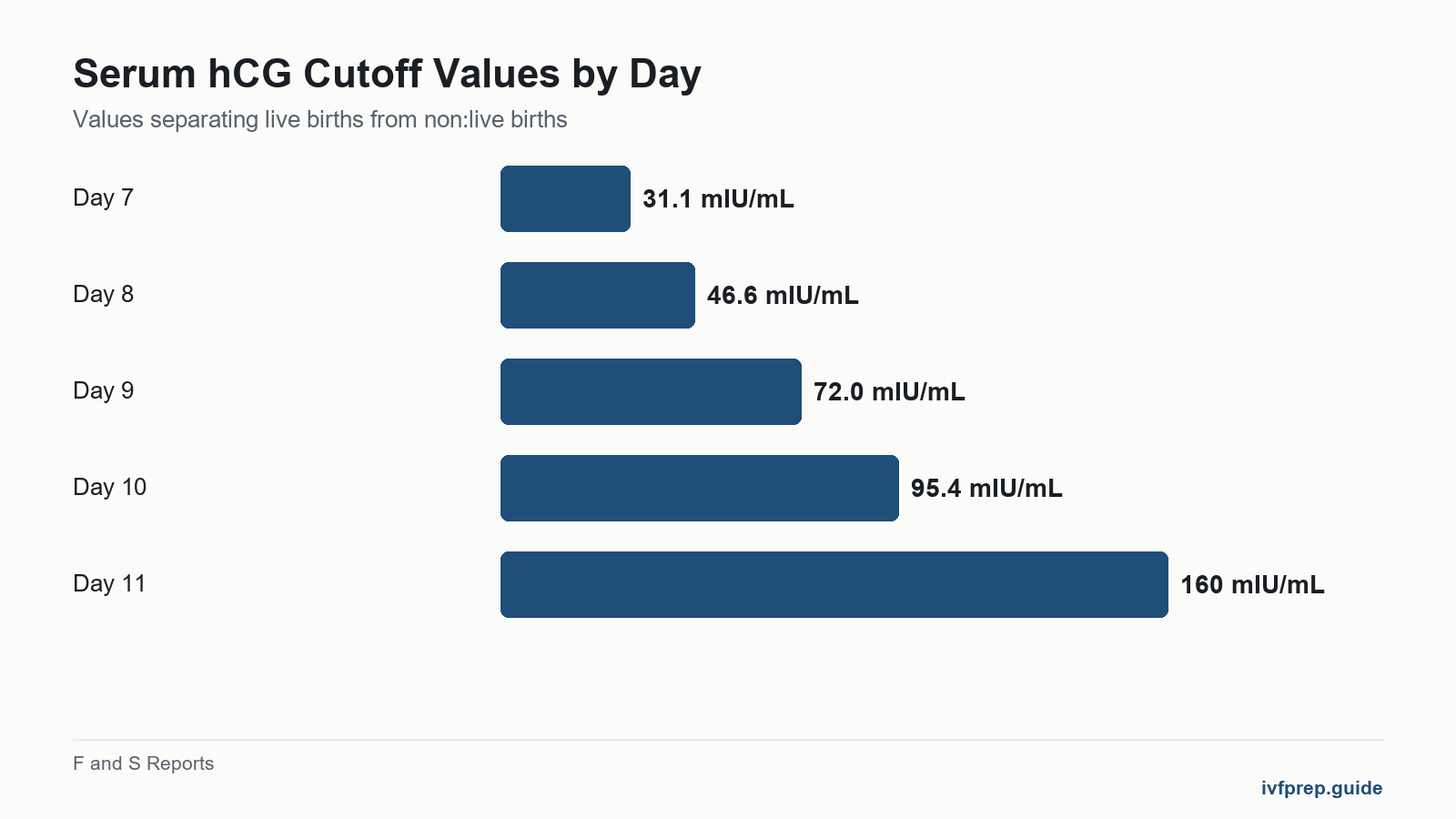
Here is the number the ranking pages leave out. In 2025, Kidera and colleagues analysed 18,491 frozen thawed blastocyst transfer cycles in F and S Reports and reported the serum hCG value that best separated cycles ending in a live birth from those that did not, for each day from 7 to 11 after transfer. On day 7 that value was 31.05 mIU/mL.
Hold it at arm’s length, because the misreading hurts. It is a serum value from a laboratory, not a urine value from a stick, and it is a line drawn backwards through a large group after every outcome was already known, which is not a threshold anyone can apply to herself on a Tuesday night. It is also a cutoff, not a median or a range, because cutoffs are what the paper reports. What it is good for is scale.
Set it beside what a home test can physically detect. In Laboratory Medicine in 2020, Herskovits and colleagues put the lower limit of detection for serum hCG assays at 0.2 to 2 mIU/mL, and for point of care urine tests at 6.3 to 100 mIU/mL. Not 25. A spread of roughly sixteen times, depending which device is in your hand.
| Days after a day 5 blastocyst transfer | Roughly equivalent days past ovulation | Serum hCG cutoff separating live birth from no live birth (Kidera 2025, 18,491 cycles) | Against urine test detection limits of 6.3 to 100 mIU/mL (Herskovits 2020) |
|---|---|---|---|
| 7 | about 12 | 31.05 mIU/mL | Above the most sensitive strips, below the least. Brand decides. |
| 8 | about 13 | 46.6 mIU/mL | Still inside the band where devices disagree. |
| 9 | about 14, when a 28 day cycle’s period is due | 72.05 mIU/mL | Inside that band, nearer its top. |
| 10 | about 15, first day a period could be called missed | 95.4 mIU/mL | At the top of the band. |
| 11 | about 16 | 159.9 mIU/mL | Above the whole band. |
Read the first row again. On day 7 the whole question is playing out in a range where two tests from two boxes can give two different answers from one sample, and neither is faulty. That is the resolution limit of the instrument, not a verdict.
What can a home pregnancy test actually see?
The box says over 99 percent accurate, which is a claim about a different day than the one you are on. The best measure of what an early test can do is Wilcox and colleagues again, in JAMA in 2001: 221 women, 136 clinical pregnancies, an assay sensitive to about 0.13 mIU/mL, roughly two hundred times finer than a strip. Even so, on the first day of the missed period 10 percent of clinical pregnancies were undetectable, and they put the ceiling for any hCG based test that day at 90 percent, rising to 97 percent a week later.
That ceiling lands on day 10 after a day five transfer. You are three days earlier with a device hundreds of times blunter. The arithmetic runs one way only.

Whether your test meets its own label is another matter. Gnoth and Johnson reviewed home pregnancy tests in Geburtshilfe und Frauenheilkunde in 2014 and concluded that many results do not match the claims in the package insert, that no standard criteria for performance claims exist, and that promises of detection eight days before a period are unrealistic. The sensitivity printed on the foil is a marketing figure standing where a measurement ought to be.
One mechanism sits on top of all this. A trigger injection contains hCG, the same molecule the test looks for, so while it clears, commonly quoted at 10 to 14 days, no strip can tell injected hCG from embryonic hCG. An early positive can therefore be residue and an early negative can be a pregnancy under the threshold. What you were given and when is a conversation with your clinic, and the trigger shot problem has its own page here.
What do people who tested on day 7 actually report?
Here are accounts from people who did exactly this, from three public Mumsnet infertility threads carrying 163 replies between them, dated November 2025, July 2024 and September 2023, split across cycles that ended both ways. They are paraphrased, they are testimony rather than data, and none of them is a preview of your result.
In the July 2024 thread, the woman who started it tested negative at four days past transfer and had a clear positive by nine. Another poster there went negative at four days, got a line so faint she assumed it was an evaporation mark at five, and had an unambiguous positive at seven.
In the November 2025 thread, one poster tested at seven days past transfer and got a positive on a cheap strip and a negative on a First Response from the same sample. Two brands, one morning, opposite answers, which is the 6.3 to 100 mIU/mL spread from the laboratory literature turning up on a bathroom shelf. Another poster there had tested from four days, was still negative at seven, and wrote that she read it as over.
In the September 2023 thread, which runs to 82 replies, the woman who started it tested negative at six days past a day five transfer and the cycle did fail. A second poster was negative at twelve days past transfer and that cycle failed too. A third had a strong positive at six days and was 21 weeks pregnant when she replied.

Where do the accounts agree with official guidance? On direction: an early negative is followed by a positive often enough that clinics are right to say wait. They diverge on one belief that circulates hard in these threads, that a negative on a sensitive test at seven days past a day five transfer means the chances are not good, because a late positive implies late implantation and late implantation means more loss. A real study sits underneath that, the 1999 Wilcox paper, but it is being read off the wrong clock: Wilcox timed implantation from ovulation in natural conception, and a transfer resets when the embryo arrives. The belief also assumes a test has one fixed threshold, and the poster holding two contradictory results from one sample quietly refutes that.
One more thing about threads, and it matters more than anything above. Nobody starts a thread to report that nothing happened. The woman whose day 7 test was blank, whose day 10 test was positive and whose pregnancy simply continued has no reason to come back. Threads collect the dramatic cases at both ends and lose the uneventful middle.
So what does a negative on day 7 rule out?
Nothing, and this is the sentence the page exists for. A blank result on day 7 is consistent with a cycle that is going to work and with one that is not, and the reason is not optimism, it is that the measurement does not yet have the resolution to separate them. It equally confirms nothing, and a page telling you otherwise in either direction would be lying to you.
What the evidence does support is the timing advice, which is why every clinic gives it. The HFEA, the UK fertility regulator, says in its own guide to IVF that you will be given a date to do a pregnancy test and, in its words, try not to do this early as you may get a false result. Your clinic sets that date from your protocol and your transfer day. If that scheduled blood test comes back negative, what a beta hCG negative result actually means and what a clinic reviews next is covered separately.
If there is bleeding, pain that is getting worse, or anything that worries you, that is a call to your clinic now rather than a question for a search box, whatever any test said. And if you are trying to work out what this week’s sensations mean, the honest answer on implantation signs covers why they do not resolve into one.
Early Testing Checklist
Keep these biological and mechanical factors in mind when evaluating an early test result:
Ticks are saved on this device only.
Frequently asked questions
Is 7 days after a day 3 transfer the same as 7 days after a day 5 transfer?
No, and the difference is two days of embryo development. A day three embryo goes back two days earlier in its own timeline, so seven days after that transfer is roughly ten days past an ovulation equivalent rather than twelve. Everything in the arithmetic above shifts earlier, and earlier means less hCG. Your clinic can place your own transfer on that timeline exactly.
Why did two brands give me different answers on the same day?
Because they are not built to the same threshold. Herskovits and colleagues put the lower limit of detection for point of care urine hCG tests at 6.3 to 100 mIU/mL, a spread of roughly sixteen times, and Gnoth and Johnson found many tests do not match the claim in their own package insert. Two devices straddling your actual level will disagree, both working as designed.
Does a faint line mean more than a blank window?
It means the sample contained enough hCG to trip that particular device and the blank one did not, which is a statement about two pieces of plastic. This site will not read a line for you in either direction, and any page that does is guessing with your evening. The people who can interpret a result against your protocol are the ones holding your notes.
Can I ask my clinic for an earlier blood test?
People do ask, and clinics answer differently. A serum assay detects from about 0.2 to 2 mIU/mL against 6.3 to 100 for a urine device, so it does see hCG sooner. What it does not do is turn a single early number into a certain answer, which is part of why many clinics decline to bring the date forward. It is a reasonable question to put to yours.
Why do forum threads make a day 7 negative look rarer than it is?
Because of who comes back to post. An early negative that quietly became an ordinary pregnancy generates no thread and no update, so the uneventful middle of the distribution is close to invisible. Across the 163 replies read for this article the accounts cluster at the two dramatic ends. That is a record of posting behaviour, not of outcomes.
Does a frozen transfer change any of this?
The arithmetic is the same, because it counts from the embryo’s own age rather than from whether it was frozen. What differs between fresh and frozen cycles is the medication used to prepare the lining and the timing your clinic builds around it, which is their territory rather than this page’s. The day 7 to day 11 figures quoted above come from frozen thawed blastocyst cycles specifically.
Finished the page? The same five questions from the top, to see what stuck.
This article is general information, not medical advice, and is not a substitute for care from a qualified healthcare professional. Speak to your doctor about your own situation.
Leave a Reply