
A quantitative beta hCG measures the exact amount of hormone in your blood rather than answering yes or no. Your clinic draws it twice because the rate of change between two samples carries information that no single value does. The interval between the draws matters as much as the numbers themselves.
Listen to this article, about 11 minutes. A synthetic voice reads the article and announces each section title as it begins; tables are read row by row and the questions at the end are left out.
Recorded 25 September 2026 from the article as published that day. Press a chapter to jump there; the highlighted line is what is playing. A play button sits beside every section heading, and once you scroll past this player a bar at the bottom of the screen keeps the controls in reach. Tap or click any sentence to hear the reading start from there.
On this page: the difference between the two tests that share a name, why the second draw exists, where the rise thresholds came from and the caveat rarely printed next to them, why doubling slows as the number climbs, and the six things that vary between clinics before anyone interprets anything.
Think you already know this? Five questions, one minute.
Every answer is on this page. Answer from what you know now; the page fills in the rest.
-
1. What does a quantitative beta hCG report that a qualitative test does not?
ACOG’s 2026 clinical consensus describes qualitative testing as establishing presence or absence and quantitative testing as used in the evaluation and management of early pregnancy. Only the quantitative one can be tracked. Read the section
-
2. Why does the clinic draw the test twice?
A single result is a point; the clinic is assessing a line. A study of low beta values after blastocyst transfer found the fold increase across 48 hours more useful than any single measurement, and if the interval slips the comparison slips with it. Read the section
-
3. The 49, 40 and 33 percent minimum rise thresholds were built for what purpose?
They are cited in ACOG Practice Bulletin 193 on tubal ectopic pregnancy and derive largely from symptomatic early pregnancies. A 2021 case series reported three embryo transfer patients with 48 hour rises of 22 to 27 percent who all went on to live births, which is a caution, not a rule. Read the section
-
4. Why does the doubling time lengthen as the value climbs?
Under about 1,200 mIU/mL the commonly cited doubling time is roughly 30 to 72 hours; over 6,000 it is often longer than 96. Above roughly 6,000 the number tells clinicians progressively less, and they move to a scan, which is what answers where and how many. Read the section
-
5. In the 2020 Journal of Ovarian Research study of 312 patients in the lowest 5 percent band at day 14, what happened?
The study defined its band as 5 to 299 mIU/mL fourteen days after a frozen blastocyst transfer, in one hospital with one assay. Both outcomes, in quantity, inside one narrow range of numbers: a value describes a group and forecasts nothing for a person. Read the section
What does quantitative actually mean on the request form?
Two different tests share the name hCG, and the word in front of it decides what you get back.
A qualitative test answers one question: is hCG present above a set cutoff. It returns a positive or a negative and nothing else. A quantitative test reports an actual figure. The American College of Obstetricians and Gynecologists, in its February 2026 clinical consensus on positive hCG test results, describes qualitative testing as being used to establish the presence or absence of pregnancy, and quantitative testing as being used in the evaluation and management of early pregnancy, which is the situation you are in.
| Qualitative hCG | Quantitative beta hCG | |
|---|---|---|
| What it reports | Positive or negative | A number, with units |
| Sample | Urine or blood | Blood |
| Typical use | Confirming presence | Tracking change over time |
| Useful to repeat | Only to confirm | Yes, that is the point of it |
| Comparable between labs | Broadly | Not without knowing the assay and units |
ACOG puts the reference cutoff for serum hCG below 5 international units per litre in people who are premenopausal and not pregnant. Laboratories set their own reporting floor, and many report anything under that figure simply as negative rather than as a value.

Why does the clinic take a second sample instead of reading the first one?
Because a single quantitative result is a point, and what the clinic is assessing is a line.
hCG in early pregnancy changes quickly, so the same underlying situation produces very different figures depending on the day it is sampled. A study of patients with low beta values fourteen days after blastocyst transfer concluded directly that the fold increase measured across 48 hours gave better predictive accuracy than any single measurement, and its authors advised against relying on a first value on its own.
This is also why the timing of the second draw is not arbitrary. If the interval slips, the expected change slips with it, and the comparison the clinic wanted to make is no longer the comparison they can make. Clinics differ on whether they use 48 or 72 hours. The number in general circulation is not the one that matters here. Yours is.
The companion piece on what a beta hCG number actually tells you covers the results call itself, including why comparing figures with strangers online is a route to distress with no information at the end of it.
Where do the expected rise figures actually come from?
This is the part almost nobody explains, and it changes how much weight the figures deserve.
For years the working rule was a rise of at least 66 per cent over two days. That figure was later shown to be the lower bound of an 85 per cent confidence interval, which meant roughly 8 per cent of viable intrauterine pregnancies were already falling below it. Work published in 2004 by Barnhart and colleagues, based on 287 people with pain or bleeding and 861 hCG measurements, put the minimum rise at 53 per cent across two days, the lower bound of a 99 per cent confidence interval, in pregnancies confirmed as viable.
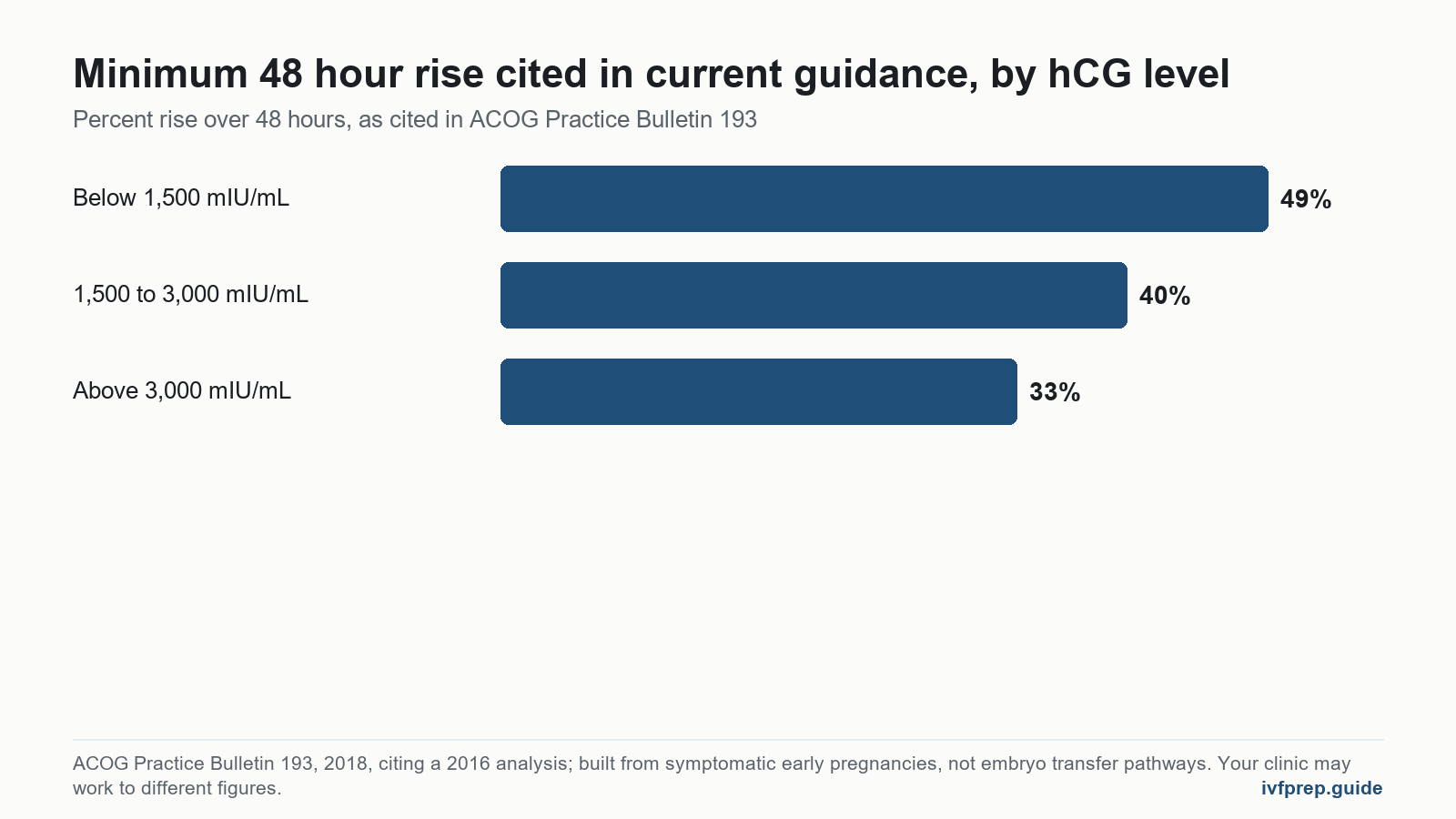
Guideline thresholds now cited more commonly are set lower again, and vary by the level itself.
| hCG level | Minimum rise over 48 hours cited in current guidance |
|---|---|
| Below 1,500 mIU/mL | 49 per cent |
| 1,500 to 3,000 mIU/mL | 40 per cent |
| Above 3,000 mIU/mL | 33 per cent |
Those three figures trace to a 2016 analysis of how hCG rise differs by the value at presentation, and they are the thresholds cited in ACOG Practice Bulletin 193 on tubal ectopic pregnancy, published in March 2018. We rechecked them in September 2026 and found them still cited as the current thresholds. The bulletin’s title, tubal ectopic pregnancy, is a fair preview of the caveat that follows.
Here is the caveat that matters most, and it is rarely printed next to the numbers. Those curves were derived largely from people who presented with symptomatic early pregnancy, typically with pain or bleeding and a pregnancy whose location was not yet known. They were built to help clinicians identify pregnancies developing in the wrong place. They were not built to grade a routine beta pathway after an embryo transfer, and applying them that way asks them to do a job they were not designed for.
A 2021 case series in F&S Reports makes the point concretely. Three patients after embryo transfer had 48 hour rises of 22.1, 23.3 and 26.9 per cent, far below every threshold above, and all three went on to live births. They represented about 0.6 per cent of that clinic population across three years. Three cases is not a rule and should not be read as one. What the authors drew from it was a caution: standard early pregnancy hCG curves should be applied to embryo transfer patients carefully, because the population is not the one the curves came from.
Why does hCG stop doubling as the number gets bigger?
Because doubling is exponential, and exponential growth of a hormone does not continue indefinitely. The commonly reproduced figures look like this.
| hCG level | Commonly cited doubling time |
|---|---|
| Under 1,200 mIU/mL | Roughly 30 to 72 hours |
| 1,200 to 6,000 mIU/mL | Roughly 72 to 96 hours |
| Over 6,000 mIU/mL | Often longer than 96 hours |
The practical consequence is that a doubling time which lengthens as the value climbs is expected arithmetic rather than a change in the situation. It is also why following values above roughly 6,000 tells clinicians progressively less, and why at that stage they move to a scan instead. A blood test measures quantity. It cannot show where something is or how many there are, and those are the questions a scan exists to answer.

Why do two clinics quote different numbers and different test days?
Because more things vary between clinics than most people realise, and every one of them shifts the figure you are handed.
| What varies | Why it changes your number |
|---|---|
| The assay | Different manufacturers and calibration, so genuinely different results from one sample |
| The units | IU/L and mIU/mL are not interchangeable on sight, so the same amount reads differently |
| The positive cutoff | Some laboratories report from 5, others from 25 |
| The test day | Reported anywhere from about 9 to 14 days after a blastocyst transfer |
| The embryo stage | A day 5 blastocyst is further along than a day 3 embryo at the same days past transfer |
| The retest interval | Commonly 48 hours, sometimes 72 |
The test day carries one extra constraint worth knowing. Serum hCG is generally not measured until around 9 to 12 days after a blastocyst transfer, because residual hormone from the trigger injection used to mature the eggs can still be circulating and produce a false positive. That is the same effect behind the trouble with home pregnancy tests after IVF, and it is a timing problem rather than a test quality problem. For where the blood test sits among everything else in a frozen cycle, the frozen embryo transfer timeline lays out the stages around it.
What can a quantitative result not settle?
Quite a lot, and being specific about it is more useful than reassurance.
- Where the pregnancy is. A number carries no location information. Only a scan does.
- How many. Ranges overlap far too much for a figure to answer this.
- What your particular outcome will be. One study looked at 312 patients whose value fell in the lowest 5 per cent band at day 14 after transfer. Within that single band, 18.6 per cent went on to live births and 47.4 per cent had an early miscarriage. Both outcomes, in quantity, inside one narrow range of numbers. That is the clearest demonstration available that a value describes a group and forecasts nothing for a person.
- Anything about how you feel. Symptoms and numbers are not two readings of the same instrument, which is the subject of the honest answer on signs of implantation.
The study behind the third point is a 2020 paper in the Journal of Ovarian Research, and its band was defined as a serum beta hCG between 5 and 299 mIU/mL fourteen days after a frozen blastocyst transfer. That definition matters, because it is one hospital’s population, one transfer type and one assay, which is exactly why its percentages describe that group and not you.
If you are searching because a symptom has appeared or disappeared and you are trying to square it with a figure, the piece on why implantation symptoms prove nothing exists for exactly that moment. The short version is that the two do not map onto each other, and no amount of reading will make them.
What does your clinic know that this page does not?
Everything specific. Your transfer date, the stage of the embryo, when your trigger was given, which assay their laboratory runs and in what units, what they consider typical at your exact point in the cycle, and your own history. This article can explain why a second draw exists and where the published thresholds came from. It cannot read your result, and nothing written for a general audience can.
If one question is worth asking when they call, it is what interval they want between the draws and what they are watching for across it. That is a question with a real answer, and it is held by the people with your notes in front of them.
Ask when they call
Six things that decide what your number means, none of which a forum can supply. Tick each one once you have the answer from your own clinic.
Ticks are saved on this device only. Your clinic holds every specific fact this page does not.
Frequently asked questions
Is a quantitative beta hCG more accurate than a qualitative one?
They answer different questions rather than the same question with different accuracy. A qualitative test reports whether hCG is above a cutoff. A quantitative test reports the amount, which is what makes tracking change across two samples possible. For monitoring early pregnancy after a transfer, quantitative testing is what clinics use.
How many hours apart should the two draws be?
Clinics commonly use 48 hours and some use 72. The published rise thresholds are expressed over a stated interval, so a draw taken early or late is not comparable against them in the same way. Your clinic sets the interval deliberately, and it is worth confirming it with them rather than assuming.
Does a slow rise mean the transfer has failed?
It is not a verdict, and this article cannot tell you what your own result means. What the published record shows is that the thresholds have documented exceptions, including embryo transfer patients with rises well under half the expected figure who went on to live births, and that the thresholds themselves were derived from a different clinical population. Clinics respond to a slow rise by testing again rather than by concluding, because at that point the information genuinely does not exist yet. Your clinic is the only party able to interpret your numbers.
Why are my results in different units from someone else on a forum?
Laboratories report in IU/L or in mIU/mL, and different manufacturers use different assays with different calibration. The same blood can produce meaningfully different printed figures depending on which laboratory ran it. A number without its units and its assay is not comparable to another number, which is why online comparison misleads so reliably.
Can I work out my own doubling time with an online calculator?
You can enter the figures, but the output carries far less meaning than the interface suggests. Those calculators apply population curves built largely from people presenting with symptoms and a pregnancy of unknown location, they assume an exact interval, and they cannot account for your assay, your units, your embryo stage or your trigger timing. Clinicians read the same arithmetic alongside everything else in your file.
Does a high first number mean twins?
A single value cannot establish how many. The ranges for one and for more than one overlap heavily, and the same figure appears in both. Number and location are questions an ultrasound scan answers, which is why clinics arrange one rather than inferring it from blood work.
Finished the page? The same five questions from the top, to see what stuck.
This article is general information, not medical advice, and is not a substitute for care from a qualified healthcare professional. Speak to your doctor about your own situation.
Leave a Reply