
No study links bloating and implantation. After an embryo transfer, bloating is listed as a common side effect of the progesterone used to support the cycle, so it turns up whether or not an embryo implants. The bloating that matters is the kind that keeps getting worse, with less urine or breathlessness: that is a call to the clinic today.
Listen to this article, about 12 minutes. A synthetic voice reads the article and announces each section title as it begins; tables are read row by row and the questions at the end are left out.
Recorded 18 October 2026 from the article as published that day. Press a chapter to jump there; the highlighted line is what is playing. A play button sits beside every section heading, and once you scroll past this player a bar at the bottom of the screen keeps the controls in reach. Tap or click any sentence to hear the reading start from there.
On this page: what four progesterone documents say about bloating, each frequency in the document’s own words, the OHSS warning lists from the HFEA, ASRM and NHS set beside them in one table, and four r/IVF threads read on 15 October 2026.
Think you already know this? Five questions, one minute.
Every answer is on this page. Answer from what you know now; the page fills in the rest.
-
1. Why can bloating after a transfer not point to one outcome?
Leaflets such as the Lubion leaflet list a bloated stomach as a side effect of the progesterone itself, which is used whatever the outcome. Read the section
-
2. How does the Cyclogest leaflet class abdominal distension in fertility treatment?
The Cyclogest leaflet, revised in October 2022, lists abdominal distension, abdominal pain and constipation as common in people undergoing assisted reproduction. Read the section
-
3. What does the NHS page on the risks of IVF say can happen to the ovaries?
The NHS IVF risks page, last reviewed in April 2025, says the ovaries can become large and painful with ovarian hyperstimulation syndrome. Read the section
-
4. What weight gain does the ASRM patient fact sheet ask people to report?
The ASRM OHSS fact sheet, revised in 2023, lists weight gain of over 3 pounds in 2 days. Clinics set their own thresholds. Read the section
-
5. What does the HFEA say about contacting the clinic with an OHSS symptom?
The HFEA page on the risks of fertility treatment says to contact the clinic immediately with any of its listed symptoms. Read the section
Checked on 15 October 2026 against UK and US medicine leaflets and the patient pages of the HFEA, the NHS and the American Society for Reproductive Medicine. This page describes what those documents say about groups of people. It cannot tell anyone what their own bloating means, and it says nothing about whether a transfer has worked. Your clinic knows your protocol, your medicines and your history; this page does not.
Is bloating a sign of implantation after a transfer?
Search for it and you get the usual implantation symptom list, where bloating sits between cramps and a metallic taste with the quiet confidence of something nobody ever measured. Most of those pages, to be fair, add that progesterone slows digestion and that bloating is not specific. Then they leave it on the list anyway. Discharge gets the same treatment, and our page on how often trials record discharge on vaginal versus injected progesterone shows the count those lists skip.
Here is the plainer version. Implantation is a ball of a few hundred cells settling into the lining of the womb. It is far too small to change the shape of a belly, and we found no study that links bloating to an embryo implanting. What does change the shape of a belly in an IVF cycle is the medicine, and the medicine is given to everyone who has a transfer, whatever happens next. A sign that appears in every outcome cannot point to one of them.
This is the same story as most of the feelings people examine in this fortnight, which our page on the honest answer about signs of implantation after transfer goes through one at a time. Bloating just has better paperwork than most of them.
What do the progesterone leaflets say about bloating?
The medicine leaflets are where the real answer lives, and they are blunter than any forum. The table gathers what the UK leaflets and product information say about bloating and its close relatives, with each frequency in the document’s own words. Which of these, if any, a person is using is set by their clinic, and nothing here is a suggestion to change anything.
| Medicine | What the document lists | How often, per the document | Source |
|---|---|---|---|
| Progesterone pessary (Cyclogest), in fertility treatment | Abdominal distension (swelling in the abdomen), abdominal pain, constipation; separately, bloat | Distension, pain and constipation: common, up to 1 in 10. Bloat: uncommon, up to 1 in 100 | Cyclogest leaflet, October 2022 |
| Progesterone injection under the skin (Lubion) | Bloated stomach, stomach pain, constipation | Common, up to 1 in 10 | Lubion leaflet, November 2025 |
| Progesterone vaginal insert (Endometrin, US) | Abdominal distension; abdominal pain | 4% and 12% of 404 women in an IVF trial | Endometrin label, July 2026 |
| Progesterone vaginal gel (Crinone) | No bloating or abdominal swelling listed | Not listed | Crinone product information, December 2020 |
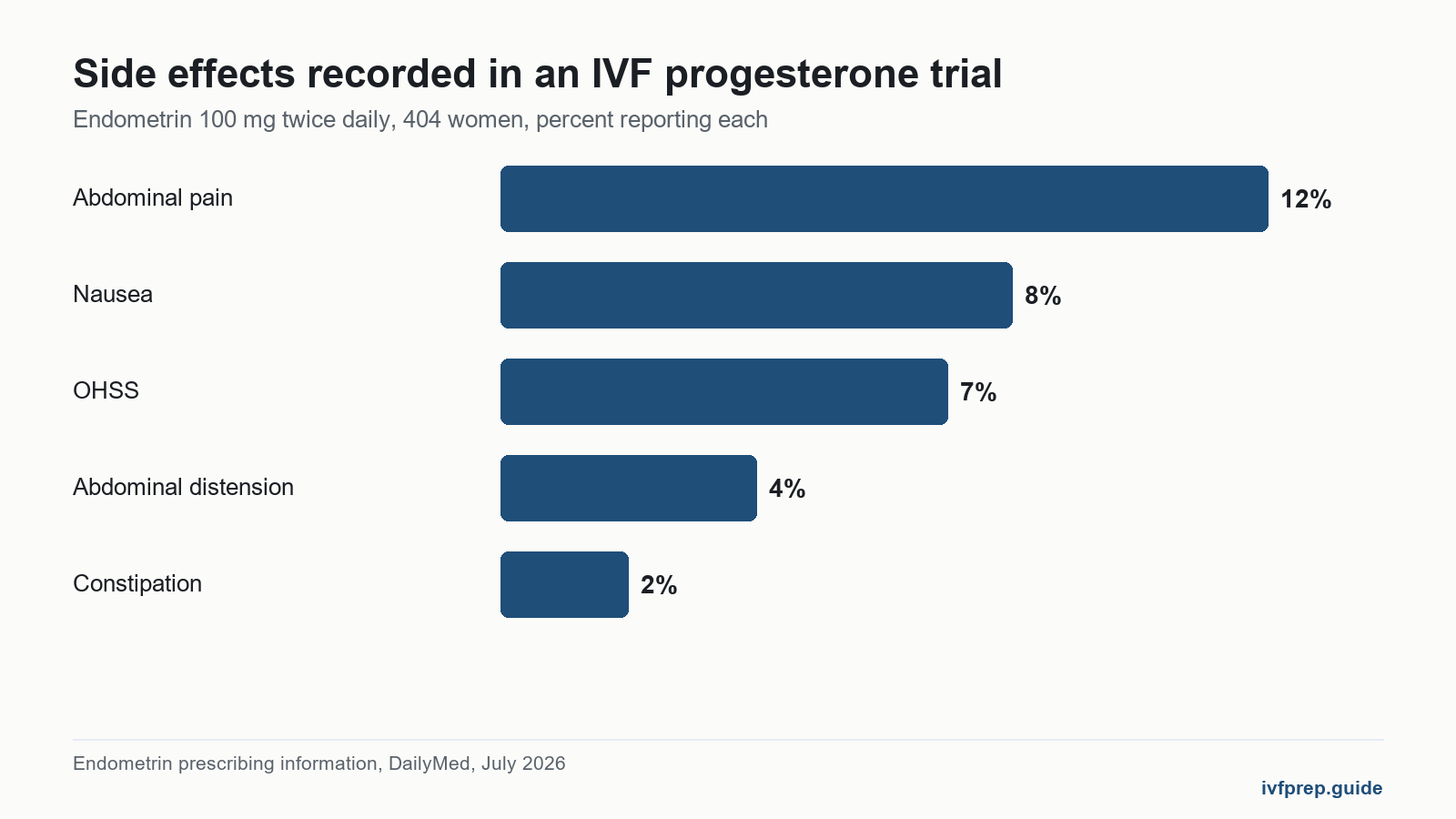
Two things stand out. Bloating and its cousins, constipation and a sore tummy, appear in the fertility treatment section of the Cyclogest leaflet and in the Lubion leaflet at the same common band of up to 1 in 10. And the documents do not agree with each other. Crinone’s product information does not list bloating at all, while the US Endometrin label, which gives actual percentages, recorded abdominal distension in about 4 in 100 women, constipation in about 2, nausea in about 8 and abdominal pain in about 12. We have given all four rather than pick the tidiest.
The same Endometrin trial table also recorded ovarian hyperstimulation syndrome in 7% of women in each group, which is a reminder that OHSS sits in the same weeks as the transfer, and why the kind of bloating matters more than the fact of it. The Lubion leaflet goes further and puts overstimulation of the ovaries first in its list of reasons to seek immediate medical help. One caution on those percentages: the Endometrin trial ran for 10 weeks and included women who did and did not become pregnant, so, as our page on what the trial numbers do and do not show about implantation nausea explains, its columns mix the medicine with egg collection, OHSS and pregnancy. If a trial of 808 women cannot pull those apart, one belly cannot either.

Why does an IVF cycle bloat more than a normal month?
Because a fresh IVF cycle asks the ovaries to grow many follicles at once, and they do not shrink back the moment the eggs are collected. The NHS page on the risks of IVF, last reviewed in April 2025, says the ovaries can become large and painful. Add progesterone slowing the gut, a few days of sitting still, and a diet of nervous biscuits, and the waistband never really stood a chance.
A frozen transfer has no egg collection in the same month, but it is not bloat free either. Medicated frozen cycles usually build the lining with oestrogen before progesterone starts, and people report the bloating starting there, before any embryo is involved. Our page comparing medicated and natural frozen transfer cycles sets out how the two kinds of cycle differ.
None of this tells anyone which way a cycle will go. It only explains why so many people in the wait feel as if they have swallowed a beach ball, and why that feeling is so poor at predicting anything.
What do people on IVF forums report about bloating?
We read four r/IVF threads from the past year, with about 45 replies between them. These are what people report, not findings, and nothing in them says what anyone’s own bloating means.
- In a May 2026 thread, a poster preparing for a medicated frozen transfer described about seven pounds of weight gain in a month, a swollen belly and breasts, blaming the oestrogen and the drugs before it. Several replies said the same tablets did the same to them, and one said looser clothes and moving about were the only things that helped.
- In an October 2025 thread, a poster the day after egg collection, with 25 eggs collected, described severe bloating and about five pounds of weight gain. She later updated the post to say she had moderate to severe OHSS and went to hospital when the pain would not settle and she could not breathe properly.
- In a September 2026 thread asking how to tell normal bloating from OHSS, one reply described moderate OHSS with severe shoulder pain on breathing in, and another said their clinic asked for a call after more than four pounds gained in two days, or any trouble breathing.
- In a September 2026 thread with 65 upvotes, people swapped stories of colleagues, a nail technician and an acquaintance on social media assuming the bloating meant pregnancy. The replies were weary, and the best answers were short.
The range ran from uncomfortable jeans to a hospital stay. Every account blamed a medicine, an egg collection or OHSS, and none of the people who wrote about their own bloating read it as a sign of anything. The people who did read it as a sign were strangers looking at someone else’s belly, which is roughly how much that reading is worth. One more thing is missing from the forums: the people who felt nothing at all. Nobody writes a thread titled my stomach was normal, in any kind of outcome, which is why having no symptoms is not evidence of anything either.
How do clinics tell ordinary bloating from OHSS?
Clinics are not asking whether you feel bloated. Nearly everyone does. They are asking whether it is getting worse and whether other things are coming with it. The HFEA says around a third of women will have mild OHSS, which can normally be treated at home with pain relief, and the ASRM patient fact sheet, revised in 2023, says the same one in three. Fewer go on to moderate or severe OHSS, and in very rare cases, the HFEA says, severe OHSS can be life threatening. The table sets the leaflets’ ordinary bloating beside what the OHSS pages ask patients to report.
| What changes | The leaflet’s ordinary bloating | What the OHSS pages ask you to report | Source |
|---|---|---|---|
| The belly | Swelling and discomfort, listed as common | Abdominal swelling, or swelling that is not improving or is getting worse | ASRM, Leeds NHS |
| Weight | Weight increase, listed as uncommon | Weight gain of over 3 pounds in 2 days | ASRM |
| Urine | Nothing listed | Decreased urination, or dark urine with less output than expected | ASRM, Leeds NHS |
| Stomach | Constipation, wind, stomach pain | Continued vomiting or nausea, difficulty keeping fluids down | ASRM, HFEA |
| Breathing | Nothing listed | Shortness of breath | HFEA, NHS |
| Pain | Abdominal pain, listed as common | Sudden abdominal pain, or stomach pains that can be severe | ASRM, HFEA |
The HFEA says strong OHSS symptoms generally appear in the week after egg collection, and the Leeds Teaching Hospitals leaflet, reviewed in June 2025, adds that OHSS sometimes does not cause symptoms until about a week after embryo transfer. So this is not a risk that ends on transfer day, and it is the honest reason to keep an eye on the belly: for the clinic’s sake, not the forum’s. Our page on pain after an embryo transfer covers the other kinds of discomfort in these days.
When does bloating after a transfer need a call to the clinic?
This is the part to read slowly, and there are no jokes in it.

Call 999 or go to A&E if you have difficulty breathing, chest pain, extreme thirst with very little urine, or swelling anywhere in the body. The NHS IVF risks page lists these among the symptoms that could be severe ovarian hyperstimulation syndrome, and it says not to drive yourself to A&E.
Ring your clinic, or its out of hours number, the same day if the bloating keeps getting worse, if you are passing less urine than you would expect, if you cannot keep fluids down, or if you gain weight quickly. The HFEA says to contact the clinic immediately with any OHSS symptom and to never feel you are wasting the clinic’s time. If the clinic cannot be reached, the NHS page says NHS 111 can help.
Ordinary, steady bloating that is uncomfortable but not changing is still worth mentioning at the next contact with the clinic, who can talk through what helps. Do not stop or change a fertility medicine on your own; that is the clinic’s decision. Side effects from any medicine can also be reported to the MHRA through the Yellow Card scheme, which is how leaflets like the ones above get their numbers. And when the wait is over, the answer comes from the blood test your clinic has booked, which our guide to how the beta hCG test works explains.
When to ring the clinic about bloating
Taken from the HFEA, ASRM and NHS pages cited above. It does not score anything, saves nothing and says nothing about whether a transfer has worked.
Ring the clinic, or its out of hours line, today if:
- the swelling keeps getting worse rather than settling
- you are passing less urine than you would expect, or it is dark
- you cannot keep fluids down, or the sickness will not stop
- you gain weight fast, past the threshold your clinic gave you
- stomach pain comes on suddenly or is severe
Call 999 or go to A&E if:
- you have difficulty breathing or chest pain
- you have extreme thirst with very little urine
- there is swelling anywhere in the body
The HFEA says never feel you are wasting the clinic’s time. If the clinic cannot be reached, NHS 111 can help.
A log of calls to the clinic
If you ring the clinic about anything in the wait, this keeps the date and what they told you in one place. It records nothing else and does not interpret anything.
Saved on this device only. It records dates and what the clinic said, nothing more; it does not score, predict or advise.
Frequently asked questions
Does bloating mean the transfer worked?
No. Bloating is a listed side effect of the progesterone given in every transfer cycle, so it appears whatever the outcome. Only the blood test the clinic books can answer that.
Does no bloating mean the transfer failed?
No. Many people on the same medicines have little or no bloating, in every kind of outcome. Its absence tells you nothing either way.
Why do I look pregnant before any test?
Stimulated ovaries, oestrogen and progesterone can all swell the belly, and people on IVF forums report strangers assuming pregnancy. It is the medicine, not a verdict.
How fast is too fast for weight gain?
The ASRM patient fact sheet asks people to report weight gain of over 3 pounds in 2 days. Clinics set their own thresholds, so use the one yours gave you.
Can OHSS start after the embryo transfer?
Yes. A Leeds NHS leaflet says OHSS sometimes does not cause symptoms until about a week after transfer, which is why worsening bloating in the wait needs a call to the clinic.
Is constipation in the two week wait normal?
The Cyclogest and Lubion leaflets list constipation as common, up to 1 in 10. Ask the clinic or a pharmacist before taking anything for it.
Finished the page? The same five questions from the top, to see what stuck.
This article is general information, not medical advice, and is not a substitute for care from a qualified healthcare professional. Speak to your doctor about your own situation.
Leave a Reply