
Embryo hatching after thaw means a warmed blastocyst has started pushing out of its outer shell, the zona pellucida. Labs also note whether it has re expanded after looking shrunken. Large studies link re expansion with higher pregnancy rates across groups, yet embryos that did not re expand still led to births, so no single word decides one transfer.
Listen to this article, about 12 minutes. A synthetic voice reads the article and announces each section title as it begins; tables are read row by row and the questions at the end are left out.
Recorded 16 October 2026 from the article as published that day. Press a chapter to jump there; the highlighted line is what is playing. A play button sits beside every section heading, and once you scroll past this player a bar at the bottom of the screen keeps the controls in reach. Tap or click any sentence to hear the reading start from there.
On this page: what collapsed, re expanded and hatched mean on a thaw report, the pregnancy rates from four studies of warmed blastocysts side by side with their sample sizes, the 906 transfer hatching study, and what five r/IVF accounts report about how the words were delivered, with every outcome left out.
Think you already know this? Five questions, one minute.
Every answer is on this page. Answer from what you know now; the page fills in the rest.
-
1. What is a blastocyst hatching out of?
Hatching is the embryo pushing out through the zona pellucida. The 2025 hatching study graded it as unhatched, early hatching, late hatching or fully hatched. Read the section
-
2. Why do many labs shrink a blastocyst before freezing it?
Fluid in the cavity can form ice, so labs often collapse it first. A 2016 study reported 97.3 percent survival after warming with laser collapse against 74.9 percent without. Read the section
-
3. In the 2025 study of 3,196 single transfers, what share of transfers of blastocysts that had not re expanded led to a live birth?
In Du and colleagues, 2025 the live birth rate was 16.9 percent without re expansion and 41.6 percent with it, before matching. These are group rates from one centre, not a forecast for any embryo. Read the section
-
4. In the 2025 study of 906 frozen transfers, how did fully hatched blastocysts compare with unhatched ones for clinical pregnancy?
The 2025 hatching study reported 54.1 percent for fully hatched and 54.3 percent for unhatched, and the fully hatched group held only 37 transfers. Read the section
-
5. What did the accounts read for this page mostly show about clinics?
Some posters were given a fresh grade and others were told nothing, and an embryologist on r/IVF called grading highly subjective. These are reports, not findings. Read the section
Checked on 16 October 2026 against the HFEA’s page on embryo freezing and six published studies of warmed blastocysts, each linked where its numbers appear. This page explains words and reports what studies found in groups of people. It cannot say what any particular embryo’s appearance means for a transfer, and it does not try. Your clinic and its embryologists know your embryos and your protocol; this page does not.
What does embryo hatching after thaw actually mean?
A blastocyst is an embryo about five or six days old: a hollow ball of cells with a fluid filled cavity inside, all wrapped in a thin protective shell called the zona pellucida. To implant, it has to get out of that shell. Getting out is called hatching, and it happens in stages, which our guide to the blastocyst stages and their numbers walks through in order.
On a thaw day report, three groups of words tend to appear, and they describe shape at one moment rather than a verdict:
- Collapsed or shrunken: the cavity has folded in and the embryo looks smaller than it did before freezing.
- Re expanding or re expanded: the cavity is filling with fluid again and the embryo is returning towards its earlier size.
- Hatching or hatched: part, or all, of the embryo has come out through an opening in the shell.
Labs grade these with a number for expansion, usually 1 to 6, where 5 is hatching and 6 is fully hatched, plus two letters for the cell groups. A 2025 study in the Journal of Assisted Reproduction and Genetics split hatching more finely still: unhatched, early hatching, late hatching and fully hatched. The letters are explained in our page on what a good quality 5 day blastocyst grade means. The numbers are the part that moves around on thaw day.
Why does a thawed embryo look collapsed at first?
Because it was meant to. Fluid inside the cavity can turn into ice crystals during freezing, so many labs deliberately shrink the blastocyst before vitrification, often with a quick laser pulse. One 2016 study in the Journal of Assisted Reproduction and Genetics reported 97.3% survival after warming with laser collapse against 74.9% without it. A collapsed embryo straight out of warming is therefore the expected starting point, not news.
The HFEA says plainly that not all embryos survive freezing and thawing, that survivors often lose a cell or two, and that in many cases the embryo recovers and carries on developing before the clinic decides whether it is suitable for transfer. What happens in the next few hours is what the studies below looked at. In a 2026 study in Fertility and Sterility, 97.5% of 846 warmed blastocysts survived and 95.5% of those began to re expand.
What did the studies find about re expansion after warming?
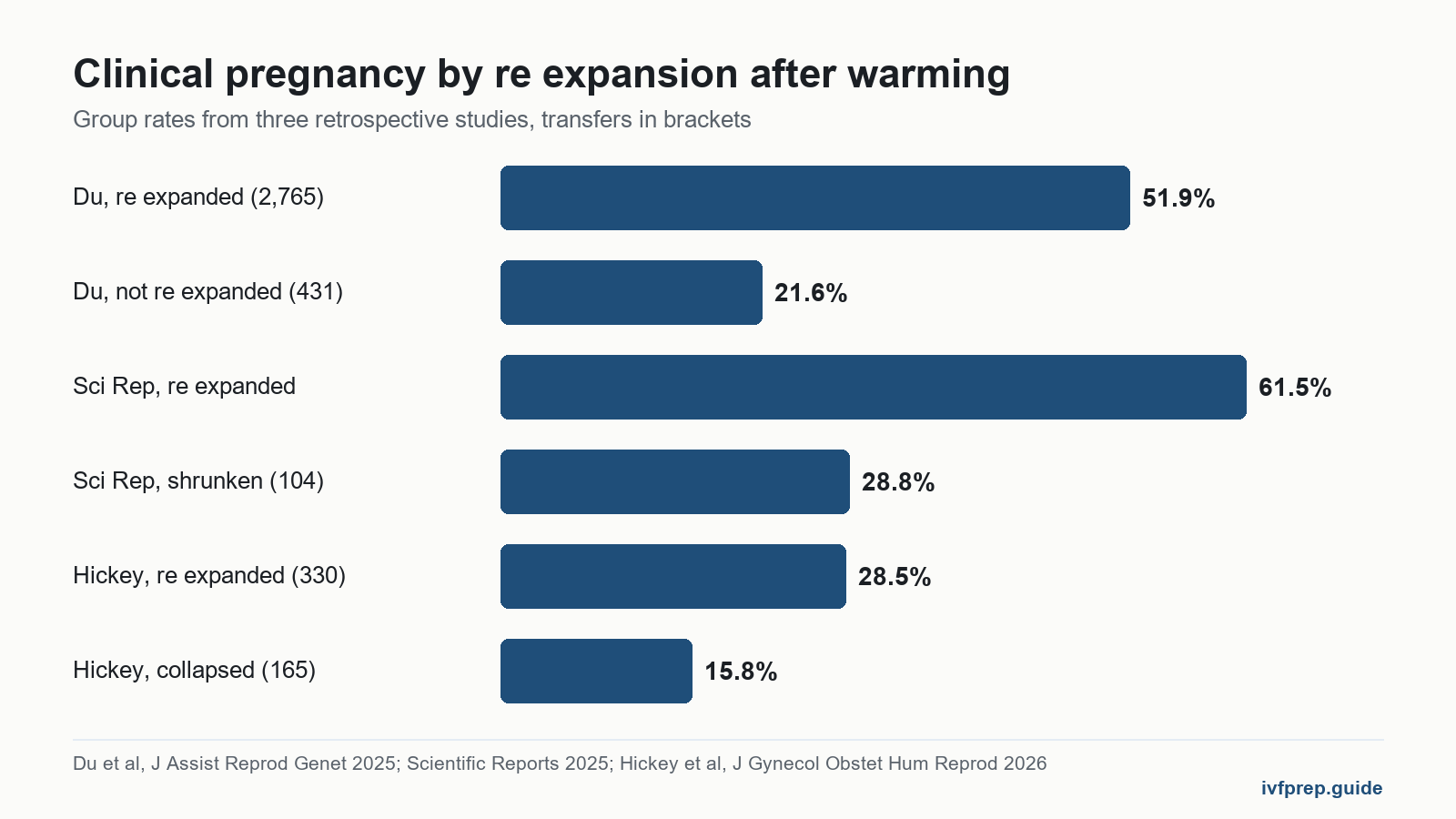
This is the gap the clinic blogs leave: they say re expansion is a good sign and stop there. Here are the numbers, side by side, from four studies that compared warmed blastocysts that re expanded with those that did not. All four are retrospective, which means they looked back at records rather than running a trial, and each comes from one centre or one network.
| Study | Transfers compared | When checked | Re expanded | Not re expanded |
|---|---|---|---|---|
| Du and colleagues, J Assist Reprod Genet, 2025 | 3,196 single transfers: 2,765 re expanded, 431 not | After 3 to 4 hours | Clinical pregnancy 51.9%, live birth 41.6% | Clinical pregnancy 21.6%, live birth 16.9% |
| Scientific Reports, 2025 | 104 completely shrunken against matched re expanded transfers from 2,172 | After 2 to 4 hours | Clinical pregnancy 61.5%, live birth 50.0% | Clinical pregnancy 28.8%, live birth 20.2% |
| Hickey and colleagues, J Gynecol Obstet Hum Reprod, 2026 | 495 age matched transfers: 330 re expanded, 165 collapsed (2005 to 2012) | At transfer | Clinical pregnancy 28.5% | Clinical pregnancy 15.8% |
| Fertility and Sterility, 2026 | 846 warmed blastocysts, filmed by time lapse | Through the post warming culture | Live birth 46.9% | Live birth 18.2% |
The direction is the same in every row: as a group, re expanded blastocysts were followed by pregnancy more often. The size of the gap differs, and the older Hickey cohort sits far below the newer ones in both columns, a reminder of how much freezing methods have changed and how badly a rate from one clinic travels to another.
The other column matters just as much. In the Du study, 16.9% of transfers of blastocysts that had not re expanded led to a live birth, and the authors found no difference in miscarriage, birth weight or birth defects between the groups. They concluded such embryos may be transferred rather than discarded. The Scientific Reports authors wrote that blastocysts that did not re expand within 2 to 4 hours should not be considered non viable. Both statements are about groups. Neither is a forecast for anyone.
Is an embryo that hatched after thaw better or worse?
Not in any simple way, and this is where forum certainty runs ahead of the data. In the 2025 hatching study of 906 frozen transfers, clinical pregnancy rates were 54.3% for unhatched, 63.3% for early hatching, 74.6% for late hatching and 54.1% for fully hatched blastocysts. Late hatching did best, and the authors linked it with higher rates after adjusting for other factors. Fully hatched sat level with unhatched, though that group held only 37 transfers, too few to say much.
A separate 2025 study in the European Journal of Obstetrics, Gynecology and Reproductive Biology compared fully hatched with not fully hatched blastocysts and found live birth rates of 56.5% and 56.4% in tested cycles, with no meaningful difference in untested ones either. So the comparison table for hatching is short:
| Hatching state | Clinical pregnancy, 906 transfers (2025) | Live birth, same study |
|---|---|---|
| Unhatched (116) | 54.3% | 39.7% |
| Early hatching (556) | 63.3% | 51.6% |
| Late hatching (197) | 74.6% | 58.3% |
| Fully hatched (37) | 54.1% | 40.5% |
Two details explain why hatching appears on so many thaw reports. Many labs open a small hole in the shell on day 4 or 5 so cells can be sampled for genetic testing, a routine step described in a 2026 study in Diagnostics, so tested embryos often start hatching early. And some clinics offer laser opening as an add on before transfer, which the HFEA rates grey, meaning there is not enough good evidence to say whether it helps most patients have a baby; our page on assisted zona hatching and what the guidelines say covers that in full.
What do people report being told on thaw day?
We read about 20 posts and comments across four r/IVF threads and one comment search, dated September 2023 to April 2026, and left out every outcome people described, because a stranger’s result says nothing about anyone else’s. What they report is how the words arrived.
- April 2026: a poster on r/IVF described two thawed embryos that had not re expanded after four hours and were transferred with an expansion grade of 1. Their clinic quoted a thaw survival rate of about 95%. Another commenter in the thread said they had not known re expansion was something an embryo needed to do until it did not.
- Same thread: one commenter said their clinic told them nothing about how the embryo looked before transfer, while others were given a fresh grade. Clinics clearly differ on what they share.
- November 2025: a poster on r/IVF said that when their embryo was not expanding well after thawing, the doctor offered to warm a second one and transfer both, and the poster read the doctor’s caution as a judgement on the first embryo.
- September 2024: a commenter on r/IVF said their embryologist described a frozen 5AA going from hatching to almost fully hatched after thaw as normal continued development.
- June 2025: another commenter on r/IVF said their embryo fully hatched after thawing, yet the clinic kept calling it a 5AA, the grade it had at freezing.
An embryologist commenting on r/IVF in September 2023 added that grading is highly subjective and varies by clinic. That matches the studies: the same embryo can be described differently in two labs, and the vocabulary itself is not standard. These are accounts, not evidence. Where they agree with the papers is that thaw day is mostly a story about shape and timing; where they part company is that a forum thread usually ends with someone’s result, and a paper ends with a rate for a crowd.

What can these numbers not tell you about one embryo?
This section is written straight.
Every number above is a rate across hundreds or thousands of transfers, at particular clinics, with their own freezing methods, patient ages and embryo grades mixed in. None of them can be turned into a chance for one embryo, and none was designed to. A retrospective study shows two things went together, not that one caused the other. And in every study here, embryos that had not re expanded still led to pregnancies.
Decisions about which embryo to warm, how long to culture it and whether to transfer are the clinic’s, made with information this page does not have. If the thaw report used a word you did not follow, the embryologist is the right person to ask, and the checklist below lists plain questions that do not ask anyone to predict anything. For what the wait itself looks like after a frozen transfer, our page on the frozen embryo transfer timeline day by day sets out the dates, and our page on what euploid means on a test report covers the other label that often sits on the same report.
If you have pain, heavy bleeding or anything that worries you after a transfer, ring your clinic or its out of hours number. The answer to whether a transfer has worked comes from the blood test the clinic has booked, and from nothing on this page.
Plain questions for the embryologist about a thaw report
Tick each one once it has been answered. These ask what words mean and how the lab works; none asks anyone to predict how a transfer will go, and decisions stay with you and your clinic.
General information only. The clinic knows your protocol and your embryos; this page does not.
Frequently asked questions
Is it normal for a frozen embryo to look shrunken when it is first warmed?
Yes. Many labs deliberately collapse blastocysts before freezing to protect them from ice crystals, so a shrunken look straight after warming is the usual starting point.
How long do labs wait to see re expansion?
The studies here checked after about 2 to 4 hours of culture. Clinics set their own timing, and many warm the embryo a few hours before the transfer appointment.
Why did my embryo’s grade number go down after thawing?
The expansion number describes the size of the cavity at that moment. A collapsed embryo is scored as smaller even though it is the same embryo that was frozen.
Is a hatched embryo harder to freeze?
A 2024 study of 6,130 biopsied blastocysts found fully hatched ones survived biopsy and freezing less often, 78.6% against 93.5%. That is about survival in the lab, not about pregnancy.
Does the HFEA recommend assisted hatching before a frozen transfer?
No. The HFEA rates it grey: there is not enough good evidence to say whether it helps most patients have a baby. Whether it is used is a decision for the clinic and the patient.
Can I ask the clinic for a photo of the embryo after thawing?
Many clinics share an image or a time lapse clip if asked, and some do not. Policies differ, so it is reasonable to ask what your clinic offers.
Finished the page? The same five questions from the top, to see what stuck.
This article is general information, not medical advice, and is not a substitute for care from a qualified healthcare professional. Speak to your doctor about your own situation.
Leave a Reply