
What happens to an embryo from day 3 to day 7?
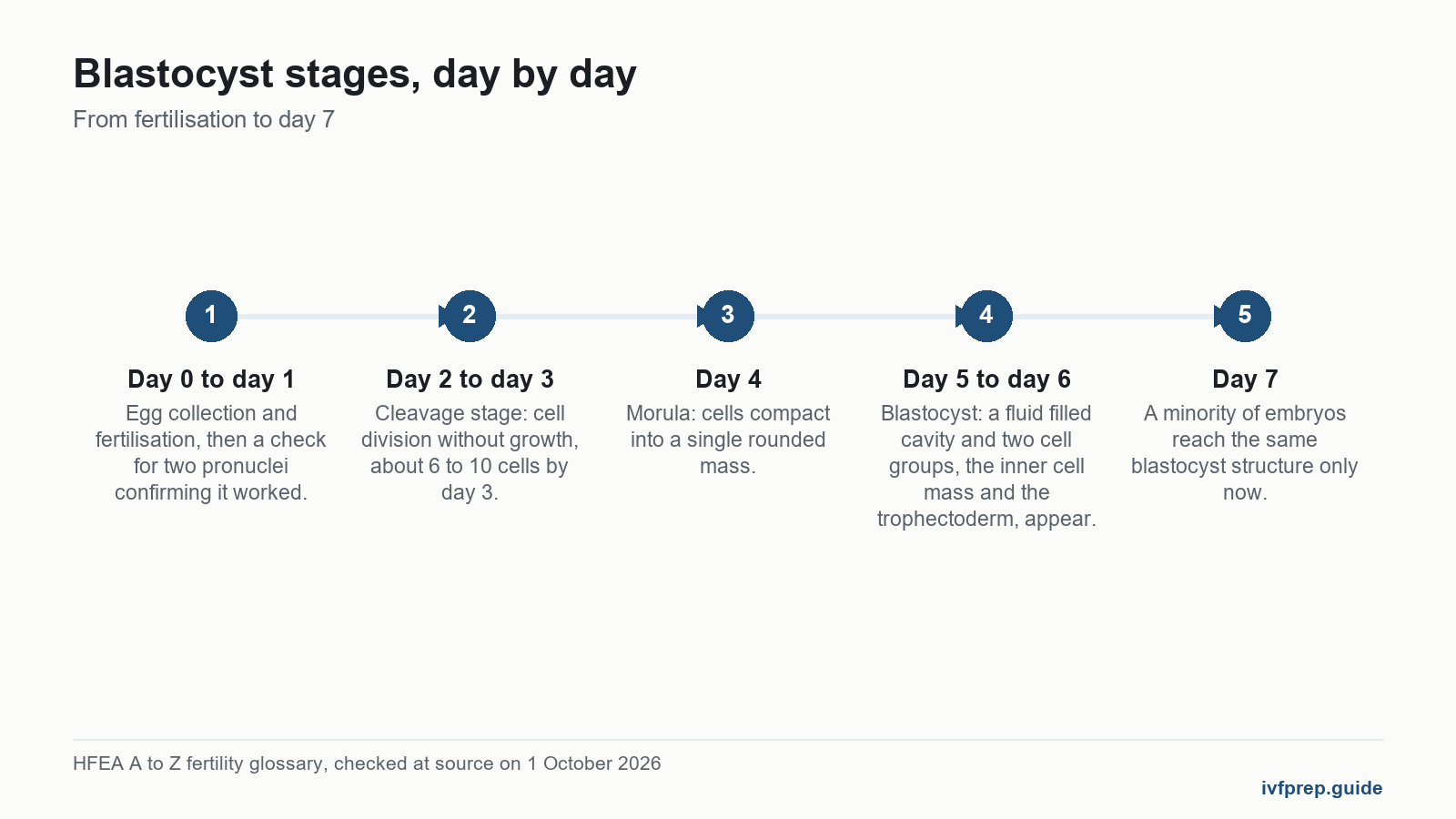
Day 0 is egg collection and fertilisation in the lab. By day 1 the embryologist checks for two pronuclei, one from the egg and one from the sperm, which confirms fertilisation happened normally; this is usually the first call a clinic makes about how things are going. Day 2 and day 3 are the cleavage stage: the embryo divides into more cells without growing in overall size, typically reported as 2 to 4 cells by day 2 and 6 to 10 cells by day 3. Some clinics transfer at that point, and the trials comparing it with waiting are set out in what blastocyst treatment changes per transfer and per cycle.
Listen to this article, about 7 minutes. A synthetic voice reads the article and announces each section title as it begins; tables are read row by row and the questions at the end are left out.
Recorded 1 October 2026 from the article as published that day. Press a chapter to jump there; the highlighted line is what is playing. A play button sits beside every section heading, and once you scroll past this player a bar at the bottom of the screen keeps the controls in reach. Tap or click any sentence to hear the reading start from there.
On this page: the published day 5, day 6 and day 7 live birth numbers from a cohort of chromosomally tested embryos, set beside what those averages cannot tell you about one specific blastocyst.
Think you already know this? Five questions, one minute.
Every answer is on this page. Answer from what you know now; the page fills in the rest.
-
1. By the blastocyst stage, what two distinct cell groups become visible inside the embryo?
The inner cell mass goes on to form the fetus and the trophectoderm goes on to form the placenta, a split the HFEA’s own glossary describes as happening once an embryo has developed for five to six days. Read the section
-
2. What does the day in a day 5 or day 6 blastocyst actually describe?
The day only records timing in culture; grading is a separate scale an embryologist applies once a blastocyst forms, on whichever day that happens. See our guide to blastocyst grading. Read the section
-
3. A 2021 study that looked only at chromosomally normal (euploid) embryos found that slower ones still had:
Lane and colleagues, Reproductive BioMedicine Online, 202100427-2/fulltext) found that day alone still mattered even once chromosomes were accounted for, so slower development is not fully explained by aneuploidy. Read the section
-
4. In the Lane and colleagues cohort of single euploid frozen transfers, what was the live birth rate for day 7 blastocysts?
68.5 per cent for day 5, 55.2 per cent for day 6 and 36.0 per cent for day 7, all single euploid frozen transfers, from Lane and colleagues, Reproductive BioMedicine Online, 202100427-2/fulltext). Read the section
-
5. What do the published cohort averages in this article actually describe?
Group averages describe a cohort, not one embryo; a 2023 Human Reproduction commentary on the clinical value of day 7 blastocysts argued slow embryos still carry real value, especially with few options. Read the section

Day 4 is the morula: the cells compact and start to fuse into a single rounded mass, named for its resemblance to a mulberry, with the individual cell boundaries becoming harder to see under the microscope. Somewhere on day 5 or day 6, a fluid filled cavity opens up inside that mass and two distinct cell groups become visible: an inner cell mass that goes on to form the fetus, and an outer layer, the trophectoderm, that goes on to form the placenta. The HFEA’s own glossary defines a blastocyst simply as “an embryo that has developed for five to six days after fertilisation.”
A minority of embryos are not there yet by day 6 and are still dividing. Some of those reach the same blastocyst structure, the cavity and the two cell layers, on day 7 instead.
What is actually different about a day 5, day 6, or day 7 blastocyst?
The day itself only records how long the embryo took to reach the blastocyst structure in culture. It is not a grade. Once an embryo becomes a blastocyst, on whichever day that happens, an embryologist scores it separately: how far the cavity has expanded, and the appearance of the inner cell mass and the trophectoderm, each given their own letter. A day 6 blastocyst can carry the same letter grades as a day 5 one; the timing and the grading are two different measurements taken at two different moments. Our guide to what a good quality blastocyst grade means covers that separate scale in full.
The reason clinics talk about these specific days is practical: those are the days an embryologist is checking the dish and deciding what to do next, which is also why the HFEA describes staff calling patients with day 1 fertilisation results and then day 5, day 6 and day 7 development updates. Many labs set day 6 as the point they stop assessing embryos that have not yet reached blastocyst, so an embryo that is still short of it by then is often not frozen or biopsied; other labs routinely extend culture to day 7 before making that call. Practice varies between clinics, so it is worth asking your own lab which rule it follows rather than assuming either one. If your blastocyst was frozen rather than transferred fresh, our frozen embryo transfer timeline covers what happens from thaw to the day of transfer itself.
What is happening on each day?
Pick a day to see what is physically happening in the lab. This does not interpret or predict anything about your own embryo.
Restates what is physically happening in the lab on each day. It does not interpret or predict anything about your own embryo; your clinic’s own update is the one that matters.
Why do some embryos take longer to reach blastocyst?
The honest answer is that nobody has a complete explanation. A widely cited 2018 commentary in Human Reproduction by the embryologist Elizabeth Hammond notes that time lapse monitoring is starting to reveal patterns in which embryos slow down, without yet explaining the biology behind them.
Slower development does correlate with two things: a mother’s age, and the chance that an embryo is chromosomally abnormal, called aneuploid, the result a PGT-A test reports as described in our guide to what a euploid embryo result means. But that correlation does not mean day alone is just a proxy for chromosomes. A 2021 study in Reproductive BioMedicine Online by Lane and colleagues at the Colorado Center for Reproductive Medicine looked only at embryos already confirmed chromosomally normal by testing, and still found that the ones which took longer to reach blastocyst had lower average success rates. Whatever is slowing an embryo down, it is not fully explained by whether its chromosome count is normal.
Do day 6 and day 7 blastocysts result in fewer live births, on average?
Across large cohorts, yes, on average, though the gap is a slope rather than a cliff. A 2023 matched cohort study in Current Medical Science by Yu and colleagues, following 2,207 matched pairs of frozen blastocyst transfers, found that within the same embryo quality grade, the clinical pregnancy rate was 61.30% for day 5 transfers against 57.56% for day 6, and the live birth rate was 44.79% against 36.16%.

The Lane and colleagues study introduced above looked at a third group. All of the embryos in it had already tested chromosomally normal, so the comparison is about day alone, not quality or chromosomes.
| Blastocyst day | Transfers in cohort | Live birth rate |
|---|---|---|
| Day 5 | 1,880 | 68.5% |
| Day 6 | 986 | 55.2% |
| Day 7 | 100 | 36.0% |
Two things are worth holding onto from that table. The fall by day is real and worth knowing about. And even the slowest group, day 7, still resulted in a live birth more than a third of the time in that cohort, which is a long way from zero.
Does a slower blastocyst mean a worse embryo?
Not necessarily, and this is the point the averages above cannot answer for any one embryo. A study average describes a group of embryos; it was never built to describe the one your clinic is looking at. Some of the embryos in the day 7 group in the Lane study were chromosomally normal, well graded, and went on to a live birth, the same as some of the day 5 group did not.
A 2023 commentary in Human Reproduction, “Better late than never: the clinical value of Day 7 blastocysts” by Fraire-Zamora and colleagues, reviewed outcomes across 1,966 blastocysts from 681 patients cultured out to day 7 and argued that these embryos carry real clinical value, particularly for patients who do not have many embryos to choose from. The point is not that day 7 is as good as day 5 on average; the cohort numbers above say plainly that it is not. The point is that a slow embryo is not automatically a discard, and clinics that extend culture to day 7 are making a defensible choice, not a long shot.
This site does not predict what your own blastocyst’s day means for your own cycle, and no article can. Your clinic has your embryo’s grade, its genetic test result if you had one done, and its own data on embryos like it; that combination tells you far more than the day on its own ever could.
Frequently asked questions
Is a day 6 blastocyst automatically a lower grade than a day 5 one?
No. The day it forms and its letter grade are two separate measurements. A day 6 blastocyst can carry the same expansion, inner cell mass and trophectoderm grades as a day 5 one; a slower embryo is not graded down for arriving later.
What is the difference between a morula and a blastocyst?
A morula is the compacted, mulberry shaped ball of cells on day 4, before the embryo has organised into separate layers. A blastocyst, usually day 5 or 6, has a fluid filled cavity and two distinct cell groups: the inner cell mass and the trophectoderm.
Do all IVF clinics culture embryos to day 7?
No. Practice varies: some labs stop assessing embryos that have not reached blastocyst by day 6, while others routinely extend culture to day 7 before deciding what to do next. Ask your own clinic which rule it follows.
Is a day 6 frozen embryo transfer scheduled differently from a day 5 one?
The thaw and transfer schedule is set by your clinic’s own protocol rather than by this article. Our frozen embryo transfer timeline covers what happens around transfer day itself, once a blastocyst has already been frozen.
Can a slow day 3 embryo still become a good blastocyst?
Yes. Cell count on day 3 does not fix what happens by day 5. Some embryos that look behind on day 3 catch up by the blastocyst stage, and some that look ahead slow down; day 3 alone is not the full picture.
Does which day a blastocyst formed affect miscarriage risk?
Published cohorts have studied implantation and live birth by day far more thoroughly than miscarriage specifically, and where miscarriage is reported, findings vary between studies. There is no single settled figure to quote here.
Finished the page? The same five questions from the top, to see what stuck.
This article is general information, not medical advice, and is not a substitute for care from a qualified healthcare professional. Speak to your doctor about your own situation.
Leave a Reply