
Blastocyst treatment means growing embryos to day 5 or 6 before transfer. The 2026 Cochrane review finds it probably raises the live birth rate from a fresh transfer, but the gain across a whole cycle, frozen embryos included, is small and uncertain, and fewer embryos are left to freeze. Which day suits your embryos is your clinic’s call.
Listen to this article, about 12 minutes. A synthetic voice reads the article and announces each section title as it begins; tables are read row by row and the questions at the end are left out.
Recorded 13 October 2026 from the article as published that day. Press a chapter to jump there; the highlighted line is what is playing. A play button sits beside every section heading, and once you scroll past this player a bar at the bottom of the screen keeps the controls in reach. Tap or click any sentence to hear the reading start from there.
On this page: the 2026 Cochrane numbers with the certainty grade on each, three clinic pages checked against them on 13 October 2026, the Dutch trial where fresh rates differed by 7.5 points and cycle rates by 0.5, and what three r/IVF threads report about the day 3 or day 5 decision.
Think you already know this? Five questions, one minute.
Every answer is on this page. Answer from what you know now; the page fills in the rest.
-
1. What does blastocyst treatment change?
Extended culture keeps embryos in the incubator until the blastocyst stage on day 5 or 6 so the lab can see which keep developing. The HFEA 2014 trends report found 78.4 percent of elective single embryo transfers that year were blastocysts. Read the section
-
2. How certain is the 2026 Cochrane review that blastocyst transfer raises live birth across a whole cycle?
The 2026 Cochrane update gives an odds ratio of 1.24 from three studies at low certainty; the per fresh transfer gain, odds ratio 1.39, is rated moderate certainty. Read the section
-
3. Which outcome did none of the three clinic pages mention?
All three framed the benefit per transfer; none mentioned cumulative live birth, the outcome the Cochrane plain language summary leads with when it says the chance after one IVF cycle may slightly improve. Read the section
-
4. In the 2022 Cochrane review, how did the chance of having no embryo to transfer change with blastocyst culture?
The 2022 version of the review found failure to transfer any embryo rose from about 1 percent to between 2 and 4 percent, at moderate certainty, and fewer cycles had embryos to freeze. Read the section
-
5. What was the most upvoted reply in the March 2026 r/IVF thread on day 3 or day 5?
In the March 2026 thread the top reply said the choice depends on the embryos, the grades and the lining; this is what people reported, not a finding. Read the section
Clinic pages tend to describe day 5 the way estate agents describe a box room: compact, full of potential, a real selling point. Some of that is true. What they rarely mention is what happens over a whole cycle rather than one transfer, and that is the whole story.
What is blastocyst treatment, and what does day 5 culture actually do?
After egg collection and fertilisation, embryos can be transferred early, at the cleavage stage on day 2 or 3, or kept in the lab for two or three more days until they become blastocysts on day 5 or 6. Blastocyst treatment is the second route, usually called extended culture. It is not a drug or a procedure on your body, just a decision about how long the embryos stay in an incubator.
The idea is selection. Some embryos stop developing between day 3 and day 5, and that would happen whether they were in the lab or in the uterus. Waiting lets the embryologist see which ones keep going, so the clinic can transfer one embryo with more confidence. The catch is just as simple: an embryo that stops in the lab is never transferred, and nobody can know for certain whether it would have done better inside the body.
Day 5 has been the UK default for some time. The HFEA report Fertility treatment 2014: trends and figures found that 78.4 percent of elective single embryo transfers in 2014 were of blastocyst stage embryos. If you want the grading side of the story, our guide to the blastocyst stages, day by day covers what happens in the dish between day 3 and day 6.
What does the latest Cochrane review actually find?
The best summary of the trials is the Cochrane review by Glujovsky and colleagues. Its plain language summary, published on 23 January 2026, says the evidence comes from 36 studies involving 8,389 women, with searches run up to October 2024. The headline in its key messages is careful: the chance of a live birth after one IVF cycle may slightly improve. That word, may, is doing honest work.
Here is what the 2026 update of the review reports for the outcomes that matter most, with the certainty the authors gave each one. Certainty is how sure they are that further research will not change the answer.
| Outcome | What the review found | Certainty |
|---|---|---|
| Live birth per fresh transfer | Probably higher with blastocysts: odds ratio 1.39 (95 percent CI 1.23 to 1.56), 19 studies, 4,787 women | Moderate |
| Cumulative live birth within 12 months of egg collection, fresh and frozen transfers together | May be slightly higher: odds ratio 1.24 (1.04 to 1.47), 3 studies, 2,328 women. If 62 percent have a baby with cleavage stage transfer, 63 to 70 percent would with blastocysts | Low |
| Cumulative live birth in the one large trial with two or more transfers per woman | Little or no difference: odds ratio 1.02 (0.81 to 1.28), 1,202 women | Low |
| Preterm birth across the cycle | Probably increased with blastocyst transfer, mainly births at 32 to 36 weeks | Moderate |
Read the middle rows twice. The per transfer gain is the solid result. The per cycle gain rests on three studies at low certainty, and most of their disagreement traces to one large trial where the difference all but vanished.
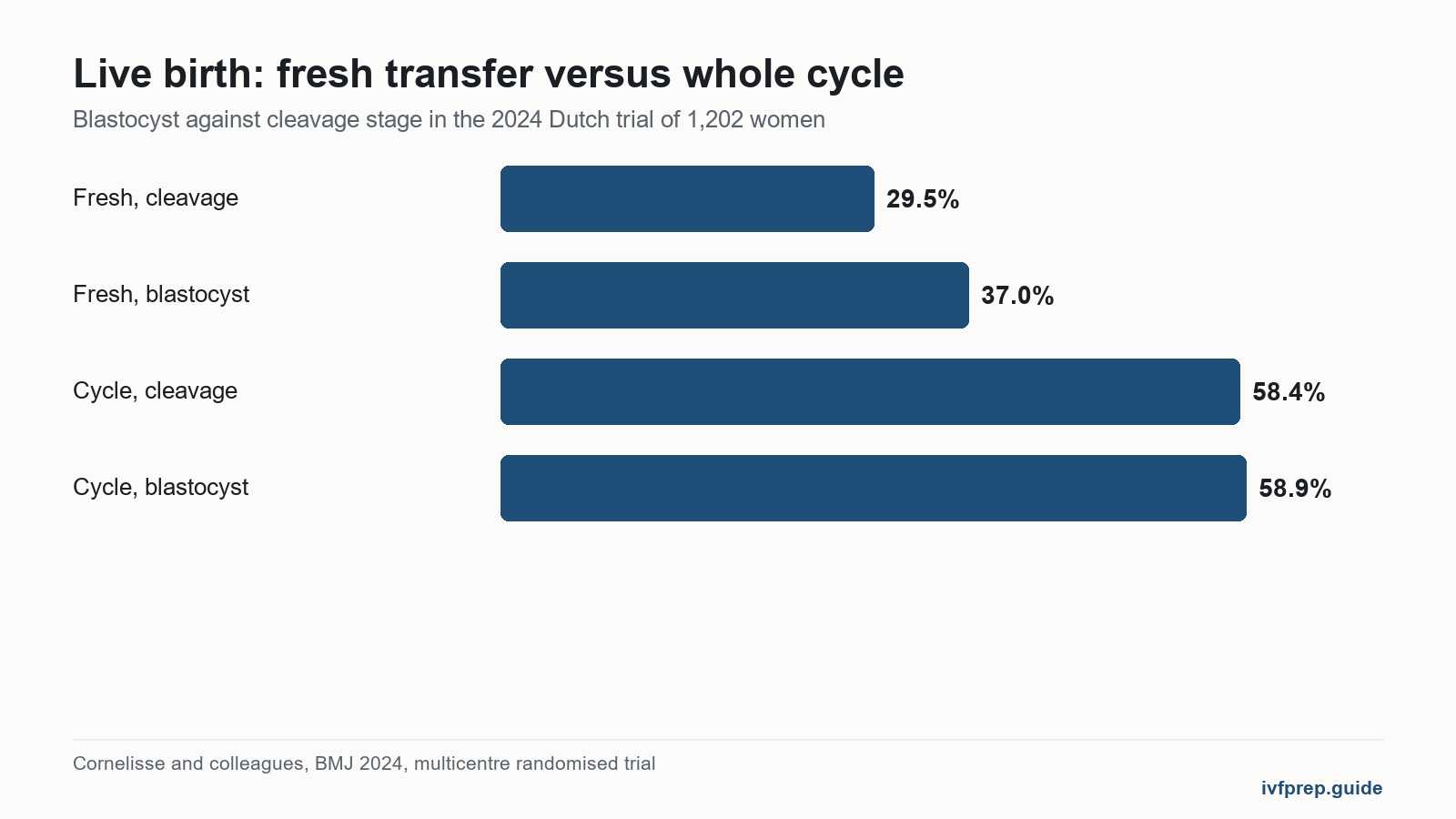
That trial is the Dutch multicentre trial by Cornelisse and colleagues in the BMJ in 2024. It randomised 1,202 women who had at least four embryos on day 2. The fresh transfer live birth rate was 37.0 percent with blastocysts against 29.5 percent at the cleavage stage. Counting every frozen transfer that followed, the cumulative live birth rate was 58.9 percent against 58.4 percent. Blastocyst transfer got people there in fewer transfers, 1.55 on average against 1.82, and it did not change how many got there.
What do clinic pages claim, and how does that compare with the evidence?
On 13 October 2026 we read three clinic pages that rank for this subject, two in London and one in Massachusetts, and set each claim beside what the trials show. None of the three mentions cumulative live birth, which is the outcome the Cochrane review lists first.
| Clinic page, read 13 October 2026 | What it claims | What the evidence says |
|---|---|---|
| Eugin, London | Blastocyst transfer increases pregnancy rates; one section says it eliminates any possibility of twins, a later one says it virtually eliminates it; cites a study of more than 500 of its own patients with no journal named | Per fresh transfer, probably true. Twins depend on how many embryos are transferred, not the day: the 2022 Cochrane version found no clear difference in multiple pregnancy |
| Fertility Centers of New England, August 2023 | Studies have shown blastocyst transfer increases the chance of pregnancy; offers significant advantages over day 3; names no study and no downside | The 2026 review supports a per transfer gain at moderate certainty and only a slight, low certainty gain per cycle |
| Concept Fertility, London | Says research consistently shows higher implantation and pregnancy rates per transfer; says only about 50 to 70 percent of embryos reach day 5; does not charge for it | The fairest of the three: it states the per transfer framing and the attrition. It does not mention the cycle level result |
None of these pages is lying, exactly. They are all answering a narrower question than the one most people are asking. Per transfer is the number that looks best on a brochure. Per cycle is the number that decides how many babies a set of embryos produces. On the Eugin twin claim, the HFEA report on fertility treatment in 2024 puts the UK multiple birth rate at 3.2 percent, and credits that fall to 84 percent of transfers using a single embryo. It is single embryo transfer that keeps twins rare, at any stage.
What does extended culture cost in embryos?
This is the part the brochures skip. Waiting to day 5 means some embryos are lost in the lab, fewer are left to freeze, and occasionally there is nothing to transfer at all. The 2022 version of the Cochrane review put numbers on both. Embryos were frozen in about 60 percent of cleavage stage cycles against 37 to 46 percent of blastocyst cycles. Failure to have any embryo to transfer rose from about 1 percent to between 2 and 4 percent. In the Dutch trial, women in the blastocyst group ended up with 3.21 frozen embryos on average against 4.39.

| What changes with day 5 culture | Direction | Source |
|---|---|---|
| Live birth from the fresh transfer | Probably up | Cochrane 2026, moderate certainty |
| Live birth across the whole cycle | Slightly up or unchanged | Cochrane 2026, low certainty |
| Embryos left to freeze | Down | Cochrane 2022, low certainty |
| No embryo available for transfer | Up, from about 1 percent to 2 to 4 percent | Cochrane 2022, moderate certainty |
| Transfers needed before a live birth | Fewer, 1.55 against 1.82 | Cornelisse, BMJ 2024 |
| Preterm birth | Probably up | Cochrane 2026, moderate certainty |
For people with plenty of embryos the trade is mostly about time: fewer transfers, the same destination. For people with few embryos the trade is different, and that is where clinics weigh the risk of an empty day 5. How many embryos you have and how they are developing is information your embryologist has and this page does not.
What do people who faced the day 3 or day 5 decision report?
Forums are evidence of what people believe and live through, not of what works. With that said, we read three r/IVF threads from 2026, about 51 comments in all, to see how this decision actually feels from the inside. Every account here is paraphrased and is what someone reported, not a finding.
In a March 2026 thread asking whether day 3 or day 5 is better, the most upvoted reply said to let the doctor and embryologist choose based on the numbers, the grades and the lining. Several people with few eggs described switching to a day 3 transfer after earlier cycles left little or nothing to transfer at day 5, one putting it as something being better than nothing at all. Another commenter argued for day 5 because reaching it is a milestone, and embryos often stop after day 3.
An April 2026 thread came from someone whose new clinic freezes some embryos on day 3 and grows the rest to day 5. The replies split the same way: some people reported day 3 transfers after failed blastocyst transfers, others had no success with either. One commenter relayed a doctor’s view that the lab is a less friendly place to grow than the body. That is a belief, often repeated, which the trials have not settled either way.
The hardest thread was from June 2026: a first cycle in which 15 eggs fertilised and none reached day 5. In 29 comments at least five people described the same thing, embryos that looked fine on day 3 and stopped by day 5, and several said friends assumed a failed transfer when in fact there had been nothing to transfer. Commenters offered theories about the cause. Those are questions for the clinic, not answers from a forum.
Where the accounts agree with the evidence: the day 5 decision depends on how many embryos there are, and an empty day 5 is a real and painful outcome that the Cochrane figures confirm, if rarely. Where they go further than the evidence: success stories in either direction are single cycles, and the trials show the whole cycle result barely moves.

What can you ask your clinic about extended culture?
The trials give averages. Your clinic has something better: its own lab’s numbers and your embryos. The checklist below holds the questions the clinic pages above do not answer: the lab’s own blastocyst rate, what happens to embryos still growing on day 5, the plan if none get there, and how many are usually frozen. None of them is a request to change your plan. They are a way of understanding it.
If you are past the transfer and reading this in the wait, the day is already decided and nothing in your body will tell you whether it was the right one. Our guide on what a good quality day 5 embryo grade means explains the letters on your report, and what a euploid embryo result does and does not tell you covers testing. For the frozen route, see medicated versus natural frozen embryo transfer.
Any bleeding, pain or worry after a transfer is a call to your clinic, at any hour they offer. Your clinic knows your protocol, your embryos and your history. This page knows the trials, and that is all it knows.
Questions to take to the clinic about extended culture
Tick each one once the clinic has answered it. This list asks questions; it does not recommend a day, and the right day for your embryos is a decision for you and your clinic.
Saved on this device only. It records which questions were answered and nothing else; it does not score, predict or advise.
Frequently asked questions
Is blastocyst transfer the same as a frozen embryo transfer?
No. Blastocyst describes the stage of the embryo, day 5 or 6. Fresh or frozen describes when it is transferred. A blastocyst can be transferred fresh in the same cycle or frozen and transferred later, and many frozen transfers in the UK are of blastocysts.
Does blastocyst culture cost extra?
It depends on the clinic. Some include extended culture in the cycle price and some charge for it or for time lapse imaging alongside it. Concept Fertility in London, for example, says on its page that it does not charge separately. Ask for the itemised price.
What percentage of embryos reach blastocyst?
Clinics commonly quote about half to two thirds of fertilised embryos, and Concept Fertility gives 50 to 70 percent. The figure varies widely with age, the lab and the individual cycle, and some cycles produce none, so a lab’s own recent figure is more useful than any average.
Does blastocyst transfer reduce the chance of twins?
Not by itself. Twins mostly depend on how many embryos are transferred. The 2022 Cochrane review found no clear difference in multiple pregnancy between the two stages. What makes single embryo transfer workable is the confidence that selection gives, and in the UK 84 percent of transfers in 2024 used a single embryo.
Is a day 6 blastocyst worse than a day 5?
Day 6 blastocysts are a normal part of extended culture and many clinics freeze and transfer them. Reported rates differ between studies and between clinics, and the day is only one piece of information alongside the grade. Your embryologist can explain how your clinic uses day 6 embryos.
Did the 2026 Cochrane review change its conclusion from 2022?
It firmed up one part. The 2022 version rated the fresh transfer gain as low quality evidence; the 2026 update, with 36 studies, rates it moderate certainty. It also added cumulative live birth as an outcome, finding a slight gain at low certainty, and dropped cumulative pregnancy.
Finished the page? The same five questions from the top, to see what stuck.
This article is general information, not medical advice, and is not a substitute for care from a qualified healthcare professional. Speak to your doctor about your own situation.
Leave a Reply