
In mosaic embryo IVF, the label means the few cells a lab tested held a mix of typical and atypical chromosome counts. It is a sample result, not a verdict on the whole embryo. Published studies disagree on how mosaic transfers compare with euploid ones, and the professional bodies disagree on how to rank them.
Listen to this article, about 10 minutes. A synthetic voice reads the article and announces each section title as it begins; tables are read row by row and the questions at the end are left out.
Recorded 5 October 2026 from the article as published that day. Press a chapter to jump there; the highlighted line is what is playing. A play button sits beside every section heading, and once you scroll past this player a bar at the bottom of the screen keeps the controls in reach. Tap or click any sentence to hear the reading start from there.
On this page: the blinded multicentre trial of 1,190 couples set beside the less even studies, and a side by side table of what PGDIS, ASRM and ESHRE each say about ranking mosaic embryos, in their own words.
Think you already know this? Five questions, one minute.
Every answer is on this page. Answer from what you know now; the page fills in the rest.
-
1. According to the 2023 ASRM committee opinion, what share of embryos are reported as mosaic?
The ASRM committee opinion gives a range of 2 to more than 20 per cent and links the spread to laboratory factors. Read the section
-
2. In the PGDIS statement’s usual cut offs, what share of abnormal signal in the sample is read as euploid?
The 2021 PGDIS position statement describes under 20 per cent as euploid and over 80 per cent as aneuploid, calling those values noise bands that vary by platform. Read the section
-
3. In the blinded Capalbo 2021 trial, how did live birth rates for low and medium grade mosaic embryos compare with euploid ones?
Capalbo and colleagues reported 43.4 per cent for euploid, 42.9 per cent for low grade and 42.0 per cent for medium grade mosaic transfers. Other studies, such as the 2020 study in Genes, found a wider gap. Read the section
-
4. Which body says there is currently no evidence based method to rank mosaic embryos for transfer?
The 2023 ASRM committee opinion says this, while the PGDIS statement offers a suggested ranking by level and type. Read the section
-
5. When is a mosaic result decided?
PGT-A is run on a biopsy before the embryo is frozen and transferred, as the HFEA describes, so nothing in the days after transfer adds information to it. Read the section
What does a mosaic embryo result actually mean?
A PGT-A report sorts each tested embryo into one of three boxes. Euploid means the sample showed the expected 46 chromosomes. Aneuploid means it showed extra or missing chromosome material. Mosaic sits between the two: some of the tested cells looked typical and some did not, usually reported with a percentage or a low or high range. Our guide to the euploid embryo result and what PGT-A can and cannot say covers the first two boxes; this page is about the third.
Mosaicism can also be whole chromosome, where an entire chromosome looks extra or missing in part of the sample, or segmental, where only a piece of one does. Reports usually say which, and both PGDIS and the studies below treat the two differently.
How often it turns up depends heavily on the lab. The 2023 ASRM committee opinion puts the share of embryos reported as mosaic at anywhere between 2 and more than 20 per cent, depending on laboratory factors. A number that wide says as much about testing methods as it does about embryos.
How does a biopsy end up labelling an embryo mosaic?
PGT-A takes five to ten cells from the trophectoderm, the outer layer of a day 5 or 6 blastocyst that goes on to form the placenta. Those cells are read as a single pooled sample, so the lab sees an average, not cell by cell answers. If the average sits clearly at normal it is called euploid; clearly abnormal, aneuploid; somewhere in the middle, mosaic.

The 2021 PGDIS position statement gives the usual cut offs: under 20 per cent abnormal reads as euploid, over 80 per cent as aneuploid, and the middle band is where a mosaic call is made. It also calls those cut offs “noise bands” and lists poor biopsy technique, sample handling and the software used to analyse the data as things that can exaggerate an apparent mosaic result. In other words, part of what gets labelled mosaic may be the test rather than the embryo, and nobody can yet say how much.
There is also a biological reason. The trophectoderm and the inner cell mass, which becomes the baby, can differ. In the trial below, when a biopsy showed low or medium mosaicism, chromosome errors in the inner cell mass were rare and no more common than after a biopsy read as euploid.
What have published studies of mosaic embryo transfers shown?
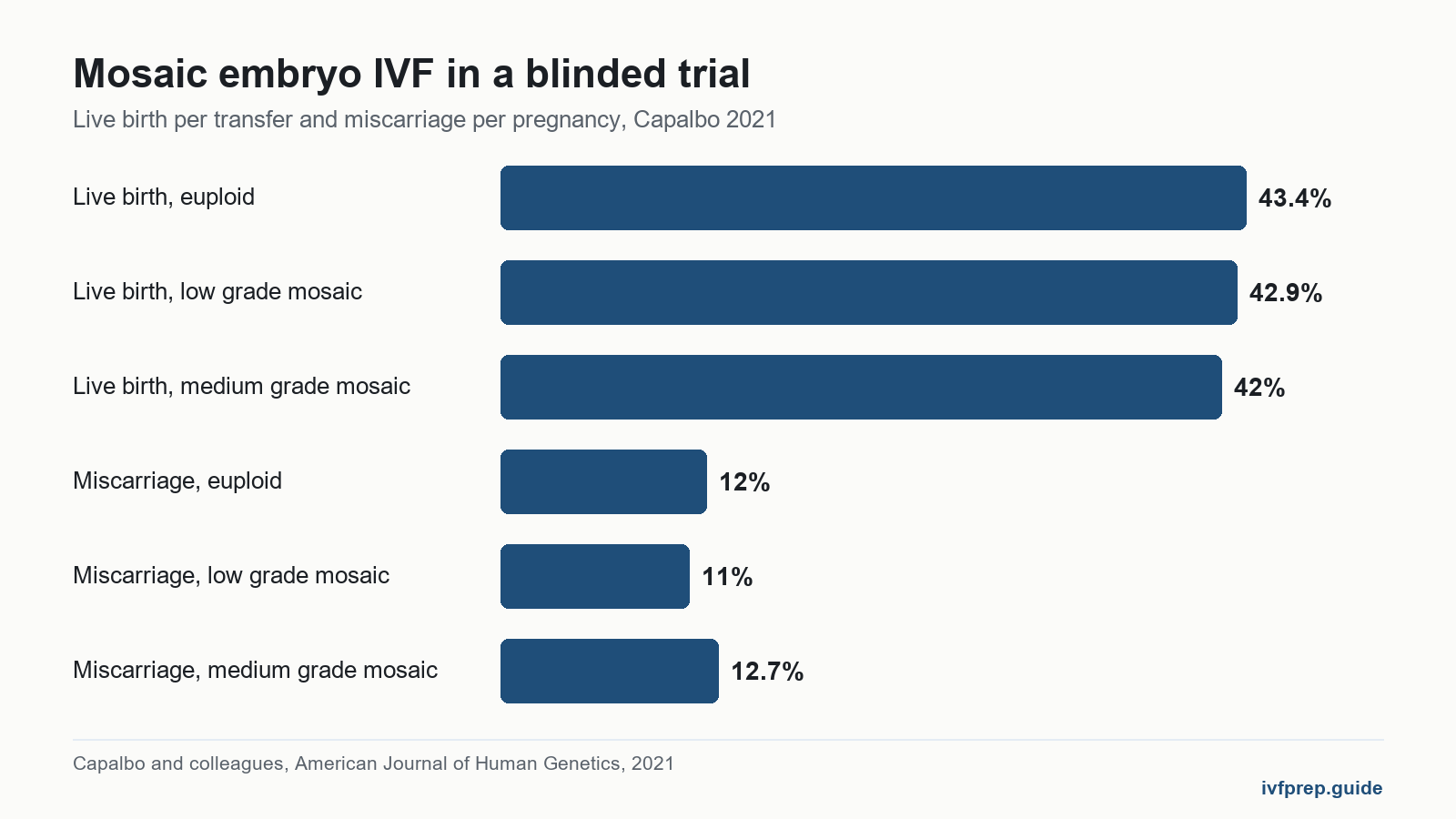
The study most often cited as the strongest evidence is Capalbo and colleagues, American Journal of Human Genetics, 2021. It was a prospective, double blinded trial run across clinics in Italy and several other countries between September 2018 and December 2019, enrolling 1,190 couples. Embryos with low grade (20 to 30 per cent) or medium grade (30 to 50 per cent) mosaic results were reported to clinics and patients as euploid, so they were chosen for single embryo transfer on how they looked, exactly like a euploid embryo. High grade mosaic embryos were not transferred.
Because nobody knew which embryos were mosaic, nobody could choose against them, which removes the bias that dogs every other study here. The result was that the three groups did almost exactly the same.
| Study and group | Transfers | Live birth | Miscarriage |
|---|---|---|---|
| Capalbo 2021, euploid | 484 | 43.4% (210) | 12.0% (29 of 241) |
| Capalbo 2021, low grade mosaic | 282 | 42.9% (121) | 11.0% (15 of 136) |
| Capalbo 2021, medium grade mosaic | 131 | 42.0% (55) | 12.7% (8 of 63) |
| Zhang 2020, euploid | 447 | 47.0% (210) | 20.5% |
| Zhang 2020, mosaic | 133 | 27.1% (36) | 33.3% |
Other studies tell a less even story. A 2020 multicentre study in Genes found live birth in 27.1 per cent of mosaic transfers against 47.0 per cent of euploid ones, with more miscarriage too. The largest registry, Viotti and colleagues in Fertility and Sterility, 2021, pooled around 1,000 mosaic embryos from several centres. Its figures are commonly quoted at 41.8 per cent implantation for mosaic against 57.2 per cent for euploid, and 25.0 against 8.6 per cent miscarriage; this page could not confirm those against the full text, though the ASRM opinion confirms the shape, describing more than twice the miscarriage rate. That registry also found that lower level and single chromosome mosaics did better than higher level and complex ones.
Why the gap? Capalbo excluded high grade mosaics and blinded everyone; the registry studies include higher levels and transfers that happened because a mosaic embryo was the last one left. Different labs also draw the mosaic line in different places. The honest summary is that the evidence is still moving, and a clinic’s own lab data matters more than any headline.
How do PGDIS, ASRM and ESHRE say clinics should rank mosaic embryos?
This is where the three bodies that write the guidance part company, and it is worth seeing their own words rather than a paraphrase that smooths it over.
| Body | On ranking mosaic embryos | On prenatal testing afterwards |
|---|---|---|
| PGDIS, 2021 | Euploid first, unless patient preference says otherwise. Among mosaics, lower level and segmental before higher level and whole chromosome, with morphology as a tiebreak. | Recommends prenatal diagnosis after any euploid or mosaic transfer. |
| ASRM, 2023 | “No evidence based method to predict the risk of an adverse outcome or rank mosaic embryos for transfer.” Prioritising euploid may be reasonable, depending on patient preference. | Genetic counselling strongly recommended for anyone pregnant after a mosaic transfer. |
| ESHRE, 2022 | Report results as putative mosaic, low or high range with 50 per cent as the cut off, and weigh them alongside morphology. “Not acceptable to discard low range mosaic embryos.” | A low range mosaic biopsy is not by itself a reason for invasive prenatal diagnosis. |
So PGDIS offers a ranking, ASRM says the evidence cannot yet support one, and ESHRE says low range mosaics should not be thrown away. The bodies also differ on what follows a pregnancy. None of them tells a patient what to do; all three put the decision in a conversation with the clinic and, ideally, a genetic counsellor.
Clinics differ in practice too. In the ESHRE survey, 52.9 per cent of responding centres had transferred mosaic embryos and would do so again, while 9.8 per cent would never consider it. And in the UK the HFEA rates PGT-A red for improving the chance of a baby for most patients, while noting there are reports of healthy live births after mosaic transfers. A clinic’s approach to mosaic results is a fair thing to ask about before testing, not only after.
Does a mosaic result change anything during the two week wait?
No. The mosaic call was made in a lab before transfer day, and nothing a body does or does not do in the days afterwards adds any information to it. A cramp does not mean the mosaic cells corrected themselves, and a quiet day does not mean they did not. This is the same point this site makes about every transfer: successful transfers with no symptoms at all are common, and they are the ones nobody posts about.

The same goes for searching. Accounts of mosaic transfers online lean heavily towards the surprise births and the hard losses, because those are the stories people write up. Neither pile is a fair sample, and the published numbers above, flat or gloomy, are group figures rather than anyone’s own outcome.
The grade an embryo was given under the microscope is a separate score again, and our guide to what a blastocyst grade means covers how it is read. For where the test result sits against the rest of a cycle, see the frozen embryo transfer timeline.
What can you ask your clinic about a mosaic result?
Because the guidance itself disagrees, the useful questions are about how your own clinic and its lab work, not about what an article thinks. The checklist below is built from the points the PGDIS statement asks clinics and labs to cover; tick them off as you ask, or print it for the appointment.
Your clinic knows your embryos, its lab’s platform and cut offs, and your history. This page knows none of them, and the answers that matter will come from there.
This article is general information, not personal medical advice. Please speak to your fertility clinic, a genetic counsellor or another qualified professional about your own situation.
Questions to ask your clinic about a mosaic result
Built from the points the PGDIS 2021 statement asks labs and clinics to cover. It does not score anything; it is a list to take to the appointment.
This list is general information, not advice about your own embryos. Your clinic and a genetic counsellor can explain what your report means.
Frequently asked questions
Is a mosaic embryo the same as an abnormal embryo?
No. Labs report mosaic as its own category, between euploid and aneuploid. It means the tested sample showed a mix of cells, and part of that signal can come from the testing itself.
Can a mosaic embryo become euploid?
Some research suggests the inner cell mass is often typical when the biopsy showed low or medium mosaicism, but whether cells correct themselves is still debated.
Why did my embryo report give a percentage?
The percentage estimates how much of the pooled biopsy looked atypical. Labs use it to place a result in a low or high range, and the cut offs vary between laboratories and platforms.
Do all clinics transfer mosaic embryos?
No. In the ESHRE survey of centres, about half had transferred mosaic embryos and would again, and about one in ten said they never would. Policies differ between clinics and countries.
Is segmental mosaicism different from whole chromosome mosaicism?
It is reported separately. PGDIS notes segmental mosaic transfers are reported to give outcomes closer to euploid ones than whole chromosome mosaics, though the data are still limited.
Who can explain a mosaic result in detail?
A genetic counsellor who works with PGT results, through the clinic or the testing lab. ASRM recommends that patients considering a mosaic transfer are offered that consultation.
Finished the page? The same five questions from the top, to see what stuck.
This article is general information, not medical advice, and is not a substitute for care from a qualified healthcare professional. Speak to your doctor about your own situation.
Leave a Reply