
12 dpo spotting after IVF usually means spotting about seven days after a day 5 transfer, or nine days after a day 3. That sits past the window where most successful pregnancies implant, and the one study that measured bleeding against implantation found no link. It predicts nothing either way, and your clinic’s test date still stands.
Listen to this article, about 10 minutes. A synthetic voice reads the article and announces each section title as it begins; tables are read row by row and the questions at the end are left out.
Recorded 10 October 2026 from the article as published that day. Press a chapter to jump there; the highlighted line is what is playing. A play button sits beside every section heading, and once you scroll past this player a bar at the bottom of the screen keeps the controls in reach. Tap or click any sentence to hear the reading start from there.
On this page: a conversion table for day 3 and day 5 transfers, scientific findings from Wilcox and Harville, forum accounts from Mumsnet and Reddit, and a symptom checklist.
Think you already know this? Five questions, one minute.
Every answer is on this page. Answer from what you know now; the page fills in the rest.
-
1. What is the approximate equivalent of 12 DPO after a day 5 embryo transfer?
According to the conversion table, 12 DPO translates to roughly 7 days past a day 5 transfer (7dp5dt). Read the section
-
2. What percentage of clinical pregnancies in the 2003 study by Harville and colleagues recorded any vaginal bleeding in the first eight weeks?
In the study published in Human Reproduction in 2003, only 14 out of 151 clinical pregnancies (about 9 percent) recorded any vaginal bleeding in the first eight weeks. Read the section
-
3. Which of the analyzed fertility tracking brands mentions the 2003 bleeding study or converts its advice for IVF cycles?
None of the analyzed pages (Belle Health, Inito, or Natural Cycles) mention the 2003 bleeding study or convert their cycle advice for IVF cycles. Read the section
-
4. Why does Guy’s and St Thomas’ advise patients to take their pregnancy test 16 days after egg collection even if they bleed before then?
Bleeding is common enough during the wait that Guy’s and St Thomas’ instructs patients to test anyway, showing that early spotting does not automatically mean the transfer failed. Read the section
-
5. What do forum accounts on Mumsnet and Reddit reveal about the relationship between spotting and cycle outcomes?
First hand accounts from an April 2025 Mumsnet thread and an April 2022 Mumsnet thread show that people with similar spotting patterns experienced completely opposite pregnancy test results. Read the section
If you are counting in DPO, you have probably been reading pages written for natural cycle trackers. After a transfer the calendar and the hormones are different, and those pages have not caught up. Checked on 14 September 2026, here is what the counting, the research and the forums add up to.
How does 12 DPO translate after a day 3 or day 5 transfer?
A transfer cycle has no ovulation to count from in the usual way, so people in treatment use embryo age. An embryo is day 0 on the day the egg was collected, so a day 5 blastocyst is five days along when it goes in. Add that age to the days since transfer for a rough DPO equivalent. For a frozen embryo it is the age at freezing that counts, not the months it spent waiting in the tank.
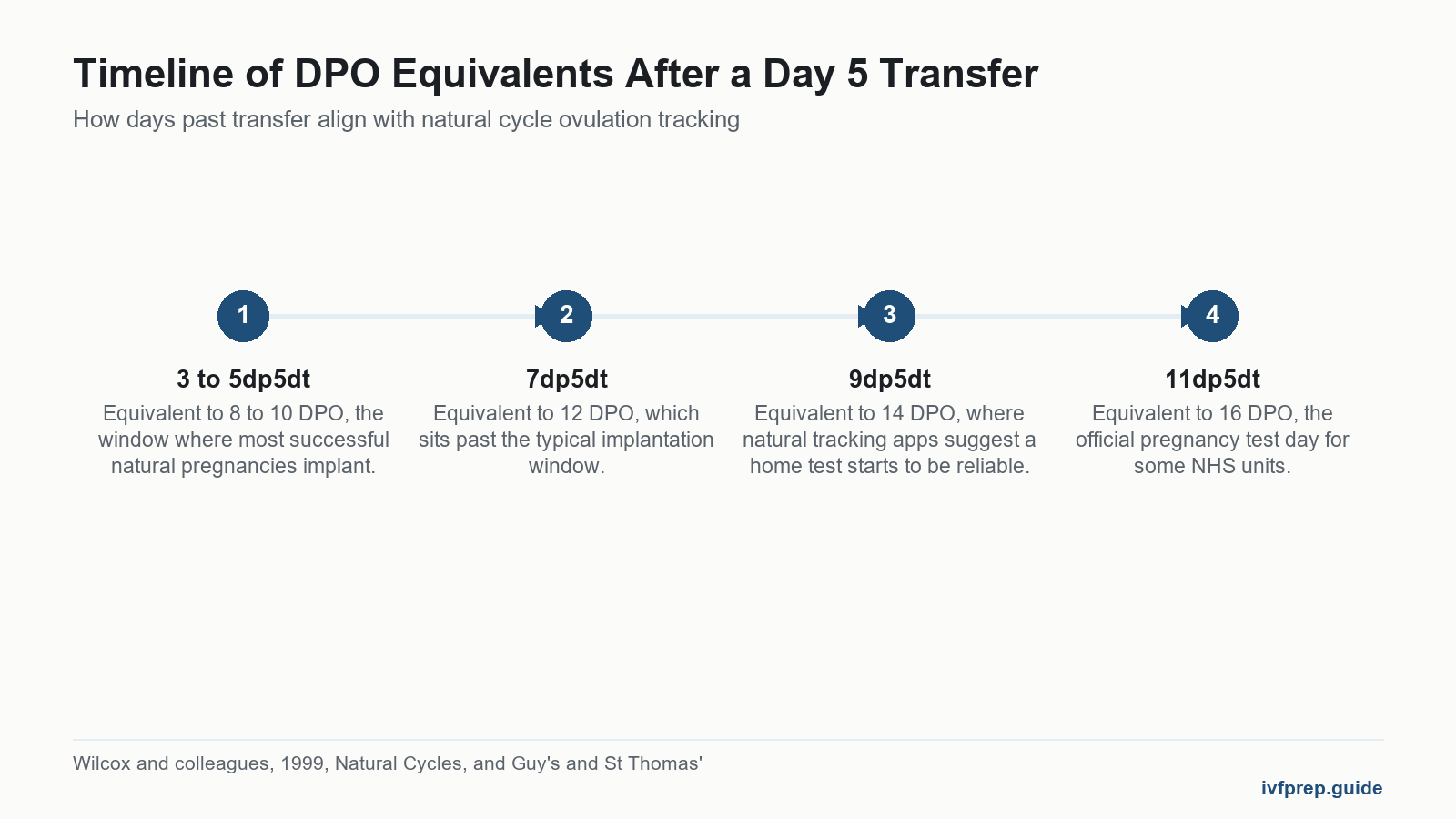
That makes 12 DPO roughly 7 days past a day 5 transfer, written 7dp5dt on forums, or 9 days past a day 3 transfer. The table puts the published markers on the same scale.
| DPO equivalent | Day 3 transfer | Day 5 transfer | What the published source says about this point |
|---|---|---|---|
| 8 to 10 DPO | 5 to 7dp3dt | 3 to 5dp5dt | The days in which most successful natural pregnancies implanted, dated from daily urine hormone samples: Wilcox and colleagues, 1999 |
| 12 DPO | 9dp3dt | 7dp5dt | Past that window. In the same group’s bleeding study, early pregnancy bleeding tended to fall around the expected period rather than at implantation: Harville and colleagues, 2003 |
| 14 DPO | 11dp3dt | 9dp5dt | Where a natural cycle tracking app suggests a home test starts to be reliable: Natural Cycles |
| 16 DPO | 13dp3dt | 11dp5dt | One NHS unit’s test day, 16 days after egg collection, taken even if bleeding has started: Guy’s and St Thomas’ |
The implantation research followed natural conceptions, so the window is a guide to biology, not a timetable for a transfer. Test dates also vary by clinic. The HFEA says only that you will be given a date and that testing early may give a false result. Your clinic’s date was written for your cycle, which this site has not seen.

Is 12 DPO too late for implantation bleeding?
On the only data that measured it, 12 DPO sits after most implantation, and implantation bleeding itself looks shaky. The timing figure tracker pages lean on comes from a study published in the New England Journal of Medicine in 1999, which dated ovulation and implantation from daily urine samples in 221 women trying to conceive. Its conclusion was that in most successful pregnancies the embryo implants 8 to 10 days after ovulation.
The same group then asked the obvious next question. Writing in Human Reproduction in 2003, they found that of 151 clinical pregnancies, 14 women, about 9 percent, recorded any vaginal bleeding in the first eight weeks. That bleeding tended to arrive around the time a period would have been expected, and the authors reported finding no support for the hypothesis that implantation can produce vaginal bleeding. Those 14 women, alongside the Right From the Start cohort of more than 4,500 pregnancies, are laid out row by row in what the cohort data shows about spotting after a missed period.
What do the pages ranking for 12 DPO spotting actually say?
Checked on 14 September 2026, the top results for this search are almost all fertility tracking brands, and each sells something that tells you when to test. That is a business model, not a scandal, but it shapes where every page ends.
| Page | What it says about 12 DPO spotting | Mentions the 2003 bleeding study? | Converts for IVF or progesterone support? |
|---|---|---|---|
| Belle Health | Often linked to implantation bleeding, since the timing can vary | No | No |
| Inito | Implantation spotting happens in 15 to 25 percent of early pregnancies, citing a medical body for the figure | No | No |
| Natural Cycles | Spotting anywhere from 7 to 14 DPO described as a common symptom of successful implantation | No | No, IVF appears only in a glossary |
Natural Cycles puts the receptive window at around 6 to 10 DPO, then stretches implantation spotting to 14 DPO. Inito’s 15 to 25 percent and the 9 percent in the 2003 study are not measuring the same thing: one is a label for bleeding caused by implantation, and the other counted any bleeding at all in confirmed pregnancies and found no sign of that cause. How long spotting lasts is its own muddle, taken apart in why nobody agrees on implantation bleeding days.
Why does spotting happen in a medicated two week wait?
There are more possible sources than in a natural cycle, and none keeps a schedule. A transfer uses a speculum and passes a catheter through the cervix, so a little bleeding from the cervix is one ordinary explanation. Vaginal progesterone, where a clinic uses it, sits against that tissue and brings residue back out, sometimes with a streak of old blood in it. Brown spotting in particular is usually older blood on its way out, which is covered in brown spotting after embryo transfer.
How routine is it? Guy’s and St Thomas’ tells patients to take their pregnancy test 16 days after egg collection even if they bleed before then. Nobody prints that line for a rare event.
No spotting is no more informative than some. Successful transfers with no symptoms are common and rarely reach a forum, because nobody posts about nothing happening; see why absence is not evidence.
What do people who have been through a transfer report about spotting at this point?
Forum threads are testimony, not evidence. For this page four threads were read in full, two on Mumsnet and two on Reddit’s r/IVF, carrying 18 first hand accounts of the wait. Eight described spotting, bleeding or brown discharge. Outcomes, where given, ran both ways; several accounts gave none, including one Reddit thread from a since deleted account.
In an April 2025 Mumsnet thread, a poster described red spotting at 7dp5dt, the 12 DPO point, after a frozen transfer, with a negative home test that day and again at 10dp5dt as the bleeding got heavier. In an April 2022 Mumsnet thread, a poster had a clear positive home test at the same 7dp5dt point and then bright red bleeding that looked like the start of a period. Their clinic answered with a blood test, not a guess. Same day count, same colour, opposite first readings.

An October 2025 r/IVF thread asked people whose transfers had worked what had made them think they were out,, and replies came from both sides. One poster described brown spotting from the day after transfer for about six days, then a smear of red around day six or seven, and a negative beta. Another described progesterone gel discharge turning brown two days before blood work, and said the same had happened on an earlier transfer that ended as a chemical pregnancy. One person with three transfers, one ending in a baby, one in a blighted ovum and one that did not implant, said the symptoms were identical all three times. One reply listed only spotting and cramping, without saying how that cycle ended, and two said they had no symptoms at all.
Where the accounts agree with the guidance: nobody’s spotting sorted their result. Where they part company: several posters were certain that a colour or a smear meant failure, and the evidence does not support reading spotting that way in either direction. The certainty is real. It is just not information. And a thread full of spotting stories is, by construction, a sample of people who spotted.
When does spotting at 12 DPO need a call to the clinic?
Any bleeding in the wait is worth telling your clinic about, not because it predicts the result but because they know your protocol. Anyone on progesterone support who bleeds should phone the clinic that prescribed it.
The NHS guidance on vaginal bleeding in pregnancy says to call 999 for heavy bleeding that soaks a pad quickly, severe pain in the tummy, pain in the shoulder, or feeling sick, faint or dizzy. Those apply on any day, whatever the cause.
Guy’s and St Thomas’ also explains why the test still matters after bleeding: some people who bleed have an ectopic pregnancy, where the embryo implants outside the womb, and that needs to be found. Early home testing after IVF is covered in home pregnancy tests after IVF, and bleeding after a positive result in early pregnancy light bleeding after IVF.
Write the day count down with the colour and amount. It will not answer your two in the morning question, but it answers the nurse’s, which is the one that leads somewhere.
What to Note and Check When Spotting
Use this checklist to gather the right details before contacting your clinic or assessing your symptoms.
Ticks are saved on this device only.
Frequently asked questions
What is 12 DPO in days past a frozen embryo transfer?
It depends on the embryo’s age when it was frozen. For a day 5 blastocyst, 12 DPO is roughly 7 days past transfer; for a day 6 blastocyst, about 6; for a day 3 embryo, about 9. It is a convention, not a clinical measurement.
Can implantation happen as late as 12 DPO?
In the 1999 urine hormone study, most successful natural pregnancies implanted 8 to 10 days after ovulation. It followed natural conceptions, so it is no timetable for a transferred embryo, and the date of spotting cannot show whether implantation happened.
Is spotting at 7dp5dt a sign the transfer failed?
It is not a sign either way. People describe spotting at this point beside both negative and positive results, and the 2003 study found no link between bleeding and implantation. Only the test your clinic arranges answers the question.
Why do 12 DPO articles keep telling you to take a test?
Most ranking pages come from companies selling tests, apps or monitors, so testing is where they lead. After IVF a trigger injection can complicate early home results, which is one reason clinics set their own date.
Does brown spotting at 12 DPO mean something different from red?
Colour is commonly explained by how long the blood took to leave the body, with brown usually older. It shows neither where the blood came from nor how the cycle will end. Heavy bleeding of any colour, or bleeding with severe pain, needs urgent help.
Is it worth counting DPO at all after a transfer?
Clinics and IVF forums count days past transfer, which makes comparison easier. Either count works for a dated note to read to your clinic. Neither count turns spotting into a result.
Finished the page? The same five questions from the top, to see what stuck.
This article is general information, not medical advice, and is not a substitute for care from a qualified healthcare professional. Speak to your doctor about your own situation.
Leave a Reply