
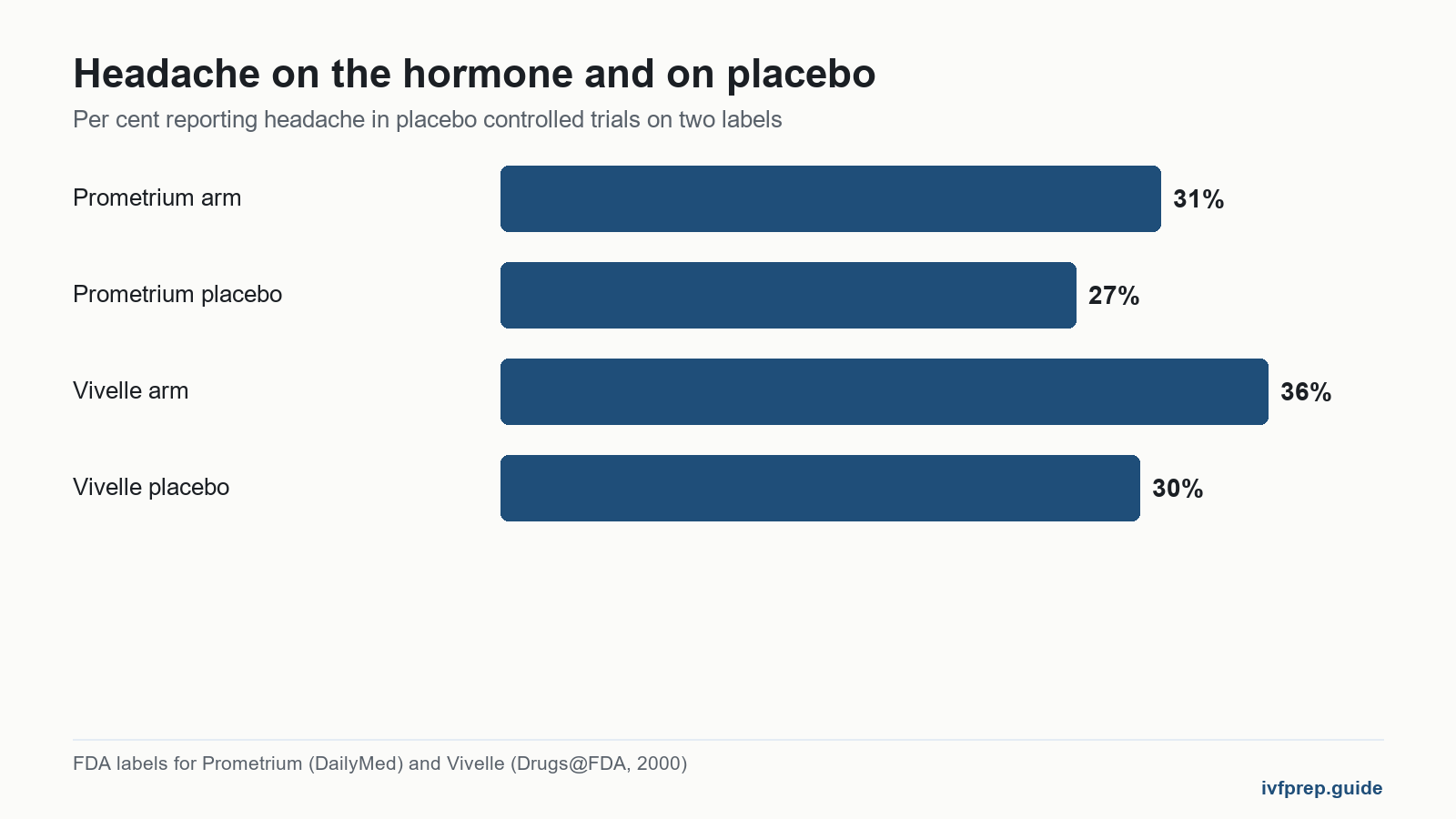
A headache and implantation have no reliable link after IVF. Headache is one of the most common side effects listed for the progesterone and estradiol used around a transfer, and in placebo controlled trials on two of those labels, 27 and about 30 per cent of people taking a dummy treatment reported headaches too. It cannot point either way.
Listen to this article, about 9 minutes. A synthetic voice reads the article and announces each section title as it begins; tables are read row by row and the questions at the end are left out.
Recorded 9 October 2026 from the article as published that day. Press a chapter to jump there; the highlighted line is what is playing. A play button sits beside every section heading, and once you scroll past this player a bar at the bottom of the screen keeps the controls in reach. Tap or click any sentence to hear the reading start from there.
On this page: a table of headache rates from five progesterone and estradiol labels set against their placebo groups, the caffeine withdrawal rule that fits transfer day, and four sets of r/IVF accounts from cycles that worked and cycles that did not.
Think you already know this? Five questions, one minute.
Every answer is on this page. Answer from what you know now; the page fills in the rest.
-
1. In the 1999 urine study by Wilcox and colleagues, when did hCG first appear?
hCG first appeared 6 to 12 days after ovulation, which is why implantation overlaps with the days people notice headaches (Wilcox, Baird and Weinberg, 1999). Read the section
-
2. In the 875 woman Prometrium trial, what share of the placebo group reported headache?
Headache was reported by 31 per cent on the hormone and 27 per cent on placebo (Prometrium label). Read the section
-
3. In the 2005 study of 98 women having IVF, when were headaches most common?
Headaches clustered in the downregulation phase, when estradiol was very low (Headache, 2005). Read the section
-
4. Under ICHD-3, how soon after the last caffeine does a caffeine withdrawal headache start?
The headache develops within 24 hours of the last caffeine and resolves within 7 days of stopping (ICHD-3 caffeine withdrawal headache). Read the section
-
5. Which headache does the NHS say needs 999 or A&E?
A sudden, extremely painful headache is on the NHS emergency list, along with numbness, confusion or loss of vision (NHS headaches). Read the section
Is a headache a sign of implantation after a transfer?
Type the question into a search bar at two in the morning and you will find headache sitting on a lot of lists: clinic blogs, lab blogs and question and answer sites that file it under “positive signs of successful implantation”, usually somewhere between cramps and a craving for pickles. The lists rarely say where the idea comes from, and that is the first clue.
The timing is what makes the story feel plausible. In the classic urine study by Wilcox, Baird and Weinberg in the New England Journal of Medicine in 1999, hCG, the pregnancy hormone, first appeared 6 to 12 days after ovulation. So an embryo is attaching in roughly the same days that people are noticing their heads. Two things happening in the same week is not the same as one causing the other.
After IVF there is a much more obvious suspect in the room. Most clinics prescribe progesterone after a transfer, and the European fertility society’s ovarian stimulation guideline strongly recommends it as luteal phase support, so this is standard practice rather than an unusual extra. Many frozen transfer cycles add estradiol as well. Both hormones list headache as a side effect, and both are taken whether or not the embryo implants. Which product, route and dose is your clinic’s decision; this page does not go near it.
Our wider page on what the evidence says about signs of implantation after a transfer covers the rest of the list. Here the question is narrow: what do the numbers say about headaches?
How often do the hormone labels report headache?
Every prescription medicine sold in the United States carries a label with an adverse reactions section, and several of the hormones used in IVF publish headache rates from their trials. Some trials had a placebo group, people given a dummy treatment, which is the comparison that matters most. Others compared two doses, so there is nothing to set the figure against.
| Label and trial | Headache on the hormone | Headache on placebo |
|---|---|---|
| Prometrium, 200 mg with oestrogen, 875 postmenopausal women over 3 years | 31 per cent | 27 per cent |
| Prometrium, 400 mg a day, 49 women in a placebo controlled trial | 16 per cent | 8 per cent |
| Vivelle estradiol patch, controlled trials | About 36 per cent | About 30 per cent |
| Crinone progesterone gel, 139 women having IVF luteal support | 17 per cent | No placebo group |
| Endometrin progesterone insert, 808 women in an assisted reproduction trial | 3 to 4 per cent | No placebo group |
Two things stand out. First, the rates swing wildly between trials of similar products, from 3 per cent on one IVF progesterone label to 17 per cent on another. That is partly how each trial asked about side effects, and it is exactly why no single “headache rate after transfer” exists. Second, in the two larger placebo comparisons the hormone arm and the dummy arm were only a few points apart, and roughly a quarter to a third of people reported headaches while taking nothing active at all. The small 49 woman trial is the exception: headaches were twice as common on the hormone, 16 against 8 per cent, with only about 25 people in each group.
None of these trials was measuring pregnancy, so none of them can say whether a headache means anything about implantation. What they can say is how ordinary a headache is in a group of people being watched closely for weeks.
Why do so many people on placebo get headaches too?
A placebo group is a useful reality check because it shows what happens to people when the drug is taken out of the picture. Headaches turn up anyway. In the large Prometrium trial, 27 per cent of the placebo group reported them; on the Vivelle patch label the figure is about 30 per cent. Headache is simply one of the commonest complaints human beings have.
Now add the conditions of a two week wait. Sleep is broken, the phone is checked hourly, coffee has often been cut back, water intake drifts, and the whole body is being scanned for meaning. It would be stranger if headaches did not appear.
IVF itself has been looked at too. A study of 98 women having IVF and embryo transfer, published in the journal Headache in 2005, found that 28.6 per cent reported headache attacks during treatment. They were more common in women with a history of migraine, and they clustered in the phase when the ovaries had been switched off by medication and estradiol was very low, not around the transfer. The study asked women afterwards rather than tracking them as it happened, so it has limits, but it points at the treatment calendar, not at the embryo.
The same pattern runs through our pages on nausea and implantation and lower back ache after transfer: the symptom is real, and the medication and the circumstances explain it in pregnant and not pregnant cycles alike.
Could cutting out caffeine be behind the headache?
For a lot of people, the two week wait is also the fortnight they quietly cut down on coffee. The NHS advises no more than 200mg of caffeine a day in pregnancy, which it puts at roughly two mugs of tea plus a can of cola, and many clinics ask patients to follow pregnancy rules from the transfer onwards.

Caffeine withdrawal headache is a formally recognised diagnosis. The international headache classification, ICHD-3, describes it as a headache that starts within 24 hours of the last caffeine after more than two weeks of taking over 200mg a day, and that clears within 7 days of stopping completely. Someone who went from three strong coffees to one on transfer day fits that window neatly, and the headache arrives right when they are looking hardest for a sign.
That is not a reason to change what your clinic has advised about caffeine. It is a reason not to hand the embryo the credit, or the blame, for a headache that a missing flat white explains perfectly well.
What do people who had headaches in the two week wait report?
We read four sets of accounts on r/IVF, the IVF community on Reddit, including one thread with more than 70 replies. These are what people report, not findings, and we paraphrase rather than quote.
In a September 2026 thread, a poster described severe headaches starting from their very first estradiol tablet while preparing for a frozen transfer. No embryo had been transferred yet. A few replies described having had the same headaches themselves.
In a March 2024 reply, a poster compared a fresh transfer that led to a pregnancy with a later frozen transfer that did not. Their symptoms, headache included, were the same in both cycles, on the same days. Their own conclusion was that it had all come from the progesterone.
In a May 2024 reply, a poster described mild headaches, cramps and backache a few days after a transfer that worked, and added that for more than a year before IVF they had felt every one of the usual symptoms in months when they were not pregnant at all.
The longest thread, from May 2025, asked people whose transfer worked what they had felt. More than 20 of the replies said nothing at all, several said their failed and successful cycles felt identical, and exactly one mentioned a headache. That thread only asked about successes, so it cannot be read the other way either.
Where the accounts agree with the labels: headaches came with the hormones, before transfer as well as after, and turned up in cycles that worked and cycles that did not. Where they cannot help: none of them is a guide to anyone else’s cycle. And people whose fortnight was uneventful rarely post at all, the silence we describe in why having no symptoms is not evidence either way.
When does a headache after transfer need a call to the clinic?
Most headaches in the two week wait are the ordinary kind. Some are not, and those are about your safety, not about the embryo.

The NHS headache guidance says to call 999 or go to A&E for a headache that started suddenly and is extremely painful, or that comes with numbness or weakness, difficulty speaking, confusion, a seizure, loss of vision, a stiff neck with a very high temperature, or a rash that does not fade under a glass. It advises an urgent GP appointment or NHS 111 for a headache with vision problems, with vomiting, or one made worse by coughing, sneezing or bending down.
During treatment, tell your clinic about any headache that is severe, will not settle or feels different from your usual ones, and ask them which painkillers are suitable before taking any. Do not stop or change any prescribed medication because of a headache; ring the clinic instead. Your clinic knows your protocol and your test date. This page does not.
For everything else, the answer is the blood test on the date your clinic gave you. The implantation timeline after a day 3 or day 5 transfer sets out when each step happens, and our page on the basal temperature implantation dip shows the same medication effect in a different costume. A headache in the two week wait is a headache. It is allowed to be just that.
This page is general information, not personal medical advice. Speak to your fertility clinic or another qualified professional about your own treatment and symptoms.
Two week wait clinic log
A private note of dates and what your clinic told you, kept in this browser only. It records what was said; it does not read anything into it.
Questions about painkillers, medication or symptoms belong with your clinic, which knows your protocol.
Frequently asked questions
Can progesterone after embryo transfer cause headaches?
Yes. Headache is listed as an adverse reaction on progesterone labels, reported by 17 per cent of women in one IVF luteal support trial of Crinone gel. It happens whether or not the transfer works.
Does having no headache after transfer mean it has failed?
No. Plenty of people who later had a positive result report feeling nothing at all during the wait. The absence of a headache tells you as little as its presence.
Can estradiol tablets or patches cause headaches during a frozen transfer cycle?
Yes. Headache is the most common systemic side effect on the Vivelle estradiol patch label, at about 36 per cent on the patch and about 30 per cent on placebo.
Are headaches during IVF more common in people who get migraines?
In a 2005 study of 98 women having IVF, headache attacks were reported by 28.6 per cent and were significantly more common in those with a migraine history. Tell your clinic if you get migraines.
Can stress during the two week wait cause headaches?
Stress, poor sleep, dehydration and cutting back on caffeine are all common headache triggers, and the two week wait tends to bring several of them at once.
Who should I ask about painkillers after a transfer?
Your fertility clinic, which knows your medication and protocol. Ask them before taking anything for a headache, and call them about one that is severe or unusual for you.
Finished the page? The same five questions from the top, to see what stuck.
This article is general information, not medical advice, and is not a substitute for care from a qualified healthcare professional. Speak to your doctor about your own situation.
Leave a Reply