
No study this research could find ties lower back ache to implantation. The lower back ache implantation idea comes from symptom lists and forum threads. Back ache after a transfer has ordinary causes, from progesterone side effects to constipation, and pregnancy back pain typically starts months later, so the ache cannot be read either way.
Listen to this article, about 10 minutes. A synthetic voice reads the article and announces each section title as it begins; tables are read row by row and the questions at the end are left out.
Recorded 7 October 2026 from the article as published that day. Press a chapter to jump there; the highlighted line is what is playing. A play button sits beside every section heading, and once you scroll past this player a bar at the bottom of the screen keeps the controls in reach. Tap or click any sentence to hear the reading start from there.
On this page: what four progesterone labels and leaflets actually record about back pain, a timeline showing when pregnancy back pain usually starts, 13 dated forum accounts, and the warning signs that need a call.
Think you already know this? Five questions, one minute.
Every answer is on this page. Answer from what you know now; the page fills in the rest.
-
1. In the 1999 urine study, how many days after ovulation did hCG first appear?
hCG first appeared 6 to 12 days after ovulation, and on day 8, 9 or 10 in 84 per cent of pregnancies that lasted (Wilcox, Baird and Weinberg, 1999). Read the section
-
2. In the once daily IVF study on the Crinone 8% label, which side effect was reported by 27 per cent of women?
The label records constipation in 27 per cent of the 139 women in that IVF study, and does not list back pain (Crinone prescribing information). Read the section
-
3. Around which week of pregnancy does the Katonis review report pregnancy back pain usually starting?
The review is reported as placing the usual onset around week 18, with the peak between weeks 24 and 36 (Katonis and colleagues, 2011). Read the section
-
4. Why do forum threads make back ache look like a sign of a positive?
The threads asked how people felt or for success stories, so positives with an ache are over represented, while symptom free positives appear as soon as someone asks (a July 2023 Mumsnet thread). Read the section
-
5. Which combination does the NHS list as possible signs of a kidney infection?
The NHS lists pain in the back or side, a high temperature and feeling sick among the main symptoms, and asks anyone pregnant to get urgent help (NHS kidney infection). Read the section
Does implantation cause lower back ache?
Nobody has shown that it does. That is a smaller statement than it sounds, so here is exactly what it covers. Implantation is the moment an embryo attaches to the lining of the womb and starts making hCG, the pregnancy hormone. In the classic urine study by Wilcox, Baird and Weinberg, published in the New England Journal of Medicine in 1999, hCG first appeared 6 to 12 days after ovulation, and on day 8, 9 or 10 in 84 per cent of the pregnancies that lasted. That gives the window. What it does not give is any sensation, because nothing marks the day outside a laboratory.
Now the pages that say otherwise. The infant formula maker Enfamil, which ranks at the top for this search, states on its implantation cramps page that most women feel implantation cramps in the lower abdomen or the lower back. No study is linked beside that sentence. A Liv Hospital page on backache after embryo transfer says the pain usually starts five to seven days after transfer, the days implantation is most likely, and mentions a fertility journal twice without linking either reference. The one source it does list, an NCBI chapter on embryo aneuploidy, is about chromosomes, not backs. To be fair to it, the same page also says back pain alone does not mean success.
So the claim that ranks is a pattern people noticed, repeated until it sounded like physiology. The same happened to cramps, which the guide to where implantation cramps are felt takes apart in more detail.
What do the progesterone labels actually say about back pain?
Less than the forums assume. Progesterone is the usual suspect for every twinge in the two week wait, and back ache is often blamed on it too. The prescribing labels print the side effects seen in the trials that licensed each product, so they are the closest thing to a record. The table below sets out what four of them say, checked on 7 October 2026.

| Product and study | Women | What the label records |
|---|---|---|
| Endometrin label, IVF luteal support study, 10 weeks | 808 | Abdominal pain 12 per cent, bloating 4 per cent, constipation 2 to 3 per cent; back pain not in the table of effects seen in 2 per cent or more |
| Crinone 8% label, once daily, IVF study | 139 | Constipation 27 per cent, perineal pain 17 per cent, abdominal pain 12 per cent; back pain not listed |
| Crinone label, every other day, a menstrual study, not IVF | 62 and 65 | Back pain 8 per cent on the 4% gel and 3 per cent on the 8% gel |
| Utrogestan 100 mg capsules leaflet, taken by mouth | Not stated | Joint, back or muscle pain listed as uncommon, up to 1 in 100 people |
| Cyclogest 200 mg leaflet, pessary | Not stated | Stomach discomfort or pain listed as common; back pain not listed |
Two things stand out. First, in the IVF studies back pain does not appear at all, while abdominal pain and constipation do, and at real rates: more than a quarter of the women in the Crinone IVF study reported constipation. Discomfort low in the tummy and pelvis is easy to describe as a back ache, which is commonly quoted as one reason the two get confused, though no label tests that. Second, where back pain does appear, it is in a study of women who were not having IVF at all.
This is the honest gain on this page. The common reassurance that “it is just the progesterone” is itself only partly supported. The labels do not prove progesterone causes back ache, and nothing proves implantation does either. Back ache in the two week wait is mostly unexplained, which is less satisfying than a sign and more accurate. What your own medication can do is a question for the clinic that prescribed it.
When does pregnancy back pain usually start?
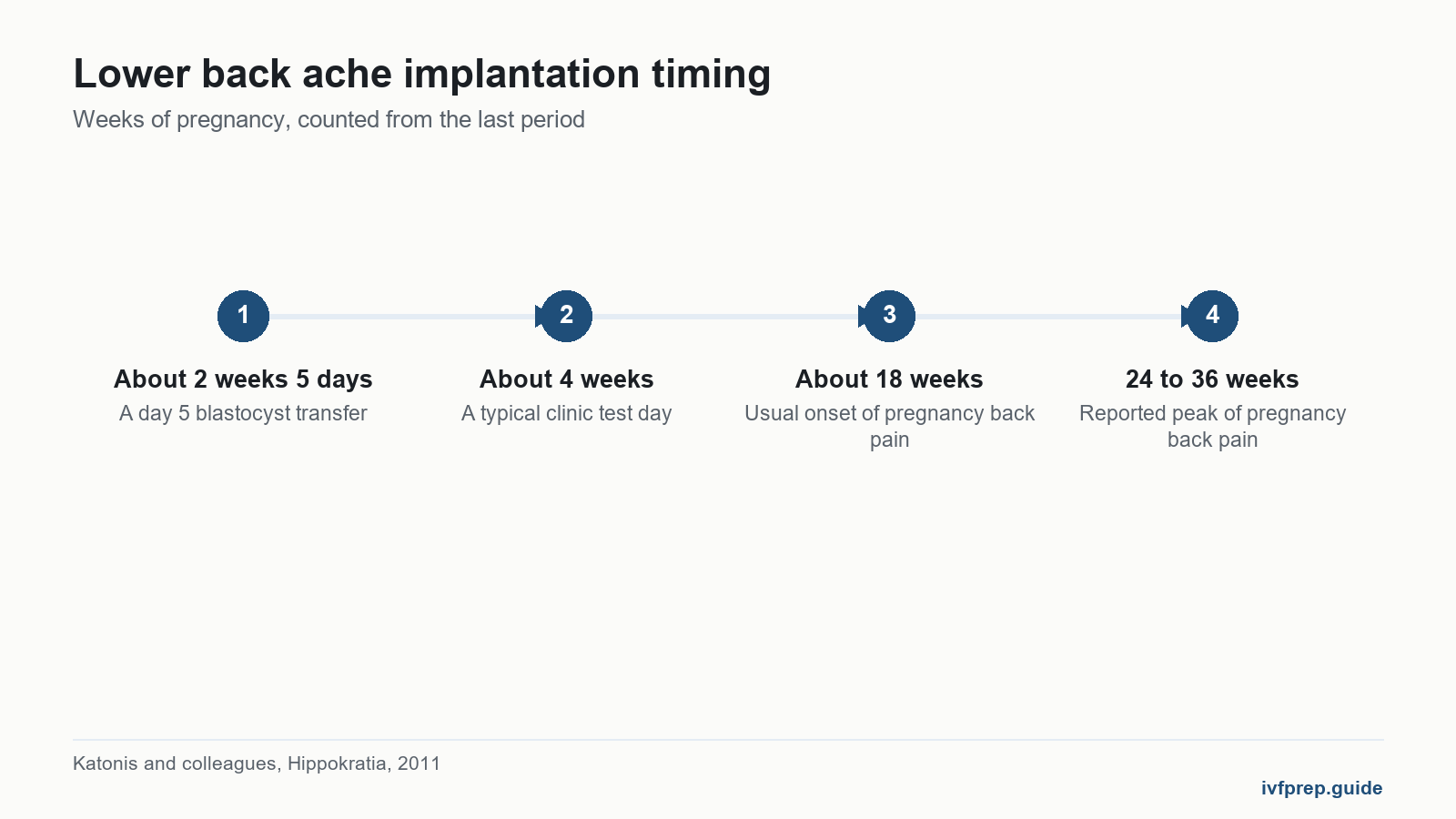
Months after the two week wait ends. A review of pregnancy related low back pain by Katonis and colleagues in Hippokratia in 2011 is reported as placing its usual onset around the 18th week of pregnancy, with the worst of it between weeks 24 and 36, while noting that some women feel it in the first trimester.
| Point in time | Roughly where it sits in pregnancy | Back pain data for that point |
|---|---|---|
| Day 5 blastocyst transfer | About 2 weeks and 5 days, counted from the last period | None. No study measures back ache as an implantation signal |
| Typical clinic test day | About 4 weeks | None specific to this point |
| Usual onset of pregnancy back pain | About 18 weeks | Reported onset in the Katonis review |
| Peak of pregnancy back pain | 24 to 36 weeks | Reported peak in the Katonis review |
Line the two up and the gap is about three months. The back pain that pregnancy is known for belongs to the second trimester, not to the week after a transfer. Some women report it earlier, which is why nobody can say a back ache during the wait is definitely not pregnancy. Nobody can say it is, either.
What do people on IVF forums report about back ache?
Mostly that they had it and later got a positive. Hold that loosely, because the pattern says more about who posts than about backs. For this page, four Mumsnet threads from December 2022 to September 2024 were read in full, covering 13 people who described their symptoms or their lack of them. These are what people report, not findings.

In a September 2024 thread on symptoms after a fresh transfer, one poster described lower back pain from the first day, and a bad night of it a week after a day 5 transfer, and later posted a positive test. Another, five days after a day 5 transfer, had a lot of lower back pain and wrote that she was hoping these were good signs. No result followed.
In a September 2024 thread asking how people felt after transfer, three replies described lower back ache with dull cramps in the first few days. All three went on to a positive test, and one of those pregnancies ended in a miscarriage at eight weeks. A fourth reply could not remember any symptoms at all in the early days and was 20 weeks pregnant.
A July 2023 thread carried the other side. One poster had three transfers with no symptoms on any of them, and the last was positive. Another had no symptoms and a positive. A later reply, in December 2023, described bad lower back pain from four days after a day 5 transfer, then cramps, and a positive. And on a December 2022 pregnancy board thread, a reply said progesterone had given her back ache in every IVF cycle; the original poster had already rung her early pregnancy unit, which told her to go to A and E if it carried on.
Now the range, honestly. Across those 13, every back ache account with a stated result was a positive, and not one person in these threads said they had back ache and a negative. That is not evidence that back ache means anything. Look at what the threads were asking for: how did you feel, what were your symptoms, success stories. People with a negative rarely come back to a symptom thread, and people with nothing to report rarely start one. The silent positives only appear when someone asks for them, which is exactly what the guide to successful transfers with no symptoms found too.
Where the accounts agree with the evidence: back ache with progesterone was mentioned as familiar, and symptom free positives turned up as soon as anyone asked. Where they part company with it: the threads still treat each ache as worth reporting, as if it carried information. The same pattern runs through accounts of pain after an egg transfer and implantation nausea.
When is back pain in the two week wait a reason to call the clinic?
When it comes with other symptoms, or when it is severe. Most back ache in the wait is ordinary, but a few patterns need a phone call that day, whatever the stage of treatment.
| What you notice | What it can point to | Source |
|---|---|---|
| Back or side pain with a high temperature, shivering, feeling sick, or blood in your pee | A kidney infection, which needs prompt treatment | NHS kidney infection |
| Tummy swelling and pain with vomiting, very little dark urine, or difficulty breathing, after a fresh cycle | Ovarian hyperstimulation syndrome | RCOG patient information |
| Pain low on one side of the tummy, pain in the tip of the shoulder, or bleeding | An ectopic pregnancy, which can follow IVF | NHS ectopic pregnancy |
| A swollen, tender leg, or chest pain and breathlessness | A possible blood clot | RCOG patient information |
The NHS kidney infection page asks anyone pregnant with these symptoms to get an urgent appointment or call 111. The RCOG leaflet on OHSS asks you to call for help if the pain is not getting better, or if you start to vomit, have urinary problems, chest pain or difficulty breathing.
If any of these apply, or if the pain simply worries you, call your clinic. They know your protocol, your medication and your history, and this page does not. Calling about a back ache is not a nuisance; it is what the clinic line is there for. For everything else, the only reading that counts is the test on the day your clinic gave you, and the guide to home pregnancy tests after IVF explains why testing early can mislead in both directions.
This page is general information, not personal medical advice. Speak to your fertility clinic or another qualified professional about your own treatment and symptoms.
Back pain in the wait: when to call today
These are the warning signs the NHS and the RCOG publish. The list interprets nothing about whether a transfer has worked. If any one applies, or anything else worries you, call your clinic or NHS 111.
Ticks are saved on this device only. One tick is enough reason to call.
Frequently asked questions
Is lower back ache a sign of implantation?
No study has shown that it is. The claim appears on symptom lists without a linked source, and back ache has ordinary causes in the two week wait. It cannot be read as a sign in either direction.
Can progesterone pessaries cause back ache?
Some people report that they do, and the Utrogestan capsule leaflet lists back pain as uncommon. The IVF studies on the Endometrin and Crinone labels record abdominal pain and constipation but not back pain. Your clinic can tell you what to expect from your own medication.
Does having no back ache after transfer mean it has not worked?
No. In the forum threads read for this page, several people had no symptoms at all and a positive test. Absence of an ache says nothing about the result, just as its presence does not.
How many days after transfer would implantation happen?
In natural conceptions, hCG first appeared 6 to 12 days after ovulation. After a day 5 transfer that is roughly 1 to 7 days later. The implantation timeline varies with the embryo’s age on transfer day.
Is back pain in early pregnancy common?
Pregnancy back pain is common, but reviews place its usual onset around week 18, long after the two week wait. Some women report it in the first trimester, which is why it cannot rule anything in or out.
When should back pain after transfer be checked the same day?
When it comes with a high temperature, vomiting, very little urine, pain on one side or in the shoulder tip, bleeding, breathlessness or a swollen leg. Call your clinic, or NHS 111, if any of those apply.
Finished the page? The same five questions from the top, to see what stuck.
This article is general information, not medical advice, and is not a substitute for care from a qualified healthcare professional. Speak to your doctor about your own situation.
Leave a Reply