
Ask implantation bleeding how many days and the published answers run from a few hours to three days, with no study behind any of them. After an embryo transfer the count is confounded by progesterone and by the transfer itself. Duration cannot tell you whether the cycle worked.
On this page: the day counts from five ranking pages set side by side with what each one rests on, the 2003 study that counted 9 percent of pregnancies with any bleeding at all, seventeen forum accounts where every duration lands on both sides of the result, and the NHS thresholds that matter more than the count.
Think you already know this? Five questions, one minute.
Every answer is on this page. Answer from what you know now; the page fills in the rest.
-
1. What do the duration figures on the ranking pages in this article’s table have in common?
The figures run from a few hours to three days, and none is tied to research; the NHS page on bleeding in pregnancy gives no duration at all. Read the section
-
2. In the 2003 prospective study of 221 women, what share of the 151 clinical pregnancies recorded any vaginal bleeding in the first eight weeks?
Fourteen of 151, and the bleeding rarely fell on the day implantation was measured; the authors found no support for implantation causing bleeding. Harville and colleagues, Human Reproduction, 2003. Read the section
-
3. Why can a bleeding count after an embryo transfer measure several things at once?
A speculum, a catheter and progesterone against the cervix can each start and stop spotting, which is why Guy’s and St Thomas’ tells patients to test on the set day even if they bleed. Read the section
-
4. Across the forum accounts this page read, what happened to the durations people reported?
A few hours and nine days both appeared beside a negative, and one day and six days both appeared beside a positive, in the Mumsnet thread from March 2021 and the others linked on this page. These are recollections, not measurements. Read the section
-
5. Which of these does the NHS say is a reason to call 999 whatever the cause?
Those are the emergency signs in the NHS guidance on vaginal bleeding in pregnancy; bleeding that continues should still be reported to your clinic. Read the section
Listen to this article, about 9 minutes. A synthetic voice reads the article and announces each section title as it begins; tables are read row by row and the questions at the end are left out.
Recorded 3 October 2026 from the article as published that day. Press a chapter to jump there; the highlighted line is what is playing. A play button sits beside every section heading, and once you scroll past this player a bar at the bottom of the screen keeps the controls in reach. Tap or click any sentence to hear the reading start from there.
You have probably already counted. Day one was Tuesday, or was it late on Monday, and does the mark you only saw when wiping count as a day at all. Then you went looking for the number that would tell you which side of the line you were on, and found four numbers. This page is about how long spotting lasts, where those figures come from, and what the count can and cannot settle. What it looks like, the colour and the amount, is covered separately in what implantation bleeding looks like.
How many days do the main sources actually say?
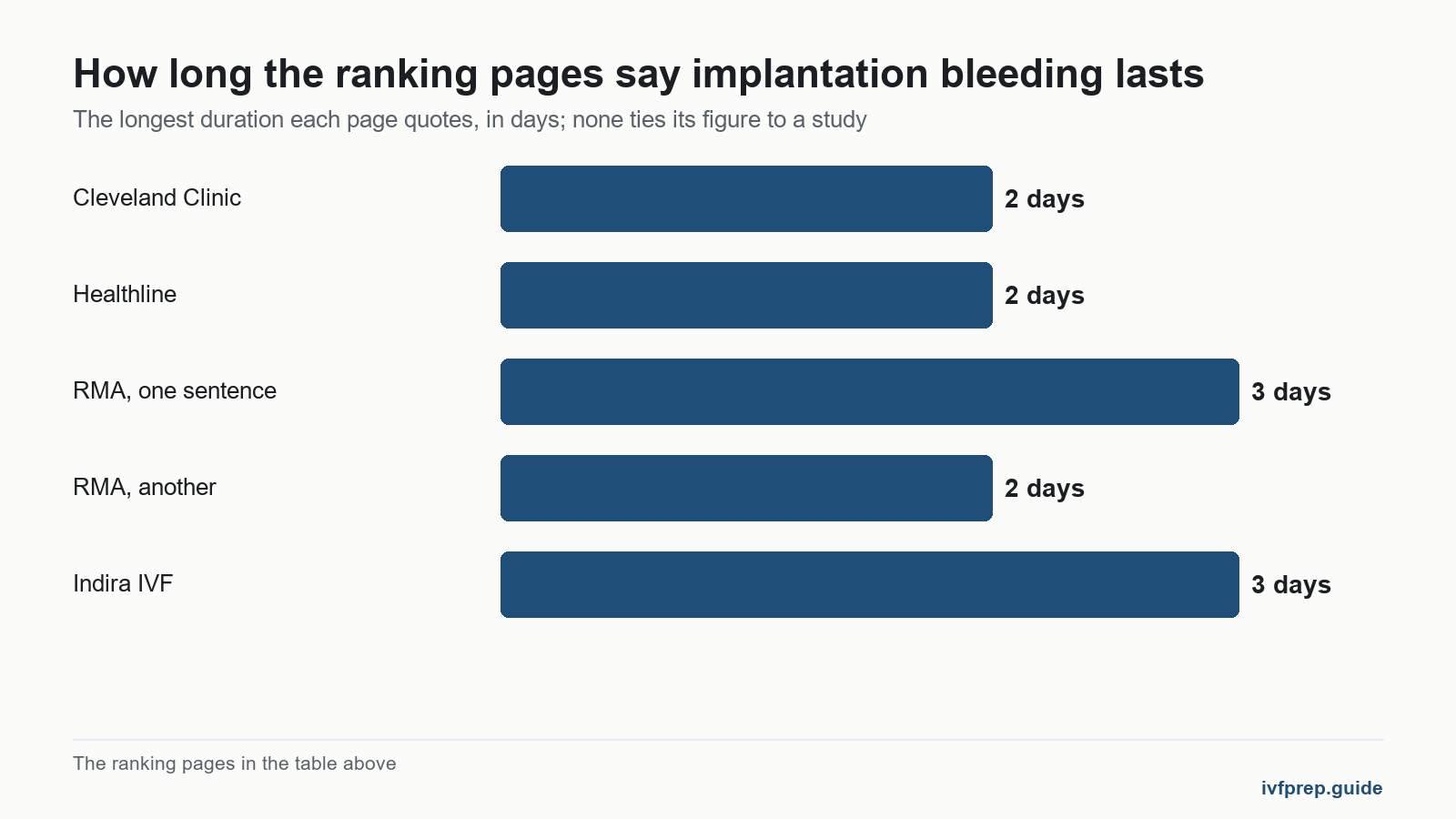
These are the pages that rank for this question. Read together rather than one at a time, they are a good illustration of how a number becomes a fact by repetition.
| Source | How long it says the bleeding lasts | What the number rests on |
|---|---|---|
| Cleveland Clinic | A few hours or a few days, and it should stop on its own after about two days | No study or data source named on the page |
| Healthline | Usually around one to two days | Cited to another consumer health article, not to research |
| RMA, a fertility clinic network | One to three days in one sentence, and a few hours to two days in another | No source named for either figure |
| Indira IVF | A few hours up to three days | No source named on the page |
| NHS | No duration given at all. Implantation is listed as one possible cause among several | General clinical guidance for patients |
| Human Reproduction, 2003 prospective study | Found no support for the idea that implantation produces bleeding in the first place | Daily diaries and daily urine hormone samples from 221 women |
The RMA page is the one worth pausing on, because it manages to disagree with itself inside a single scroll: one to three days in one place, and elsewhere the firmer claim that light spotting lasts a few hours to two days and that anything longer is unlikely to be implantation bleeding. Healthline’s one to two days is the tidiest figure of the lot, and following its citation leads to another article written for readers rather than to any measurement. None of this is fraud. It is what happens when a plausible number is passed along enough times that everybody assumes somebody else checked it.

Where do those day counts come from?
Almost every duration you can find was reported by someone who already knew how their cycle ended. That is the whole problem in one sentence. People who spotted for two days and got a positive test remember the two days precisely and write them down. People who spotted for two days and got a negative rarely write anything down at all, and people for whom nothing happened have nothing to report. Measure a thing only after you know the answer and you will get a beautifully consistent number that describes memory rather than bodies.
The exception is a small prospective study. In 2003, researchers publishing in Human Reproduction followed 221 women trying to conceive, using daily diaries and daily urine samples so that ovulation and implantation could be dated rather than guessed at. Among the 151 clinical pregnancies, 14 women, about 9 percent, recorded at least one day of vaginal bleeding in the first eight weeks. The bleeding tended to fall around the time a period would have been due, and rarely on the day implantation was measured to have happened. The authors concluded that they found no support for the hypothesis that implantation can produce vaginal bleeding. What that finding means for spotting that arrives about a week after a day 5 transfer is worked through in 12 DPO spotting after IVF and the timing data.
That leaves an awkward gap. The Cleveland Clinic page says about one in four pregnant women will experience implantation bleeding, while the study that actually counted found 9 percent recording any bleeding at all across eight weeks, and almost none of it at implantation. Both figures are published by serious organisations. They cannot both describe the same thing, and the honest position is that the popular figure is an estimate of a category that may not be a category. The related question of what a period comparison is worth is taken up in implantation bleeding or period, and the same missing evidence is why nothing about the colour or length of a bleed separates a miscarriage from implantation bleeding either.
Does the length of the bleed mean anything after a transfer?
In a medicated cycle, less than nothing, because the count is measuring several things at once. Guy’s and St Thomas’ NHS Foundation Trust notes in its embryo transfer information that patients should test on the set day even if they bleed before it, which tells you how routine bleeding in this window is. The transfer itself involves a speculum and a catheter through a cervix that bleeds more readily than usual. Vaginal progesterone sits against that tissue twice a day and carries waxy residue back out, sometimes with a streak in it. Any of those can start, stop and restart on their own schedule, so a three day count may be one source, or three sources taking turns.
Which is why this page will not turn duration into a test, and why no honest page can. A short bleed is not a good sign and a long one is not a bad sign. Nothing at all is not a sign either, which is the subject of why absence is not evidence, and the same logic applied to every other symptom is in why implantation bleeding symptoms prove nothing. Your clinic knows your protocol, your lining and your medication doses. This site knows none of those things.

What do people who have been through the two week wait report?
Forum threads are not evidence of what is true, but they are good evidence of what people actually experience and say. Reading four Mumsnet threads on spotting after transfer, 17 posts in total carried both a duration and an outcome, and the durations landed on both sides of every result.
In a March 2021 thread, the original poster described spotting that started four days after transfer and continued through to test day, roughly nine days, and reported a negative. Another poster in the same thread described six days of spotting and came back to say she had a baby. In an August 2023 thread, the poster who started it had spotting for a few hours on transfer day only, and her clinic confirmed a negative ten days later, while another poster in that thread described two days and a positive test. In an April 2023 thread, two posters each described a single day of very light spotting and both reported positive tests.
Set against each other, a few hours appears on the unsuccessful side and nine days on it too. One day appears on the successful side and six days appears there as well. If duration sorted outcomes, that pattern would not be possible. It is also a direct contradiction of the tidy rule on several ranking pages that anything past three days is unlikely to be implantation bleeding, since plenty of people bleed longer than that and go on to a positive test, and plenty bleed for an hour and do not.
One more thing is worth naming. A fourth thread, from November 2020, was titled as a request for stories of hope. It collected 15 replies and not one of them reported an unsuccessful outcome. That is not a finding about bleeding. It is a finding about questions: ask for hope and hope is what arrives, which is why the forum sample you are reading at two in the morning is bent out of shape before you get to it. Every account above is one person’s recollection, posted publicly under a username, and none of it is a measurement of anything.
When does the number of days actually matter?
It matters for your safety, and not for your result. Volume and pain are what clinics ask about, because those are what change the plan. Bleeding that continues does need to be reported, not because a longer count means a worse outcome, but because a cause that is worth finding is worth finding early.
The NHS guidance on vaginal bleeding in pregnancy says to call 999 for heavy bleeding, meaning soaking a pad soon after putting it on, or for severe abdominal pain, shoulder tip pain, or feeling faint. Those are emergencies whatever the cause and whatever day of the wait you are on.
Guy’s and St Thomas’ pregnancy test guidance adds two things. Take the test on the day your clinic set even if you have been bleeding, because a small number of people who bleed after a cycle have an ectopic pregnancy, which needs finding. And after a positive test, before the first scan, contact the unit for heavy bleeding, brown spotting, sharp pain on one side, shoulder pain or faintness. Your own clinic’s instructions come first, always, because they wrote them for your cycle. Light bleeding on progesterone is covered further in early pregnancy light bleeding after IVF.
The count you are keeping is not useless. Written down with dates and volume, it is genuinely helpful to the person you speak to on the phone. It just answers their question, not yours.
Two week wait clinic log
A private note of dates and what your clinic told you, kept in this browser only. It records what was said; it does not read anything into it.
Questions about bleeding, pain or medication belong with your clinic, which knows your protocol. Heavy bleeding, severe pain, shoulder tip pain or feeling faint is a 999 call.
Frequently asked questions
Why do websites disagree about how many days implantation bleeding lasts?
Because none of them is measuring. The figures are drawn from what people recalled after they already knew their result, then repeated from page to page. Cleveland Clinic says a few hours to a few days, Healthline says one to two days and cites another article, and RMA gives two different answers on one page.
Can spotting be over in a few hours and still be called implantation bleeding?
Most sources allow for a few hours, yes. But naming it does not verify it. A mark seen once and never again is equally consistent with the transfer procedure, with progesterone residue, or with a small amount of cervical bleeding that has nothing to do with an embryo.
If it lasts more than three days, does that mean it is not implantation bleeding?
Several ranking pages say so. Forum accounts do not support the rule: people report five, six and nine day runs of light spotting followed by both positive and negative results. Longer bleeding is worth reporting to your clinic, but a day count does not identify a cause.
Does vaginal progesterone make spotting last longer?
It can add to it. Pessaries and gels sit against tissue that is more fragile than usual and carry residue back out, which sometimes has a streak of blood in it. That means a count during a medicated cycle may be measuring the medication rather than anything else. Your clinic can tell you what is expected on your protocol.
Should I still take the pregnancy test if I have been bleeding for days?
Yes. Guy’s and St Thomas’ tells patients to test on the set day even if they bleed beforehand, partly because a small number of people who bleed after a cycle have an ectopic pregnancy that needs to be found. Follow the date your own clinic gave you.
Is it worth writing down how many days it lasted?
For the phone call, yes. Dates, volume and any pain are the details a nurse will ask for, and they are easier to give from a note than from memory at the end of a difficult fortnight. For predicting your result, the count is not worth the anxiety it costs.
Finished the page? The same five questions from the top, to see what stuck.
This article is general information, not medical advice, and is not a substitute for care from a qualified healthcare professional. Speak to your doctor about your own situation.
Leave a Reply