
Most pain after egg transfer has a mechanical explanation rather than a mysterious one. A deliberately full bladder, the ultrasound probe pressing on it, the speculum and sometimes the catheter all leave soreness behind. Progesterone adds its own cramping. None of it, in either direction, tells you what the result will be.
Listen to this article, about 10 minutes. A synthetic voice reads the article and announces each section title as it begins; tables are read row by row and the questions at the end are left out.
Recorded 10 October 2026 from the article as published that day. Press a chapter to jump there; the highlighted line is what is playing. A play button sits beside every section heading, and once you scroll past this player a bar at the bottom of the screen keeps the controls in reach. Tap or click any sentence to hear the reading start from there.
On this page: a detailed comparison table of post transfer symptoms, real patient reports from community threads, and a checklist of urgent escalation signs.
Think you already know this? Five questions, one minute.
Every answer is on this page. Answer from what you know now; the page fills in the rest.
-
1. According to the 2022 consensus paper, what is a primary mechanical cause of discomfort during the transfer?
The 2022 consensus on transfer technique notes that excessive distension of the bladder can cause significant discomfort. Read the section
-
2. What proportion of IVF patients are typically affected by mild ovarian hyperstimulation?
According to the RCOG patient information, mild ovarian hyperstimulation affects roughly a third of IVF patients. Read the section
-
3. In the forum accounts analyzed, which aspect of the procedure was most frequently named as the primary source of pain?
In the August 2026 thread, the poster and commenters noted that the catheter felt like nothing, while the full bladder and scan pressure caused the actual pain. Read the section
-
4. What do sudden shortness of breath, chest pain, or pain and swelling in a calf indicate after a transfer?
The RCOG guidelines state that these symptoms can indicate fluid in the chest or a blood clot, requiring immediate emergency attention. Read the section
-
5. What did the 2022 consensus on transfer technique conclude about immediate bed rest after a transfer?
The 2022 consensus on transfer technique reviewed the evidence on immediate mobilization and concluded that bed rest should not be recommended. Read the section
Why does a transfer hurt when everyone calls it simple?
An embryo transfer is quick and usually needs no anaesthetic, and somewhere between the clinic website and the waiting room that becomes painless. Those are not the same claim. Quick means quick.
Three things are happening to the same square inch of you at once. Your bladder has been filled on purpose so it lifts the uterus into a position the scan can see. A probe is being pressed down onto that bladder from the outside. A speculum is holding the vaginal walls open from the inside. The catheter, the part everyone braces for, is often the part people barely notice.
The guidance clinicians read is more candid about this than most patient leaflets. A 2022 consensus paper on transfer technique, published in Human Reproduction Open, says the bladder should be full enough that you feel the urge to go, and that excessive distension of the bladder can cause significant discomfort. That sentence exists. It is simply not the one printed on the appointment card.

What is actually causing the pain after an egg transfer?
Here is every source of discomfort in the procedure and the days after it, with what the primary source actually says about each. Nothing in this table is a sign of anything. It is plumbing, pressure and hormones.
| What is happening | Where it tends to be felt | What the source says |
|---|---|---|
| A bladder filled on purpose | Low and central, dull until something presses on it | Full enough to feel the urge to urinate, and excessive distension causes significant discomfort (Human Reproduction Open, 2022) |
| The ultrasound probe on your abdomen | Over the pubic bone, worse the fuller you are | Transabdominal scanning guides the catheter, so the probe presses where the bladder already is (same consensus paper) |
| The speculum | Stretching at the vaginal opening and walls | A standard Cusco speculum is usual, and different sizes should be available for different anatomy (same consensus paper) |
| The catheter, sometimes with a tenaculum on the cervix | A deep central cramp, or a pinch at the cervix | A tenaculum for traction or gentle dilatation is used when catheterisation is difficult, and a difficult transfer is partly defined by patient discomfort (same consensus paper) |
| Progesterone support | Abdominal ache, swelling, bowel cramping | Abdominal pain and abdominal distension are both listed as common, meaning up to 1 in 10 people, for assisted reproduction use (Cyclogest patient leaflet, checked 10 September 2026) |
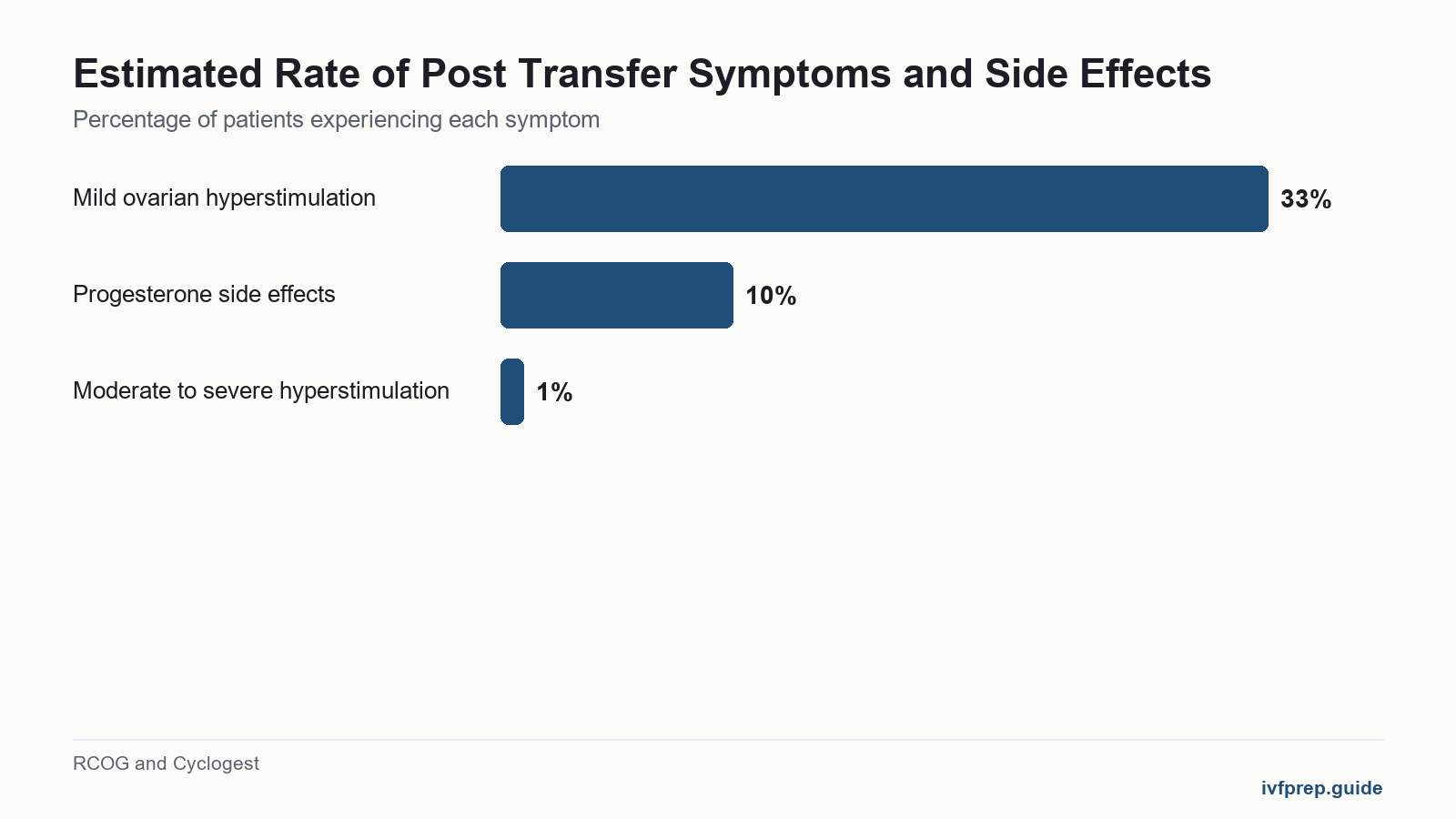
| Ovaries still enlarged after a fresh cycle | Bloating and an ache on both sides | Mild ovarian hyperstimulation affects roughly a third of IVF patients, and moderate to severe affects just over 1 per cent (RCOG patient information) |
We rechecked the two figures in that table most likely to have moved on 4 October 2026. The Cyclogest product label still lists abdominal pain and abdominal distension as common in assisted reproduction, in a text last revised in December 2023. The RCOG leaflet still gives as many as 33 in 100 for mild hyperstimulation and just over 1 in 100 for moderate or severe, but it says it was published in July 2016 and would be reviewed every three years, so those percentages are older than the page around them suggests. The UK regulator’s own page on the risks of fertility treatment describes the same warning signs, and on when to call, the two sources agree.
If you want the order these happen in, we walk through it step by step in the egg transfer process, minute by minute in the room.
What do people who have had a transfer actually report?
Forum accounts are testimony, not evidence, and none of them can tell you anything about your own body. They are useful for one thing: showing which part of the procedure people keep naming. We read around ninety comments across three threads in the r/IVF community, posted between February and August 2026.
In an August 2026 thread titled around the transfer being the most painful procedure so far, the poster had four retrievals, a saline sonogram and an HSG behind them and still found the transfer the worst of it. Their reason was the bladder. They wrote that the catheter itself felt like nothing at all.
Several people in that same thread described arriving with what they thought was a full bladder, being told it was not full enough, and drinking more in the waiting room. A few described the opposite, being sent to release some before the scan could see anything. Others reported no discomfort whatsoever and were mildly baffled by the fuss.
A May 2026 thread pushing back on the phrase that transfers are not painful traces the same sequence: the poster says the pain started with the external ultrasound, doubled when the speculum went in, and that the catheter was barely noticeable. Comments underneath range from people who were sedated for theirs to people who rated it a flat zero.
The days afterwards look just as scattered. In a February 2026 thread about cramping on progesterone, one person described severe cramping that woke them at night through two transfers, both of which were negative from the first test onward, so there was no implantation to credit it to. Someone replying to them described the same night waking cramps alongside a positive test. Same symptom, opposite results, and neither person could have called it in advance.
Where the accounts and the official guidance agree is the culprit: the bladder, not the catheter. Where they part company is the instruction. The consensus paper gives no volume at all, only the urge to go. The people in those threads were told to drink anything from sixteen ounces to eight glasses in two hours. That gap is where a lot of avoidable pain lives, and it is worth raising with your own clinic, who know how they scan and what they need to see.

Which pain needs your clinic the same day?
This part is written straight. Soreness that eases over hours is one thing. Pain that climbs is another, and after a fresh cycle in particular your ovaries may still be enlarged, so the threshold for calling is low. Nobody at a clinic thinks you are wasting their time.
| What you notice | Why it is taken seriously | What to do |
|---|---|---|
| Pain getting worse rather than better, rapid bloating, weight gain, feeling very thirsty, passing very little urine | These are the signs of ovarian hyperstimulation moving from mild to moderate or severe (RCOG) | Contact your fertility clinic that day |
| Sudden shortness of breath, chest pain, or pain and swelling in a calf | These can indicate fluid in the chest or a clot, and are the reason severe hyperstimulation is treated urgently | A and E, or 999, without waiting for the clinic to open |
| Sharp one sided tummy pain with pain at the tip of your shoulder, feeling faint or dizzy | This combination is how a ruptured ectopic pregnancy presents (NHS) | Call 999 or go straight to A and E |
| Heavy bleeding, or a temperature | Neither belongs in the ordinary aftermath of a transfer | Ring the clinic, and out of hours use the emergency number on your paperwork |
Sudden severe one sided pain has rarer causes too, including twisting of an enlarged ovary. That is not a reason to be frightened. It is the reason the answer to sudden severe pain is a same day phone call rather than a search engine at two in the morning.
Symptom Escalation Checklist
Review these warning signs to determine if you need to contact your clinic or seek emergency medical care.
Ticks are saved on this device only. Always consult your clinic directly for medical concerns.
Does the pain mean anything about the result?
No, and this is the part the ranking pages get wrong on purpose. One of the clinic pages competing for this exact question is titled around positive signs after embryo transfer, which is a promise nobody can keep.
Cramping happens after transfers that work and after transfers that do not. Absolutely nothing happens after transfers that work and after transfers that do not. The reason forums feel otherwise is that nobody writes a post saying day six was completely uneventful. Silence is invisible, so the symptom stories are all you see, and they look like a pattern because you are reading them at speed and at night.
We take the same line everywhere on this site: read our honest answer on the signs of implantation after a transfer, and if you are trying to place a cramp on a map, where implantation cramps are actually felt explains why location tells you less than the internet suggests. And if the question is how long the cramping should go on, how long implantation cramps last sets out why nobody has actually timed it.
Does lying still afterwards help?
It does not appear to. The 2022 consensus on transfer technique reviewed the evidence on immediate mobilisation and concluded that bed rest should not be recommended.
Which is quietly good news for anyone lying very flat in a car park worrying that a speed bump undid the whole cycle. If you walked out and drove home, you did not get it wrong. If you spent three days horizontal because it was the only thing that felt like doing something, you did not get it wrong either. Neither of those is the variable, and it was never in your hands. The frozen embryo transfer timeline sets out what is actually happening on each of those days, and our comparison of where clinic advice on what to do after a FET contradicts itself shows how differently four clinics answer the same question about rest.
Frequently asked questions
How long does soreness after an egg transfer usually last?
Bladder soreness commonly settles within hours of emptying it, and people in the threads we read described it lingering through the same afternoon. Cramping linked to progesterone can carry on for as long as the medication does. Pain that is still climbing after a day, rather than easing, is a reason to ring your clinic rather than wait it out.
Is it normal to feel nothing at all after an egg transfer?
Yes, and it is more common than forums make it look. Plenty of people in the threads we read rated the procedure a zero and noticed nothing in the days afterwards. Feeling nothing is not an absence of something that should be there. It is simply one of the ordinary ways this goes.
Why do clinics give such different instructions about drinking water?
Because the guidance does not set a volume. The 2022 consensus on transfer technique asks only that the bladder be full enough to feel the urge to urinate, and warns that overdistension causes significant discomfort. Clinics translate that into their own numbers, which is why one person is told sixteen ounces and another is told eight glasses.
Could progesterone be causing the cramping rather than the embryo?
It is one recognised source of it. The manufacturer leaflet for a widely used progesterone pessary lists abdominal pain and abdominal distension as common in assisted reproduction, meaning up to 1 in 10 people. Progesterone also slows the bowel, and lower bowel cramping sits close enough to the uterus to be hard to tell apart.
Should I ask my clinic before taking anything for the pain?
Yes. We do not give medication guidance on this site, and there is a good reason for that: your clinic knows your protocol, your medication list and your scan results, and this page knows none of those. Ask them what they are happy for you to take.
Does a difficult transfer mean something went wrong?
Not by itself. The consensus paper defines a difficult transfer partly by patient discomfort or blood at the end of the catheter, and says the effect of difficult transfers on outcomes is debated, with studies pointing in both directions. Nobody can tell you what your own transfer means, and anyone who does is guessing.
Finished the page? The same five questions from the top, to see what stuck.
This article is general information, not medical advice, and is not a substitute for care from a qualified healthcare professional. Speak to your doctor about your own situation.
Leave a Reply