
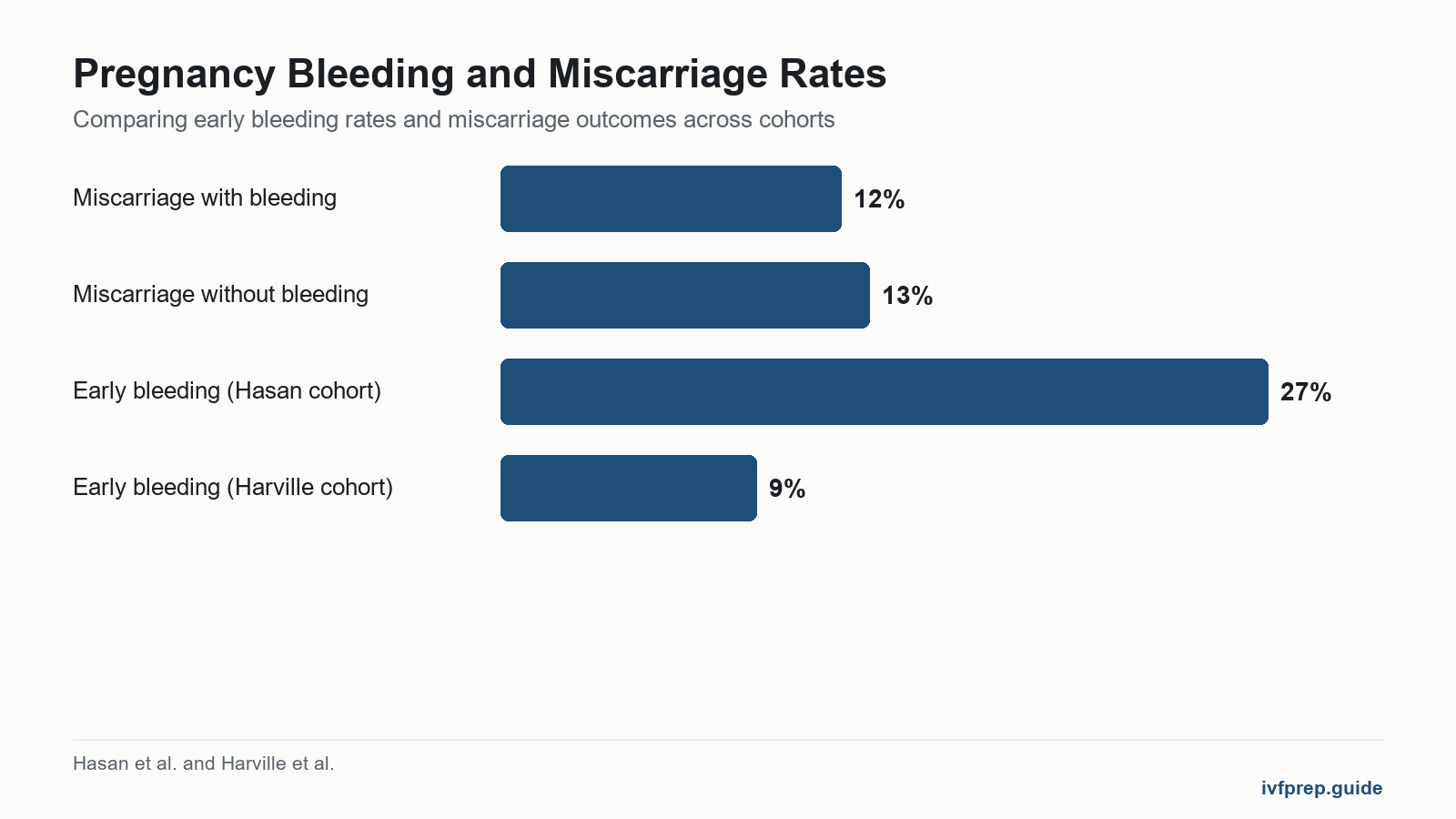
Spotting after a missed period means different things depending on whether a pregnancy test is negative, not yet taken or positive, so that is the first question. In one cohort of 4,539 pregnancies about a quarter involved early bleeding, and miscarriage rates were 12 percent with it and 13 percent without. Heavy bleeding with pain is the exception.
Listen to this article, about 11 minutes. A synthetic voice reads the article and announces each section title as it begins; tables are read row by row and the questions at the end are left out.
Recorded 10 October 2026 from the article as published that day. Press a chapter to jump there; the highlighted line is what is playing. A play button sits beside every section heading, and once you scroll past this player a bar at the bottom of the screen keeps the controls in reach. Tap or click any sentence to hear the reading start from there.
On this page: cohort figures from US and UK studies, named medical sources, a clinical guidance table, and an interactive scenario chooser.
Think you already know this? Five questions, one minute.
Every answer is on this page. Answer from what you know now; the page fills in the rest.
-
1. What did clinical studies find regarding the colour of vaginal spotting and pregnancy outcomes?
The NHS and clinical studies do not find spotting colour useful for predicting outcomes. Learn more from the NHS page on bleeding in pregnancy. Read the section
-
2. According to NHS guidance, after how many missed periods in a row should you see a GP?
The NHS advises seeing a GP if you have missed three periods in a row. Read the full NHS guidance on missed or late periods. Read the section
-
3. In Harville and colleagues’ 2003 diary study, what percentage of women who became clinically pregnant recorded early bleeding?
In the study of 151 clinically pregnant women, 14 (about 9 percent) recorded at least one day of bleeding in the first eight weeks. See Harville and colleagues’ 2003 study in Human Reproduction. Read the section
-
4. In the Right From the Start cohort of 4,539 pregnancies, what was the miscarriage rate for those who experienced early bleeding?
The miscarriage rate was 12 percent for those who bled and 13 percent for those who did not. Read more in the study by Hasan and colleagues, Annals of Epidemiology. Read the section
-
5. Why does a missed period lose its typical meaning during IVF treatment?
Progesterone can hold a period back and cause spotting, altering typical timelines. Check the HFEA’s guide to IVF for more on treatment protocols. Read the section
Those numbers describe thousands of strangers. They cannot read your situation, and nothing on this page will try. If you are in fertility treatment, your clinic holds your protocol, your dates and your results, and it is the only place that can say what your bleeding means. This page can tell you what the research counted, which is more than the usual list of causes, hormones, stress, infection, fibroids, manages. That list explains everything, which is a polite way of saying it explains nothing.
Why does the timing of the spotting matter more than its colour?
Because a missed period followed by spotting sits in one of three situations, and each one has a much shorter list of explanations than all three together. Colour does not sort them. The NHS page on bleeding in pregnancy lists pink, red and brown alike, and none of the studies below found colour useful for telling outcomes apart. More on the colour question in what brown spotting after a transfer usually means.
| Where you are | What the spotting can reflect | What actually narrows it | Source |
|---|---|---|---|
| Test negative, period late, now spotting | A late or light period; stress, weight change, hormonal contraception, PMOS (formerly PCOS), perimenopause, breastfeeding | Time, a repeat test, and a GP if periods stay irregular or three are missed in a row | NHS, missed or late periods |
| Period late, no test yet, spotting around when it was due | Either the start of a period or bleeding in a very early pregnancy | A pregnancy test; bleeding in early pregnancy tended to fall near the expected period date | Harville and colleagues, Human Reproduction, 2003 |
| Test already positive, now spotting | Cervical changes, infection, a subchorionic bleed, miscarriage, ectopic pregnancy, or no cause found | Assessment by a clinician; heavy bleeding, pain, shoulder tip pain or dizziness are urgent | NHS, vaginal bleeding in pregnancy |
Spotting and Missed Period Evaluation Steps
Follow these clinical steps and checks to evaluate spotting after a missed period based on cohort data and guidelines.
Ticks are saved on this device only.
What can spotting in place of a period mean when the test is negative?
Usually a period that is late, light or both. The NHS guidance on missed or late periods, reviewed in June 2026, names pregnancy, stress, perimenopause, polyendocrine metabolic ovarian syndrome (the condition formerly called PCOS), sudden weight loss, being overweight, heavy exercise, some hormonal contraception and breastfeeding. It advises seeing a GP after three missed periods in a row, or when a missed period comes with other changes.
A negative test taken early is not the last word, and a negative taken after a true delay usually is. How long to wait before trusting one depends on the test and the cycle, which is why home testing after IVF has its own page. If you are in treatment, a missed period is not really the signal at all, for reasons covered further down.
What if the period is late and you have not tested yet?
Then the spotting could be the start of the period or bleeding in a very early pregnancy, and only a test separates the two. The most careful look at that overlap is a daily diary study. In Harville and colleagues’ 2003 study in Human Reproduction, 221 women trying to conceive recorded any bleeding every day and gave daily urine samples, so ovulation and implantation could be dated from hormones rather than memory. Of the 151 who became clinically pregnant, 14, about 9 percent, recorded at least one day of bleeding in the first eight weeks. Twelve of those 14 pregnancies ended in a live birth.
Two further findings matter here. The bleeding tended to fall around the time a period would have been expected, which is exactly the moment someone decides their period has arrived after all. And the authors found no support for the idea that implantation itself causes bleeding. That puts them at odds with the NHS page above, which still lists implantation bleeding as a cause. It is a genuine disagreement, and fourteen women is a small base for either side of it.
There is also a reason not to settle any of this alone. The NHS description of ectopic pregnancy symptoms says the bleeding can start and stop, can be watery and dark brown, and is sometimes mistaken for a regular period. Pain low down on one side, shoulder tip pain, or pain when going to the toilet alongside a missed period needs medical advice, even before a positive test.

How often do people bleed after a positive test, and what did those pregnancies do?
Often, and the counting is better than the ranking pages suggest. The largest source is Right From the Start, a United States community cohort that enrolled women before or in early pregnancy between 2000 and 2008. Its two papers analyse slightly different subsets of the same women, hence counts that differ by a handful.
| Study and cohort | Pregnancies | How many bled | What the pregnancies did | Source |
|---|---|---|---|---|
| Right From the Start, bleeding patterns paper, 2010 | 4,539 | 1,207, about a quarter; 8 percent of those reported heavy bleeding; most episodes fell in weeks 5 to 8 and lasted under three days | Miscarriage in 12 percent of those who bled and 13 percent of those who did not | Hasan and colleagues, Annals of Epidemiology |
| Right From the Start, miscarriage risk paper, 2009 | 4,510 | 1,204 (27 percent); 97 with heavy bleeding | Unadjusted odds of miscarriage 1.1 for any bleeding (interval 0.9 to 1.3); 3.0 for heavy bleeding (interval 1.9 to 4.6), mostly where pain came with it | Hasan and colleagues, Obstetrics and Gynecology |
| North Carolina Early Pregnancy Study, 2003 | 151 | 14 (9 percent) in the first eight weeks | 12 of the 14 ended in a live birth | Harville and colleagues, Human Reproduction |
Read the first row carefully, because it cuts both ways. Spotting did not sort these pregnancies into good and bad piles. Neither did its absence: 13 percent of the women who never bled miscarried anyway. A quiet first trimester is not a guarantee, and a spotty one is not a verdict. What did separate the groups was heavy bleeding, particularly with pain. This site’s page on light bleeding in early pregnancy while on progesterone goes through the adjusted figures from the same cohort.
None of these women conceived through IVF, and none were taking the luteal support most people in treatment are still on at this stage. The figures are the best available for the general question, not a forecast for a medicated one.
What do people who have posted about this actually report?
Forum accounts are testimony, not evidence, and nothing below is a finding about anyone’s pregnancy. They are here because they show the range. On 22 September 2026 this site read three public Mumsnet threads on spotting around a missed period or at five to six weeks, and counted 13 people describing their own experience.
On a conception board thread from September 2022, one poster described a week of brown discharge before an expected period, one faint line and then negative tests. She came back in October 2022 to say the period had arrived three weeks late and that she suspected stress. Another replier said she had not tested positive until eleven days late. Same symptom, opposite answers.
On a pregnancy board thread from June 2023 that ran to 104 replies, the original poster described pale brown discharge at about five and a half weeks that turned red, heavier and crampy over two days. She posted no outcome in the thread. Further down, one replier described significant bleeding at around eight weeks in a pregnancy that became a child now four years old, and another, with a history of repeated losses, described pink and brown discharge near six weeks and returned in February 2024 to report good news.
On a pregnancy board thread from October 2022, the original poster described cramping and pink brown spotting at five weeks after an earlier chemical pregnancy, and had no clear answer by her last update in November. One replier described brown spotting in an earlier pregnancy that turned bright red and ended in miscarriage, then a later pregnancy with red spotting once or twice and a heartbeat on the scan.
Of the 13, five described a pregnancy that continued past the bleeding, one also described a loss, one turned out not to be pregnant, and the rest gave no outcome on the pages read. The largest thread is the lesson: its opening poster never said how it ended, and the people who came back to post were mostly the ones with good news. Forums are weighted towards whoever still wants to talk. Where the accounts agree with the research is that spotting alone sorted nothing. Where they part company is colour: posters lean hard on brown meaning fine and red meaning trouble, a rule no study above supports.
Where does IVF change the picture?
In three ways. First, a missed period is not the test. The HFEA’s guide to IVF says you will be given a date for a pregnancy test after transfer, and warns that testing early can give a false result. Second, the progesterone most people take after transfer can hold a period back and can cause spotting of its own, so late and early stop meaning what they usually mean. The page on implantation bleeding or period after IVF covers why the usual comparison fails. Third, you know your dates to the day, which is why spotting at 12 DPO after a transfer can be placed on a timeline most people never get.
It is also worth knowing that most pregnancies involve no bleeding at all: 137 of the 151 in the diary study above. Cycles where nothing happens are almost invisible online, because nobody starts a thread about nothing happening. The page on successful implantation without bleeding sets out what that looks like.

Do not stop, start or change any medication because of spotting. Decisions about luteal support belong to the clinic that prescribed it.
When does spotting after a missed period need a call today?
Contact your clinic, maternity unit, early pregnancy unit or NHS 111 about any bleeding once you know or think you are pregnant. The NHS advises calling 999 if you are pregnant and bleeding with severe tummy pain, pain in the shoulder, feeling faint, dizzy or sick, or bleeding heavy enough to soak a pad soon after putting it on. Those are signs that need treatment straight away, whatever a forum or a symptom checker has said.
Frequently asked questions
Can you be pregnant and still get something that looks like a light period?
Some bleeding in early pregnancy is common, and in one daily diary study it tended to fall around the date a period was due. That study concluded it was generally light and unlikely to be mistaken for a full period. Only a pregnancy test separates the two, not the look of the blood.
How long after a missed period is a negative test reliable?
It depends on the test’s sensitivity and on when ovulation actually happened, which can shift in a stressful or irregular cycle. A repeat test a few days later answers more than any symptom. If you are in treatment, your clinic’s scheduled blood test is the result that counts.
Is brown spotting after a missed period safer than red?
Forums say so; the research does not. The NHS lists pink, red and brown bleeding together, and colour did not separate outcomes in the cohort studies on this page. Amount and pain are what clinicians ask about first.
Does having no spotting at all mean everything is fine?
No, and it does not mean anything is wrong either. In the Right From the Start cohort, 13 percent of women who never bled had a miscarriage, almost the same as those who did bleed. Absence of a symptom is not a signal in either direction.
Why do some articles call this implantation bleeding?
Because the idea is widely repeated, including on NHS pages. The one prospective study that dated implantation from hormone samples found no support for it, and bleeding there rarely fell on the day of implantation. The honest position is that the question is not settled.
Should I stop progesterone if my period seems to start?
That decision belongs to the clinic that prescribed it. Progesterone can itself cause spotting and can delay a period, so bleeding on it is hard to read. Call the clinic and describe what is happening rather than changing anything yourself.
Finished the page? The same five questions from the top, to see what stuck.
This article is general information, not medical advice, and is not a substitute for care from a qualified healthcare professional. Speak to your doctor about your own situation.
Leave a Reply