
When day 9 after embryo transfer feel like period coming is the closest description you have, the most likely cause is the luteal support itself. The Cyclogest label lists abdominal pain, bloating, constipation and breast pain as common in fertility treatment. That picture shows up in cycles that worked and cycles that did not.
Listen to this article, about 10 minutes. A synthetic voice reads the article and announces each section title as it begins; tables are read row by row and the questions at the end are left out.
Recorded 26 September 2026 from the article as published that day. Press a chapter to jump there; the highlighted line is what is playing. A play button sits beside every section heading, and once you scroll past this player a bar at the bottom of the screen keeps the controls in reach. Tap or click any sentence to hear the reading start from there.
On this page: the progesterone side effect list that matches the premenstrual picture item for item, the implantation window translated into transfer days, and seven dated accounts from day 8 to 10 split deliberately across both outcomes.
Think you already know this? Five questions, one minute.
Every answer is on this page. Answer from what you know now; the page fills in the rest.
-
1. Which of these is listed as a common side effect of luteal phase support in fertility treatment?
The Cyclogest 400mg summary of product characteristics lists abdominal distension, abdominal pain, constipation, breast pain and fatigue as common in assisted reproduction use. That is the premenstrual picture, printed in a drug label. Read the section
-
2. Wilcox and colleagues timed implantation in most continuing pregnancies at how long after ovulation?
The 1999 New England Journal of Medicine study tracked daily urine samples from 221 women. Translated into transfer days, that window falls around days three to five after a day 5 transfer. Read the section
-
3. In the published work quoted on this page, what was actually measured against IVF outcome?
The 149 woman cohort in Human Reproduction measured bleeding, not sensation. No published study separates cramping by outcome, which is why no page can tell you what cramping means. Read the section
-
4. In the December 2024 thread read for this page, how many of the accounts naming an outcome named a positive?
Six from six, in that thread. That is not biology. It is who comes back to update a thread once a result is in. Read the section
-
5. What does Guy’s and St Thomas’ NHS Foundation Trust say about bleeding before the test date?
Guy’s and St Thomas’ says to take the test sixteen days after egg collection even if you bleed before that, because some people who bleed could have an ectopic pregnancy. Read the section
Why does day 9 after embryo transfer feel like period coming?
Because you are taking a drug whose documented common effects are, almost item for item, the sensations of a period about to start. A duller answer than the internet would like.
The summary of product characteristics for Cyclogest 400mg, the regulator approved document rather than a clinic blog, last revised on 13 December 2023, carries a separate side effect list for luteal phase support in assisted reproduction. Common, meaning up to one user in ten: abdominal distension, abdominal pain, constipation, breast pain, fatigue, mood altered, hot flush, night sweats, weight increased. Uncommon: pelvic pain, vaginal haemorrhage, metrorrhagia.
Read that back as though somebody had typed it into a forum at two in the morning. Bloated, crampy, sore breasts, exhausted, warm, weepy. It is the premenstrual script word for word, printed in a drug label. Somewhere between the label and the search results, the same list got renamed early pregnancy signs.
Two entries are worth reading twice. Constipation is on the list, and a full bowel produces exactly the low dragging ache people describe. The other is placement: a pessary sits close to the cervix, and posters in the threads below blame the pessary about as often as they credit implantation.

What is actually happening in the uterus by day 9?
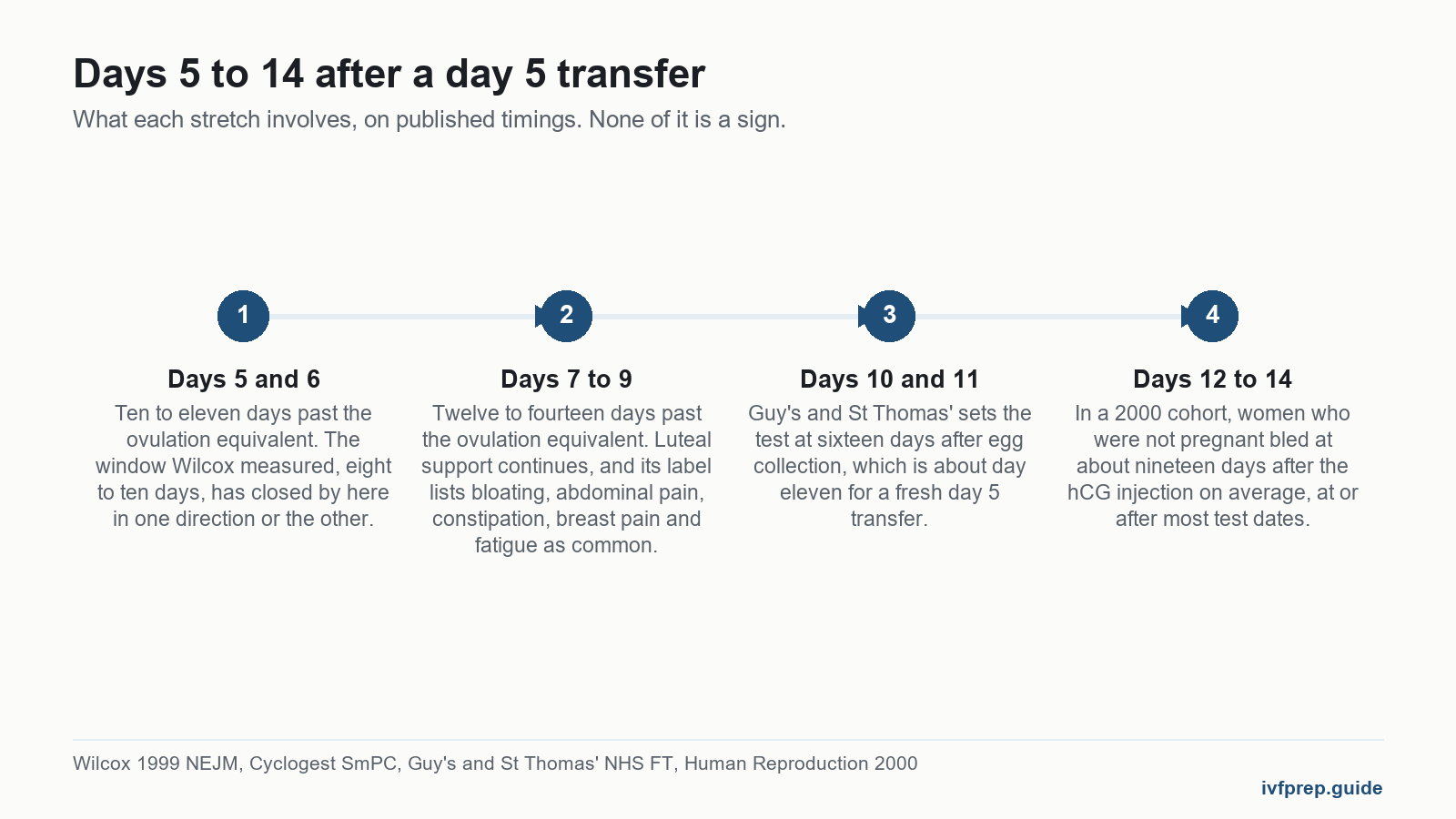
Some arithmetic, because nobody sets it out and it changes how day 9 reads. A day 5 blastocyst is already five days past fertilisation when it is transferred, so day 9 after a day 5 transfer sits roughly fourteen days past the equivalent of ovulation. After a day 3 transfer, roughly twelve.
That matters because implantation has been timed. Wilcox, Baird and Weinberg collected daily urine from 221 women trying to conceive, in the New England Journal of Medicine, 1999. In most pregnancies that continued, implantation occurred eight to ten days after ovulation. Translated into transfer days, that window falls around days three to five after a day 5 transfer. The endometrial receptivity review on NCBI Bookshelf puts the receptive window at about six days after ovulation lasting roughly four days, which lines up.
So by day 9 after a blastocyst transfer, on published averages, that window has already come and gone in one direction or the other. Two caveats sit on that sentence. These are averages from a natural conception study, not a statement about your cycle. And there is no evidence that implantation produces a sensation you could feel: it is microscopic, in tissue with no pain fibres pointed at it. The frozen embryo transfer timeline sets out the whole cycle stage by stage.
Can cramping at day 9 tell you anything about the outcome?
No, and it is worth being precise about why rather than just saying do not worry. For cramping to work as a sign, two things would have to be true: it would have to happen more often in one outcome than in the other, and you would have to be able to tell the two apart. Neither has been shown.
What has been measured is bleeding, not the feeling. Roman and colleagues reviewed 149 consecutive women on vaginal micronised progesterone in Human Reproduction in 2000. Among the women who were not pregnant, bleeding began at about nineteen days after the hCG injection on average. In the pregnant group, only three bled within nineteen days: two were biochemical pregnancies and one went to term. Small, twenty six years old, and about blood rather than about a sensation. It is still more than most pages ranking for this question are working with.
Here is every sensation people describe at this point, set against what the label lists and what has been measured. Nothing in this table is a sign.
| What it feels like at day 9 | Listed as an effect of luteal support | What has been measured against outcome |
|---|---|---|
| Low central cramping, like a period starting | Yes, abdominal pain, common in ART use (Cyclogest SmPC) | Nothing. No published study separates cramping by outcome |
| Bloating, waistband tight | Yes, abdominal distension, common (same document) | Nothing |
| Breasts sore or heavy | Yes, breast pain, common (same document) | Nothing |
| Flattened, tearful, overheating | Yes, fatigue, mood altered and hot flush, all common (same document) | Nothing |
| Light spotting | Yes, vaginal haemorrhage and metrorrhagia, uncommon (same document) | Bleeding before the test was rarer in the pregnant group of a 149 woman cohort, and one of the three who bled went to term (Human Reproduction, 2000) |
| Nothing at all | Nothing to list | Nothing, and it is almost invisible online, because no one writes a post about a week in which nothing happened |
That last row is the one this site exists for. A transfer that works with no symptoms at all is ordinary, and it generates no thread and no list. If you have read fifty accounts of cramping this week, you read a sample that excluded the quietest outcome by construction. The same gap runs through the usual signs of implantation lists.

What do women at day 8 to 10 after transfer actually report?
These are accounts, not evidence. I read the replies in four dated threads on the Mumsnet infertility board and kept every account naming both a day after transfer and an outcome. Seven did, paraphrased below with dates and links.
- The woman who started a thread on 3 December 2024 was eight days past a day 5 frozen transfer with bad period style cramps and no bleeding, on Cyclogest twice a day. She posted a positive result on 10 December.
- In the same thread, a replier on 5 December 2024 had three transfers and cramped in both that were positive. Another on 6 December 2024 had significant cramping, a positive, then a chemical pregnancy. A third, the same day, cramped for the whole two weeks and was twelve weeks pregnant when she wrote.
- The woman who started a thread on 31 August 2021 was six days past a frozen transfer with severe back pain and period cramps, on two pessaries a day, and had faint lines on 1 and 2 September. On 3 September, her official test day, the result was negative.
- A replier in that same thread on 1 September 2021 had intense cramping at days nine and ten, a positive on day ten, and then a chemical pregnancy.
- The woman who started a thread on 5 June 2022 was seven days past a day 5 transfer, felt her period was close to starting, and had a negative test. A replier said her own bleed arrived about three days after she stopped the progesterone.
- In a thread from 17 September 2024, a replier on her third transfer said that in her previous cycles her period had not arrived until days after she stopped the pessaries.
Where the accounts agree with the clinical guidance: the feeling is common, and the medication is the usual explanation. Nobody in these threads was surprised by it.
Where they do not agree is in the shape of the evidence. Read the December 2024 thread on its own and cramping looks like a good sign: every account in it that named an outcome named a positive, six from six. That is not biology, it is who comes back to a thread. Both negatives here came from threads where the woman asking was the one who later reported it, which is why I searched threads titled around failure as well as around good news. Both outcomes cramp. Only one tends to write it down.
Why do symptom lists make cramping look like a good sign?
Survivorship, mostly. A positive gives somebody a reason to come back and update a thread. A negative usually does not, and nobody should be asked to. Then the lists get compiled from that archive. There is no post titled day 9, felt completely normal, tested positive, because there is nothing to ask and nobody to ask it of. So the quiet version never makes the list, and its absence reads, at two in the morning, as though having no symptoms means something bad. It does not. It means nothing was written down.
One filter worth applying to everything you read this week. If a page collecting success stories is also selling you a supplement on the same screen, it is doing two jobs and only one of them is telling you what happened. The clinic pages have the opposite problem: good on the mechanism, quiet on the feeling, and rarely willing to say out loud that the woman whose cycle did not work felt exactly the same thing. If your own test has already come back the wrong way, what an early negative test does and does not settle handles the timing question separately.
What should you do if bleeding starts before test day?
Take the test anyway, on the date your clinic gave you. Guy’s and St Thomas’ NHS Foundation Trust states it plainly: take the pregnancy test sixteen days after egg collection even if you bleed before that, because some people who bleed could have an ectopic pregnancy. The instruction is there for safety, not for hope.
Testing earlier than the date you were given is the other common instinct, and the HFEA advises against it: you will be given a date to do a pregnancy test, and doing it early risks a false result.
Your clinic set that date, knows your protocol and holds your notes. This page does not and cannot. Contact them the same day about heavy bleeding, severe or one sided pain, shoulder tip pain, or feeling faint. Do not start, stop or change any medication on the strength of anything you read here or in a forum. Earlier in the wait, what to do after a frozen embryo transfer and pain after the transfer procedure cover the first few days.
Clinic call log
Phone calls in the two week wait are hard to remember afterwards, and the answer you were given matters more than anything on a forum. Write down the date, what you asked and what they said.
A record of what your clinic told you, nothing more. It does not interpret anything and it predicts nothing. Kept on this device only.
Frequently asked questions
Is cramping at day 9 more meaningful than cramping at day 5?
No. Both sit inside the stretch covered by luteal support, and no published study has separated cramping by outcome at any day of the wait. The day it starts is not information either.
Does having no symptoms at all mean the transfer failed?
No. A transfer that works with no symptoms whatsoever is ordinary. It is close to invisible online because nobody writes a post about a week in which nothing happened, which is why the symptom lists never include it.
Can a period start while I am still taking progesterone pessaries?
Vaginal bleeding is listed as an uncommon effect of luteal support on the Cyclogest label, so it can happen. In a 149 woman cohort in Human Reproduction, women who were not pregnant bled at about nineteen days after the hCG injection on average, which is around or after most test dates. Your clinic decides when the medication stops.
Should I test early at day 9?
The HFEA advises against testing before the date your clinic gives you, because doing it early risks a false result. Your clinic set that date around your own protocol.
Is the cramping the embryo implanting?
By day 9 after a day 5 transfer the implantation window measured by Wilcox and colleagues in the New England Journal of Medicine has already passed. There is also no evidence that implantation itself produces any sensation a person can feel.
Why do all the clinic pages say the same thing about progesterone?
Because the mechanism really is the progesterone and they are right about it. What they tend to leave out is that the woman whose cycle did not work felt exactly the same, and Guy’s and St Thomas’ is unusually direct in saying the test still has to happen on the given date whatever the week felt like.
Finished the page? The same five questions from the top, to see what stuck.
This article is general information, not medical advice, and is not a substitute for care from a qualified healthcare professional. Speak to your doctor about your own situation.
Leave a Reply