
A euploid embryo is one the lab counted as having the expected number of chromosomes, the result PGT-A testing looks for. Large studies link it to higher implantation and live birth rates than an untested embryo, but that is a group finding. It cannot promise one transfer will work, and PGT-A is not recommended for every patient.
Listen to this article, about 10 minutes. A synthetic voice reads the article and announces each section title as it begins; tables are read row by row and the questions at the end are left out.
Recorded 30 September 2026 from the article as published that day. Press a chapter to jump there; the highlighted line is what is playing. A play button sits beside every section heading, and once you scroll past this player a bar at the bottom of the screen keeps the controls in reach. Tap or click any sentence to hear the reading start from there.
On this page: what euploid, aneuploid and mosaic actually mean under the lab’s own cut-offs, the ASRM’s 2024 verdict on testing every patient, a cited cohort of 8,175 euploid transfers, and the PGT-A accuracy lawsuits now moving through US courts.
Think you already know this? Five questions, one minute.
Every answer is on this page. Answer from what you know now; the page fills in the rest.
-
1. Under the common PGDIS cut-offs, what counts as a euploid result?
Per the 2021 PGDIS position statement, under 20 per cent abnormal cells is reported as euploid; the range between 20 and 80 per cent is where a mosaic call gets made. Read the section
-
2. What did the ASRM’s 2024 committee opinion conclude about testing every IVF patient?
Quoted directly from the 2024 ASRM committee opinion, which reviewed trial evidence including the STAR Trial and a 2021 China trial before reaching that conclusion. Read the section
-
3. In a cohort of 8,175 single euploid transfers between 2011 and 2018, which age group had the highest live birth rate?
From Cornelisse and colleagues, 2020; the live birth rate fell gently with age even after a euploid result, from 62.5 to 52.9 per cent across the full range studied. Read the section
-
4. Two studies on this page report different live birth rates for mosaic embryo transfers. What do they agree on?
A 2020 multicentre study in Genes found lower rates for mosaic transfers than euploid ones, while a 2025 study found them close to equivalent; both confirm mosaic transfers have produced live births. Read the section
-
5. What is the central allegation in the PGT-A class action lawsuits reported in 2024 and 2025?
Per Time’s March 2025 report and the filed complaint in Petersen v. Natera, which alleges the company marketed PGT-A as up to 99 per cent accurate. Read the section
What does euploid actually mean?
A euploid embryo has 46 chromosomes, the number a lab expects to see in the cells it tests. An aneuploid embryo has a different count, extra or missing chromosome material. A mosaic embryo sits between the two: some of the tested cells look typical and some do not, because the error happened after fertilisation, in one branch of the embryo’s own cell divisions rather than in the egg or sperm.
Labs draw the line with a cut-off, not a single test for mosaicism itself. The 2021 PGDIS position statement describes the common convention: under 20 per cent abnormal cells in the sample is reported as euploid, over 80 per cent is reported as aneuploid, and the range between is where a mosaic call gets made. Different labs, and different testing platforms, can draw that line in slightly different places.
Three labels, one small biopsy. All three describe the handful of cells a lab happened to test, not a guarantee about every cell in the embryo.
What does my result category actually mean?
Pick the category your clinic used. This restates what the category means in the lab’s own terms. It does not interpret your result or estimate a chance of success.
Restates the lab’s own categories. It does not interpret a result or estimate a chance of success; ask your clinic about your own.
What is PGT-A testing, and how is it done?
PGT-A, preimplantation genetic testing for aneuploidy, is done on a blastocyst, usually on day 5 or 6, sometimes day 7; our piece on blastocyst stages, day by day covers what those days actually represent before any testing happens. A small number of cells are removed from the trophectoderm, the outer layer that goes on to form the placenta, not from the inner cell mass that becomes the baby. Per the HFEA’s page on embryo testing, the embryo is then frozen while the biopsy is analysed, and a result usually comes back before a decision is made about which embryo to transfer.

Because the test reads a sample rather than the whole embryo, the trophectoderm result is used as a stand in for the inner cell mass. Most of the time the two agree. The cases where they do not are a large part of why a euploid or aneuploid call is a strong signal, not a certainty, and why a mosaic call exists at all.
Does every IVF patient need a PGT-A test?
No. The 2024 ASRM committee opinion states plainly that “the routine use of blastocyst biopsy with aneuploidy testing in all infertile patients undergoing IVF treatment cannot be recommended.” That is the professional body that represents US fertility clinics, reviewing its own field’s evidence and declining to endorse testing everyone.
Two of the trials behind that conclusion looked at good prognosis patients, the group most likely to have several embryos to choose from. The STAR Trial, run in 2019, found an ongoing pregnancy rate of 50 per cent per transfer with PGT-A against 46 per cent without, not a significant difference once the whole intention to treat group was counted. A 2021 trial in China reported live births in 77.2 per cent of the PGT-A group against 81.8 per cent of the conventional IVF group, among 1,212 patients, favouring no testing at all.
Where the opinion does describe a benefit is narrower: patients of advanced maternal age with a reasonable number of eggs, people with a history of recurrent pregnancy loss, and clinics aiming to transfer one embryo at a time rather than two. Younger patients with no particular risk factor are the group the evidence supports least.
What are the published outcomes after a euploid transfer?
A large single network cohort gives the clearest picture of what happens after a euploid result specifically. Cornelisse and colleagues, Journal of Assisted Reproduction and Genetics, 2020, followed 8,175 single euploid frozen embryo transfers at IVIRMA New Jersey between 2011 and 2018.
| Age at transfer | Transfers | Implantation rate | Live birth rate |
|---|---|---|---|
| Under 35 | 3,789 | 82.0% | 62.5% |
| 35 to 37 | 2,200 | 78.7% | 58.3% |
| 38 to 40 | 1,624 | 77.6% | 56.0% |
| 41 to 42 | 319 | 73.4% | 52.2% |
| Over 42 | 243 | 73.3% | 52.9% |
Two things stand out. The live birth rate falls with age even after testing, because a euploid result says nothing about the uterus, the lining or anything else in the cycle. And the fall is gentle, from 62.5 to 52.9 per cent across the whole range in this cohort, which is a far smaller drop than the fall in egg quality that testing is partly meant to sidestep.
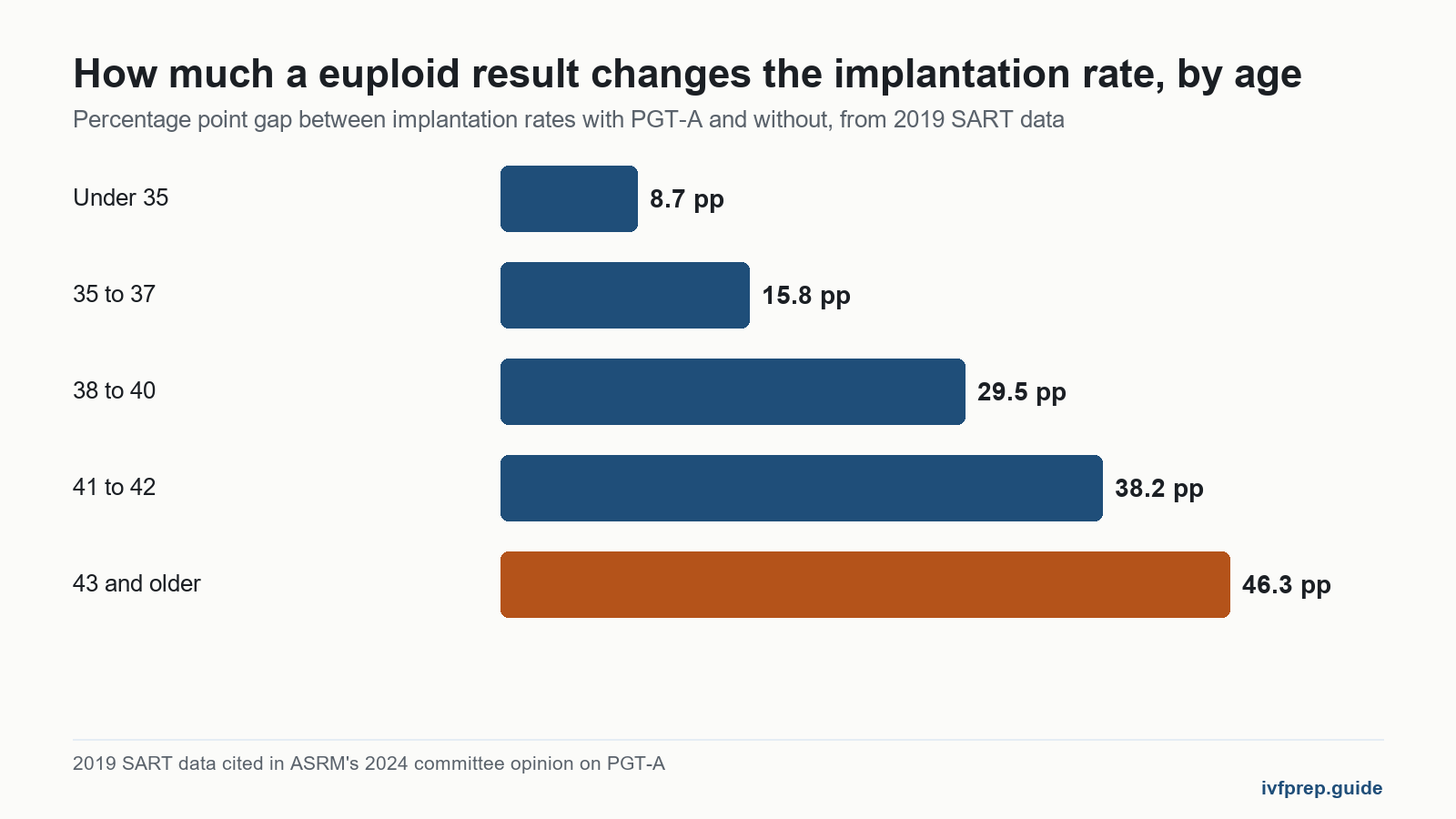
The gap between a euploid transfer and an untested one is exactly where the ASRM opinion found the strongest case for testing: age. Its review of 2019 SART data found implantation rates with PGT-A against without PGT-A across five age bands, and the gap widens every step: 62.7 against 54.0 per cent under 35, 60.7 against 44.9 per cent at 35 to 37, 59.5 against 30.0 per cent at 38 to 40, 56.1 against 17.9 per cent at 41 to 42, and 53.7 against 7.4 per cent at 43 and older. The chart below draws that gap out by age.
What does a mosaic result mean, and what happens if one is transferred?
A mosaic result means the sample tested carried a mix of typical and atypical cells, usually reported as a percentage. It is neither a clean pass nor a clean fail, and clinics vary in which mosaic embryos they are willing to transfer, and in what order, against any euploid embryos from the same cycle.
Published outcomes for mosaic transfers do not agree with each other, and this site would rather say so than pick the flattering number. A 2020 multicentre study in Genes followed 133 mosaic embryo transfer cycles against 447 euploid and 777 untested transfers at several clinics, and found live birth in 27.1 per cent of mosaic transfers (36 of 133), 47.0 per cent of euploid transfers (210 of 447) and 35.1 per cent of untested transfers (273 of 777), with a higher miscarriage rate for mosaic transfers too, 33.3 against 20.5 per cent.
A more recent single cohort tells a different story. A 2025 study comparing 56 mosaic and 819 euploid transfers, tested by next generation sequencing at one network, found live birth rates close enough to call equivalent: 50.0 per cent for mosaic against 51.8 per cent for euploid. The two studies are five years and different laboratories apart, not a single trend, and neither cancels the other out. What they agree on is that mosaic embryos have produced live births in the hundreds across published research, and that a clinic weighing whether to transfer one is working from group numbers that have moved over time, not a fixed answer.
Whether a mosaic embryo is offered for transfer, and which one first, is a decision for a clinic and its own lab’s data, not something this page can make for a reader. How the blinded trials compare with the registries, and where PGDIS, ASRM and ESHRE disagree on ranking mosaic embryos, is laid out in our guide to what a mosaic embryo result means in IVF.
Can a PGT-A result be wrong?
Yes, and that is now the subject of active litigation rather than a theoretical caveat. Nearly 700 IVF patients have filed class action lawsuits against PGT-A testing companies, reported by Time in March 2025, naming CooperSurgical, Natera, Reproductive Genetic Innovations, Ovation Fertility, Progenesis and Igenomix as defendants.
One of the filed cases, Petersen v. Natera, Inc., filed 8 October 2024 in the US District Court for the Northern District of California, alleges the company marketed its PGT-A test as up to 99 per cent accurate while the test led some patients to discard embryos later shown to be viable. The named plaintiff has said publicly that an embryo her test flagged as having serious chromosomal abnormalities was transferred anyway and resulted in a live birth.
These are allegations in an active case, not a finding against any test, and this site is not positioned to judge the underlying science of a lawsuit still working through the courts. What it establishes plainly is the point the ASRM opinion already makes in calmer language: a PGT-A result is a probability from a small sample, not a certainty, in either direction.
What does a euploid result mean during the two week wait?
Nothing you can feel. A PGT-A result is settled in the lab before transfer day, and nothing about the two week wait that follows, no symptom and no absence of one, adds any information to it. Our piece on why no bleeding and no symptoms is not evidence either way covers why the body stays quiet whatever is happening inside a cycle that already has a euploid or mosaic result attached to it.

A euploid result and a good embryo grade are related but separate things, decided by different parts of the same biopsy and scored on different scales. Our guide to what a blastocyst grade actually means covers the letters and numbers, and the frozen embryo transfer timeline covers where the testing result sits against the rest of the cycle, day by day.
Your clinic knows your embryos, your lab’s testing platform and your own history, and this page knows none of them. Questions about a specific result belong with your clinic or embryologist, who can explain what it means for your own transfer.
This article is general information, not personal medical advice. Please speak to your fertility clinic or another qualified professional about your own situation.
Frequently asked questions
Is a euploid embryo the same as a good quality embryo?
No. Euploid describes the chromosome count from a genetic test. Grade describes how the embryo looks under a microscope, scored separately. An embryo can be euploid and a lower grade, or a higher grade and aneuploid.
Can a euploid embryo still fail to implant?
Yes. In the largest cohort on this page, implantation rates after a euploid transfer ranged from 73.3 to 82.0 per cent by age, meaning a meaningful share of euploid transfers did not implant even in the youngest, highest performing group.
Does PGT-A testing damage the embryo?
The biopsy removes a small number of trophectoderm cells, not cells from the inner cell mass. Reported live birth rates after euploid transfer in large cohorts are not lower than general blastocyst transfer rates, though this page is not the place for a full safety review of the biopsy procedure itself.
Why would a clinic recommend against PGT-A for a younger patient?
Because the ASRM’s own review found no significant difference in live birth rates with or without testing for patients aged 37 or younger on a per cycle basis, while testing adds cost and can, in some cycles, mean no embryo is available to transfer.
What happens if every tested embryo comes back aneuploid?
That is a conversation for your clinic, covering the testing platform used, whether a repeat cycle is recommended, and whether mosaic results were reported separately from aneuploid ones. It is outside what a general article can advise on.
Is a mosaic embryo the same risk as an aneuploid one?
No, they are reported as different categories. Published outcomes for mosaic transfers vary between studies on this page, from clearly lower than euploid to close to equivalent, which is different from an aneuploid result, where clinics do not generally recommend transfer.
Finished the page? The same five questions from the top, to see what stuck.
This article is general information, not medical advice, and is not a substitute for care from a qualified healthcare professional. Speak to your doctor about your own situation.
Leave a Reply