
A medicated FET replaces your own cycle with oestrogen and then progesterone, so the clinic sets the transfer date; a natural FET follows your own ovulation. In the largest trial, 4,376 ovulatory women had near identical healthy live birth rates either way, but fewer pregnancy complications after natural cycles. Your clinic decides which suits you.
Listen to this article, about 11 minutes. A synthetic voice reads the article and announces each section title as it begins; tables are read row by row and the questions at the end are left out.
Recorded 2 October 2026 from the article as published that day. Press a chapter to jump there; the highlighted line is what is playing. A play button sits beside every section heading, and once you scroll past this player a bar at the bottom of the screen keeps the controls in reach. Tap or click any sentence to hear the reading start from there.
On this page: five randomised trials of medicated against natural frozen transfers set side by side with their sizes and dates, the PnROVE complication figures, why the 2025 Cochrane review has been overtaken, and what eleven Mumsnet replies reported.
Think you already know this? Five questions, one minute.
Every answer is on this page. Answer from what you know now; the page fills in the rest.
-
1. In a medicated FET, what is the transfer date counted forward from?
A medicated cycle has no ovulation. Oestrogen builds the lining and the transfer is timed from the chosen day progesterone starts, as the 2023 review in Reproductive Biology and Endocrinology describes. Read the section
-
2. Who did every randomised trial on this page recruit?
The PnROVE trial and the COMPETE trial both enrolled ovulatory women only, so neither measured what happens when cycles are irregular. Read the section
-
3. In PnROVE, the largest trial, what were the healthy live birth rates?
The PnROVE trial in the BMJ randomised 4,376 women and found no significant difference. The 54.0 and 43.0 figures are from the smaller COMPETE trial. Read the section
-
4. What does a medicated cycle leave out that a natural cycle has?
With no ovulation there is no corpus luteum. Medication replaces the progesterone but not hormones such as relaxin, the idea tested in a 2019 study in Hypertension. Read the section
-
5. For natural against hormone therapy cycles, what did the 2025 Cochrane live birth estimate rest on?
The Cochrane review pooled 32 trials overall, but this comparison’s live birth estimate came from one study of 233 people, rated low certainty. PnROVE and COMPETE were published after it. Read the section
What is a medicated FET, and how is it different from a natural one?
A frozen embryo has to arrive while the lining of the womb is receptive, and that window is only a few days wide. Every frozen transfer protocol is an answer to one practical question: how does the clinic know which day that is?
In a medicated cycle, also called a programmed, artificial or hormone replacement cycle, the answer is that the clinic decides. Oestrogen builds the lining, progesterone is started on a chosen day, and the transfer is counted forward from that day. You do not ovulate, which matters later in this article. In a natural cycle the answer is your own ovulation: the clinic watches for it and counts forward. A modified natural cycle adds one trigger injection so the hour of ovulation can be booked, which the guide to how the trigger shot in a modified natural FET works covers in detail.
This is a very ordinary decision now. Frozen transfers made up 48 per cent of UK IVF cycles in 2024, according to the HFEA figures for 2024, so roughly half of everyone in treatment is having some version of this conversation.
Why would a clinic choose a medicated cycle?
Mostly because it works when your own cycle will not cooperate, and because it turns a moving target into a fixed appointment. Ovulation is not punctual, and a natural cycle can drift late, arrive early, or not arrive at all that month.

Here is a fact the comparison pages rarely mention: every trial in the table below recruited only women who ovulate regularly. The PnROVE trial in the BMJ says ovulatory women in its title, and the COMPETE trial in PLOS Medicine enrolled only women with a regular menstrual cycle. None of them can tell you anything about someone whose cycles are irregular, which is exactly the group for whom clinics most often use a medicated cycle. If that is you, the headline results on this page were not measured on anyone like you, in either direction.
The other reasons are practical: a date that can be planned around work or travel, and fewer short notice scans. Which of those apply is the clinic’s judgement, not this page’s.
Questions for the protocol conversation
Tick the ones you want to raise with your clinic. None of these has a right answer you can find online; they are for the team who has your notes.
Ticks are saved on this device only. This list records questions; it does not recommend a protocol.
What did the big randomised trials find?
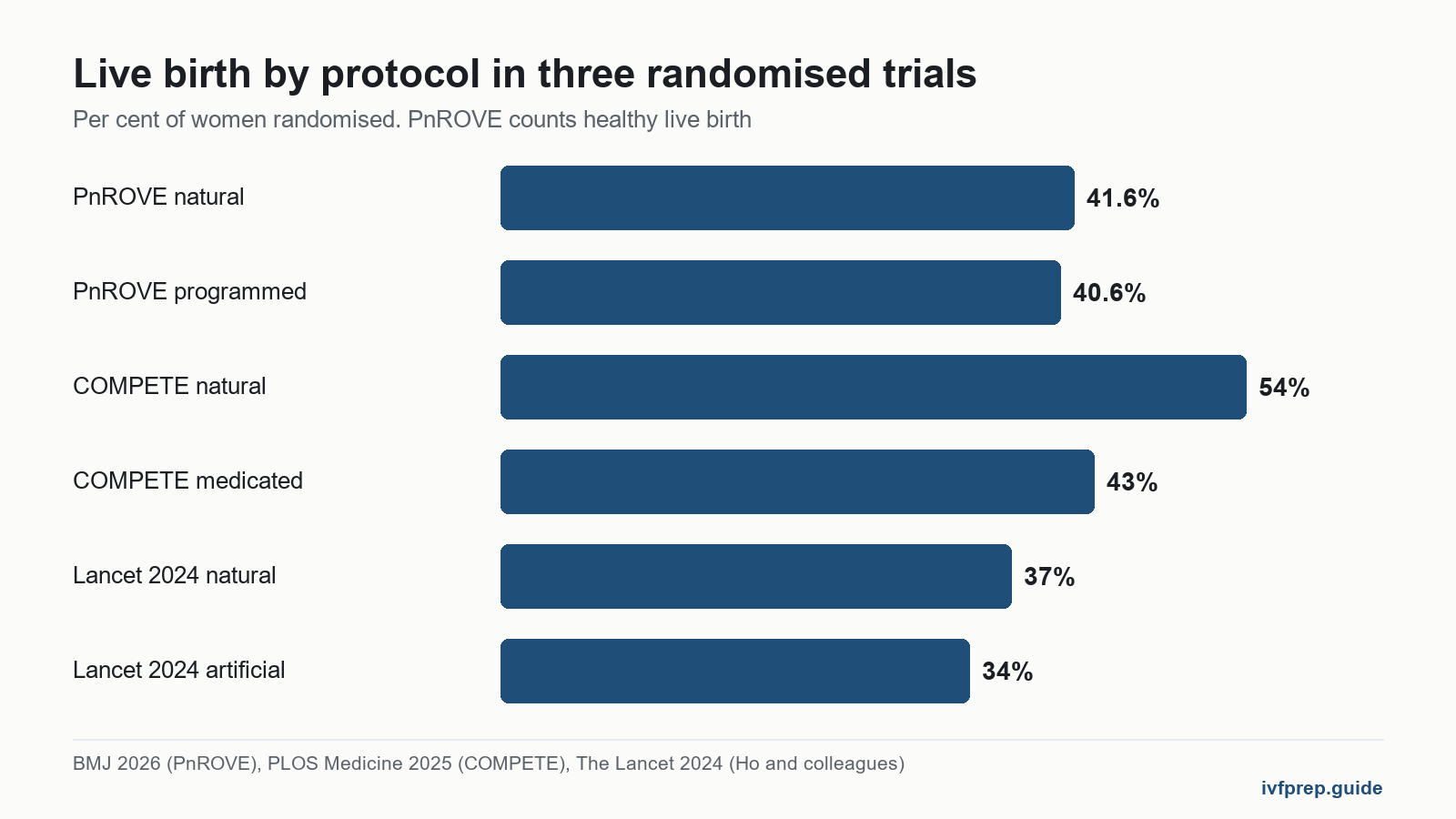
Five randomised trials, set out side by side with their sizes and dates, because the clinic pages tend to summarise all of this as “similar” without a single number. Each row links to its source.
| Trial, journal, date | Who and how many | Main result | Other findings |
|---|---|---|---|
| PnROVE, BMJ, January 2026 | 4,376 ovulatory women, 24 sites in China | Healthy live birth 41.6% natural vs 40.6% programmed, no significant difference | Pre-eclampsia 2.9% vs 4.6%; postpartum haemorrhage 2.0% vs 6.1%; first trimester loss 12.1% vs 15.2% |
| COMPETE, PLOS Medicine, June 2025 | 902 women with regular cycles, one centre in Xi’an | Live birth 54.0% natural vs 43.0% hormone replacement | Miscarriage 13.0% vs 21.4%; hypertensive disorders 9.3% vs 8.0%, not significantly different |
| Ho and colleagues, The Lancet, July 2024 | 1,428 ovulatory women, Ho Chi Minh City, three arms of 476 | Live birth 37% natural, 33% modified natural, 34% artificial, no significant difference | Maternal and neonatal outcomes did not differ, with low power to detect small differences |
| Geysenbergh and colleagues, Human Reproduction, 2026 | 554 ovulatory women, five Belgian centres | Clinical pregnancy with heartbeat 33.1% natural vs 28.9% artificial, no significant difference | Cycles cancelled 3.9% natural vs 9.4% artificial |
| ANTARCTICA, Human Reproduction, 2016 | 959 women analysed, the Netherlands | Ongoing pregnancy 11.5% modified natural vs 9.6% artificial; natural judged non inferior | Recruited 2009 to 2014, so absolute rates are far lower than in the newer trials |
Read the middle column first. Four of the five found no meaningful difference in the main result. COMPETE is the exception, with 11 more live births per 100 women after natural cycles, and it is a real finding from a well run trial. But it was one centre and about 900 women, and PnROVE, nearly five times larger and across 24 sites, did not reproduce it. The honest summary: any effect on live birth is small enough that careful trials cannot agree on it. The right hand column is where the newer evidence leans one way.
Why would the protocol change the risk of pregnancy complications?
Because of what a medicated cycle leaves out. When you ovulate, the empty follicle becomes the corpus luteum, a temporary gland that makes progesterone and several other hormones in early pregnancy, including relaxin, which helps blood vessels relax. A medicated cycle has no ovulation, so it has no corpus luteum. The medication replaces the progesterone. It does not replace the rest.
That idea came from small studies first. In a 2019 study in the journal Hypertension, pre-eclampsia occurred in 12.8 per cent of pregnancies after programmed transfers without a corpus luteum, against 3.9 per cent after modified natural transfers with one. A small observational study cannot prove cause, which is why the randomised trials matter.
PnROVE is the first trial big enough to test it properly, and it pointed the same way. Among clinical pregnancies, pre-eclampsia occurred in 38 of 1,302 after natural cycles and 61 of 1,326 after programmed ones. Postpartum haemorrhage was 2.0 per cent against 6.1 per cent, and placenta accreta spectrum 1.8 per cent against 3.6 per cent. The authors concluded that natural ovulation was as effective, “but with a lower risk of maternal complications”.
Read those numbers as what they are. They are real differences, and they are small in absolute terms: more than 95 in every 100 pregnancies in both arms had no pre-eclampsia. They apply to ovulatory women, and COMPETE, the smaller trial, found no difference in hypertensive disorders at all. It is a reasonable thing to ask about, especially if you have a history of high blood pressure in pregnancy, and the answer belongs to the people who know your history.
Why does the Cochrane review still say nobody knows?
Because of when it was written. The Cochrane review of cycle regimens, published in June 2025, pooled 32 randomised trials and 6,352 women, and concluded that the authors were uncertain whether one regimen is more effective and safer than another. That sentence is now quoted everywhere as the last word.
Look at what sat under it, though. For the comparison this page is about, natural versus hormone therapy cycles, the live birth estimate rested on one study of 233 participants, rated low certainty, and the review found no data at all on pre-eclampsia or hypertensive disorders. The two largest trials in the table above, COMPETE and PnROVE, were published in June 2025 and January 2026, after its searches. A page that quotes the Cochrane conclusion without that context is quoting an honest review that has simply been overtaken.
What do people who have had both actually report?
Eleven replies across three public Mumsnet threads, from April 2024 to January 2025, describing their own frozen cycles. These are reports, not evidence, and they are summarised here in our words.
In a Mumsnet thread from January 2025, one poster said her clinic took the choice away because her cycles were unpredictable and she ovulated late; another chose a medicated cycle because she liked knowing the transfer date in advance. A third said she had found unmedicated cycles more stressful, because the timing of ovulation kept complicating things, and planned to go back to medicated.
In a thread from November 2024, one poster described a medicated cycle that brought “mood swings, palpitations, anxiety, bloating” and said she felt better on a natural cycle with a trigger. The person who started the thread reported that her clinic offered natural first, with the option to switch to medicated if it did not work out.
In a thread from April 2024, monitoring ranged from one scan around day nine or ten plus home ovulation tests, to scans twice a week for three weeks when ovulation came late. One poster said she chose natural because of her own risk of pre-eclampsia.
The range matters more than any single story. Results were reported in both directions: people with a negative on one protocol and a positive on the other, either way round. That says a great deal about how random a single transfer is and almost nothing about the protocol. Every reply in the April thread came from someone whose natural cycle had worked, which is how forums lean: people post when something happened.
Where the accounts agree with the trials: the choice really is mostly about control against fewer drugs, and both routes produce pregnancies. Where they part company: several posters believed natural is simply better for implantation. One good trial supports that, and the largest one does not.
What does the protocol mean for the two week wait?
Less than it might feel like. The protocol was settled before transfer day, and nothing about it can be read during the wait. Progesterone is present either way, from your own corpus luteum or from the medication, and progesterone produces many of the feelings people try to read as signs. That is one reason having no symptoms at all tells you nothing either way, whichever protocol you were on.

If you want to see how the dates fit together from start to test day, the frozen embryo transfer timeline walks through it, and the guide to what clinics actually advise after a FET covers the days that follow. Questions about your own medication, dates or test day go to your clinic, which knows your protocol in a way no website can.
Frequently asked questions
Is a medicated FET less successful than a natural one?
The trials disagree. The largest, PnROVE with 4,376 women, found near identical healthy live birth rates. COMPETE, with 902 women at one centre, found more live births after natural cycles. Both recruited only women who ovulate regularly, and your clinic is the one placed to weigh them.
Do these results apply if my cycles are irregular?
No. Every trial on this page enrolled only ovulatory women, so none of them measured what happens when cycles are irregular. That is the situation where clinics most often use a medicated cycle, and the conversation belongs with your own team.
Are medicated cycles cancelled more often?
The evidence is mixed. A 2026 Belgian trial reported 9.4 per cent of artificial cycles cancelled against 3.9 per cent of natural ones, while COMPETE reported 3.1 per cent and 3.8 per cent, slightly the other way. Cancellation rules also vary between clinics.
How big is the difference in pre-eclampsia?
In PnROVE it was 2.9 per cent after natural cycles and 4.6 per cent after programmed cycles, among clinical pregnancies, an absolute gap of under two percentage points. COMPETE found no significant difference in hypertensive disorders. Most pregnancies in both arms had none.
Why does a medicated cycle need progesterone support for longer?
Because there is no corpus luteum to make it. In a natural cycle the gland left after ovulation produces progesterone in early pregnancy; in a medicated cycle the medication does that job. How long it continues is your clinic’s decision, not something to change from a website.
Can I switch protocol after a transfer that did not work?
People do, in both directions, and clinics sometimes suggest it. One transfer that did not work does not show that its protocol was the problem, because a single transfer carries a lot of chance either way. Whether a change makes sense is a question for the team who has your notes.
Finished the page? The same five questions from the top, to see what stuck.
This article is general information, not medical advice, and is not a substitute for care from a qualified healthcare professional. Speak to your doctor about your own situation.
Leave a Reply