
No study has ever linked heavier or earlier twins implantation bleeding to a twin pregnancy. The amount of blood carries no information about how many embryos implanted, and the only thing that can count them is your clinic’s scan. The belief lives on forums and parenting blogs, and none of them cite a source for it.
Listen to this article, about 12 minutes. A synthetic voice reads the article and announces each section title as it begins; tables are read row by row and the questions at the end are left out.
Recorded 12 October 2026 from the article as published that day. Press a chapter to jump there; the highlighted line is what is playing. A play button sits beside every section heading, and once you scroll past this player a bar at the bottom of the screen keeps the controls in reach. Tap or click any sentence to hear the reading start from there.
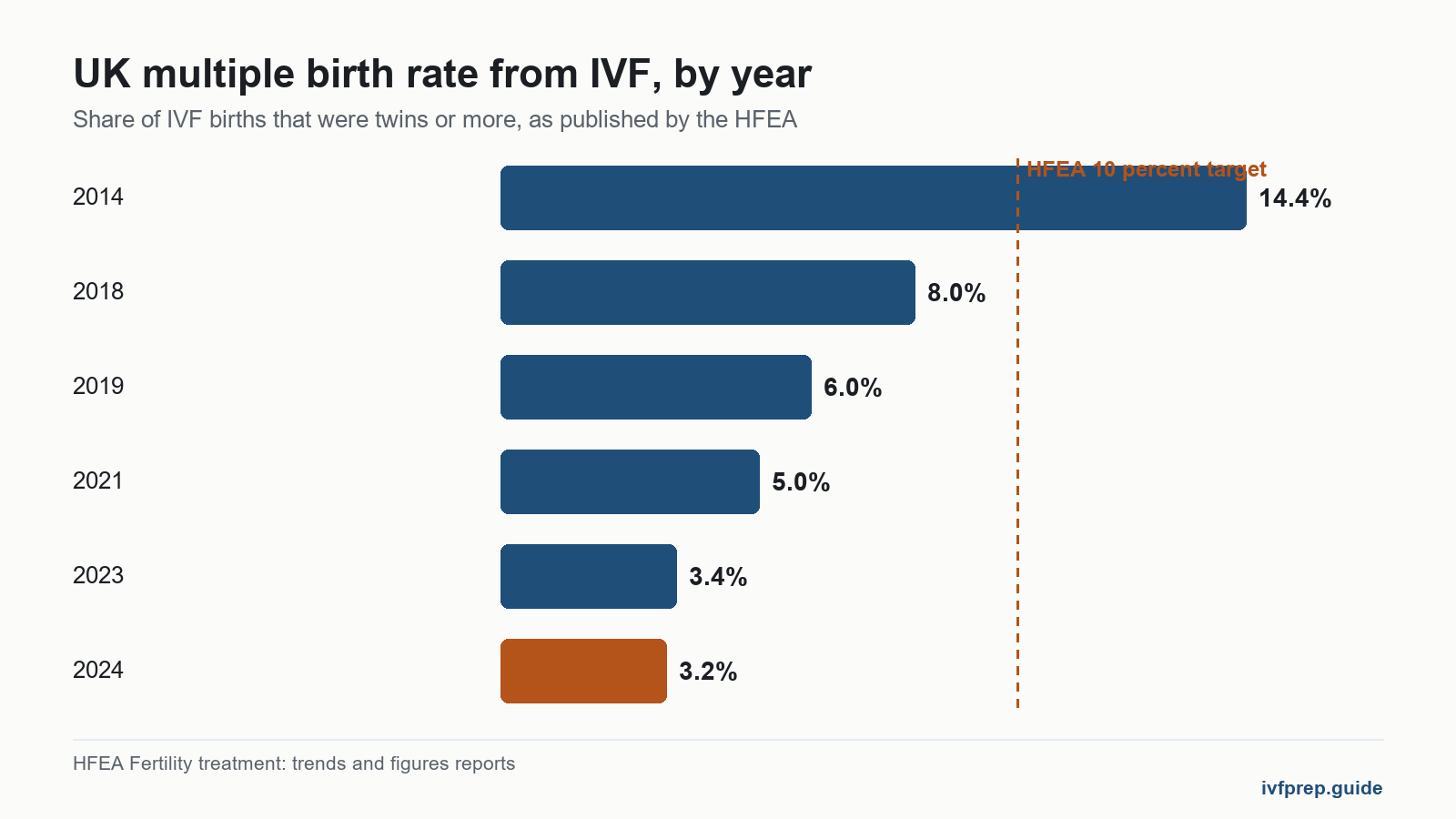
On this page: a table of what six pages that rank for this query say about twins and bleeding beside the source each gives, the HFEA multiple birth rate falling from 14.4 percent in 2014 to 3.2 percent in 2024, four studies of bleeding in twin pregnancies with their counts, and 22 dated accounts from two r/IVF threads.
Think you already know this? Five questions, one minute.
Every answer is on this page. Answer from what you know now; the page fills in the rest.
-
1. What did the 2003 Human Reproduction study conclude about implantation and bleeding?
Harville, Wilcox, Baird and Weinberg dated implantation from daily urine samples in 221 women; 14 of 151 clinical pregnancies bled in the first eight weeks, mostly around the time a period was due, and the authors found no support for implantation causing bleeding. Read the section
-
2. Which pages in the table make the claim that bleeding is heavier or more common with twins?
Flo Health quotes an obstetrician saying bleeding is generally not heavier with twins, and the Healthline and Medical News Today pages on heavy implantation bleeding do not mention twins at all; the claim appears only on pages that cite nothing. Read the section
-
3. What UK multiple birth rate from IVF does the HFEA report for 2024?
The HFEA Fertility treatment 2024 report states the average multiple birth rate decreased from 14.4 percent in 2014 to its lowest UK average of 3.2 percent in 2024, a preliminary figure, with 84 percent of transfers using a single embryo. Read the section
-
4. In the 2013 cohort of 2,106 twin pregnancies, what share reported bleeding before 22 weeks?
McPherson and colleagues recorded 175 of 2,106 twin pregnancies reporting bleeding before 22 weeks, about 8.3 percent, and studied what happened next rather than how much blood there was. Read the section
-
5. How did the four people in the March 2026 r/IVF thread with identical twins from one embryo say they found out?
In the March 2026 thread every one of the four learned it at a scan, and none described bleeding as the thing that told them; these are accounts of what people reported, not findings. Read the section
Somewhere tonight a thread is being written that begins with the word heavier and ends with the word twins. It has a comforting logic, two embryos, twice the disturbance, twice the blood. The trouble is that nobody has ever measured it, and when researchers went looking at bleeding in early pregnancy they found something stranger: implantation may not cause bleeding at all.
Does heavier implantation bleeding mean twins?
No. Not heavier, not earlier, not twice, not pinker. No published study compares the volume of early bleeding between twin and singleton pregnancies, and this site looked on 12 October 2026 and could not find a paper that had even asked the question.
The deeper problem is with the category itself. A prospective study published in Human Reproduction in 2003 by Harville, Wilcox, Baird and Weinberg followed 221 women with daily urine samples so that implantation could be dated directly. Of the 151 who became clinically pregnant, 14 recorded any bleeding at all in the first eight weeks, which is 9 percent, and 12 of those 14 went on to a live birth. The bleeding clustered around the time a period would have been due, rarely on the day of implantation, and the authors wrote that they found no support for the hypothesis that implantation can produce vaginal bleeding. It is hard for twins to make a thing heavier when the thing may not exist.
So the answer is flat, and flat in both directions. A heavier bleed is not a sign of twins. A lighter one, or none, is not a sign of one embryo or of none. We covered what colour and amount can tell you in what implantation bleeding looks like: volume changes whether you phone the clinic, not what the scan will show.

What do the pages that rank for this actually say, and what do they cite?
The twin claim is usually attributed to “experts” without anyone saying which. On 12 October 2026 we read the pages that come up for this query and recorded, for each, what it says about twins and what source it gives.
| Page | What it says about twins and bleeding | Source it gives |
|---|---|---|
| Flo Health, implantation bleeding | Quotes an obstetrician saying implantation bleeding is generally not heavier with twins, because the embryos are too small for a second one to change the amount | An expert quote, no study |
| Healthline, first trimester bleeding | Says you might have a greater chance of first trimester bleeding with more than one baby, and that a 2016 study of IVF twins found bleeding did not change the high chance of a healthy pregnancy | No source on the chance claim; the outcome claim cites Eaton and colleagues, 2016 |
| Healthline, heavy implantation bleeding | Does not mention twins at all; quotes ACOG that 15 to 25 percent of women bleed in the first trimester | ACOG patient information for the bleeding figure |
| Medical News Today, heavy implantation bleeding | Does not mention twins at all | Not applicable |
| Cleveland Clinic, implantation bleeding | Heavy bleeding is not typical of implantation and can point to something else; twins are not mentioned | Clinic patient information |
| Parenting blog, implantation bleeding with twins | Reasons that two blastocysts disturb more of the lining, so bleeding may be more common | None |
Read the right hand column. The medical sites either do not make the twin claim or quote a doctor denying it. It appears only on the pages with no sources, and there as reasoning rather than a finding: two of something ought to do more than one of it. Nothing in this literature was measured that way.
How common are IVF twins now?
Rarer than the forums suggest, and getting rarer every year the regulator publishes. The HFEA report Fertility treatment 2024: trends and figures states that the average multiple birth rate decreased from 14.4 percent in 2014 to its lowest UK average of 3.2 percent in 2024, with 84 percent of transfers in 2024 using a single embryo, which the HFEA describes as one of the highest rates across Europe. The 2023 report gives 3.4 percent for 2023 and recalls that in the early 1990s the UK multiple birth rate from IVF was around 28 percent. The HFEA notes that the figures for 2020 to 2024 are preliminary and have not been validated, so the last two bars may shift a little.
Put that beside the bleeding figure and the arithmetic is worth seeing once. Take 1,000 IVF pregnancies. On the HFEA rate, about 32 are multiples. On the Harville figure, about 90 involve some early bleeding. No study has connected the two, so the simplest assumption is that they are independent, and on it roughly 3 of the 90 who bled are carrying twins and 87 are carrying one. The same 3 in 100 split applies to the 910 who did not bleed. Bleeding moves nothing, and neither group’s odds say anything about one person inside it. Only the scan counts.
That is a UK birth figure. Clinics elsewhere transfer two embryos more often, so the share of twins varies by country and by clinic, and yours can tell you its own rate.
What do twin pregnancies that bled actually show in the studies?
Three papers have looked at bleeding in twin pregnancies, and none did what the forum theory needs, which is to measure the blood and compare it with singletons. They asked a different question: when a twin pregnancy bleeds early, what happens next.
| Study | Who was studied | What it recorded | What it means for the twin question |
|---|---|---|---|
| Harville and colleagues, Human Reproduction, 2003 | 151 clinical pregnancies dated from daily urine samples | 14 bled in the first 8 weeks (9 percent); 12 of the 14 reached live birth; no support for implantation causing bleeding | The category the theory rests on may not exist |
| McPherson and colleagues, American Journal of Obstetrics and Gynecology, 2013 | 2,106 twin pregnancies, retrospective cohort | 175 reported bleeding before 22 weeks, about 8.3 percent; bleeding linked to higher risk of abruption, PPROM and birth before 34 weeks | Most twin pregnancies did not bleed; the study measured outcomes, not amount |
| Eaton, Zhang and Kazer, Fertility and Sterility, 2016 | IVF twin gestations with two sacs on the first scan, 1999 to 2010 | 65 women reported first trimester bleeding and 288 did not; live birth rates were similar at 87.7 percent and 91.7 percent | Bleeding did not predict whether the twins continued; volume was not compared with singletons |
| Ge and colleagues, Frontiers in Endocrinology, 2023 | 4,128 IVF twin pregnancies diagnosed at the first scan | 570 had an intrauterine haematoma in the first trimester, 13.8 percent | A haematoma, not implantation, is the usual named cause when early bleeding in twins is studied |
Two things stand out. In every cohort, most twin pregnancies did not bleed at all. And when early bleeding in twins is studied, the cause researchers name is a haematoma, not the embryo arriving. The McPherson paper also carries a reminder that belongs here straight: in twin pregnancies, early bleeding was associated with a higher chance of later complications. That is a reason to tell your clinic about any bleeding, not a reason to read it at home.
What do people who had twins say about their two week wait?
Forums are evidence of what people believe, not of what is true. But they are the only place where people who ended up with twins describe their own wait, so we read two long threads on r/IVF and counted. Every account below is paraphrased, dated, and what someone reported, not a finding.
In a thread from July 2025 asking whether anyone had a positive beta with no bleed, 17 people said whether they bled in a pregnancy that continued. Ten reported no bleeding at all, six a little spotting, and one bled in a cycle that failed and not in the one that worked. Two of the ten with no bleeding were carrying twins: one had just seen two heartbeats from a single embryo that split, with no bleed in any of six pregnancies; the other had identical twins as the last of four pregnancies and no bleeding in any. The same poster wrote that implantation bleeding is rare and that many fertility doctors call it a myth.
In a March 2026 thread asking how often a single embryo splits into twins, 63 comments included four people with identical twins from one transferred embryo. Every one found out at a scan; not one described bleeding, heavier or otherwise, as the thing that told them. A fifth account, from August 2025, cuts the other way and belongs here for that reason: that person did bleed before the first blood test, was told there were two sacs, and then one stopped growing. Bleeding and twins can coincide. The accounts do not show one predicting the other.
Where the accounts agree with the evidence: most continuing pregnancies, twin or single, involved no bleeding, and nobody reported that volume told them anything. Where they diverge: the threads call spotting implantation bleeding, a label the 2003 study found no support for. We wrote about why uneventful cycles never reach the forums in no bleeding, no symptoms, why absence is not evidence. Twenty two accounts from two threads on one platform is a count, not a rate.

How does anyone find out it is twins?
At a scan, and only at a scan. A blood test measures hCG, and the ranges for one and two embryos overlap so widely that clinics do not read a number as a count. NHS guidance on antenatal care with twins says twins are usually found at the dating scan between 11 and 14 weeks. After IVF, clinics commonly offer an earlier scan, often somewhere around six to eight weeks after transfer, to look for a heartbeat and count the sacs. When it is booked varies by clinic and protocol, and the date on your own paperwork is the only one that applies to you.
Until then there is nothing to count, and nothing you can observe that counts. The tool below is a logger, not a decoder: it keeps the date, what the clinic said and the scan date they gave, so at two in the morning you are reading your own notes rather than a stranger’s theory.
What the clinic said, by date
A record of your own conversations with the clinic, kept on this device, so that at two in the morning you are reading your notes rather than a forum. It records dates and words and nothing else.
This log interprets nothing, counts nothing and predicts nothing. Only your clinic’s scan can say how many embryos there are. Entries are saved on this device only.
When is bleeding a phone call rather than a search?
Everything above is about what bleeding cannot tell you. This section is about the thing it can, and it is written straight.
- Bleeding heavy enough to need a pad, or that soaks a pad quickly, is a same day call to your clinic, or to NHS 111 out of hours. NHS guidance on vaginal bleeding in pregnancy treats heavy bleeding as something to be assessed, not watched.
- Severe pain, pain on one side, shoulder tip pain, feeling faint or dizzy: call 999 or go to A&E. These need ruling out the day they happen.
- Light spotting with no pain: tell your clinic when it opens. They will want to know, and they will not want you to have spent the night deciding whether it counted.
- Any bleeding that frightens you, whatever the amount: that is enough reason to ring. Clinics expect these calls during the wait.
What your clinic has that this page does not: your protocol, the number of embryos transferred, your medication, your scan date and your history. Where to draw the line on bleeding is covered in more detail in clots in the two week wait and in what settles miscarriage against implantation bleeding. Neither of those pages can count embryos either. Nothing can, until the scan.
Frequently asked questions
Can implantation bleeding happen twice if it is twins?
There is no evidence for it. Embryos transferred together implant in the same window, and the 2003 Human Reproduction study found no support for implantation causing bleeding at all. A second bleed days after a first one is more often old blood, progesterone irritation or something your clinic should hear about, which is the reason to tell them.
Does implantation bleeding last longer with twins?
No study has measured it. In the 2003 prospective study, 14 of 151 clinical pregnancies bled in the first eight weeks, mostly around the time a period would have been due, and the researchers did not find duration or volume tracking anything about the pregnancy. Duration is not a counting tool.
Is first trimester bleeding more common in twin pregnancies?
Possibly, but the comparison has not been made cleanly. In a 2013 cohort of 2,106 twin pregnancies, about 8.3 percent reported bleeding before 22 weeks, and in Eaton’s 2016 IVF twin cohort 65 women bled and 288 did not. Neither paper compared those rates with singletons, so the honest answer is that most twin pregnancies did not bleed and nobody has shown they bleed more.
If two embryos were transferred, does bleeding mean both implanted?
No. Bleeding carries no information about how many embryos implanted, or whether any did. The number of embryos transferred changes the chance of twins, which your clinic can discuss with you, and only the scan shows what happened.
Can a single embryo transfer still produce twins?
Yes, when one embryo splits into identical twins. It is uncommon: the HFEA reports a UK multiple birth rate of 3.2 percent of IVF births in 2024 with 84 percent of transfers using a single embryo. In the March 2026 r/IVF thread, the four people who reported this all learned it at a scan, not from a symptom.
When will the clinic know how many embryos there are?
At the first scan. After IVF that is commonly somewhere around six to eight weeks after transfer, though the timing varies by clinic and protocol, and NHS guidance says twins conceived naturally are usually found at the dating scan between 11 and 14 weeks. Your clinic’s own date is the one that applies.
Finished the page? The same five questions from the top, to see what stuck.
This article is general information, not medical advice, and is not a substitute for care from a qualified healthcare professional. Speak to your doctor about your own situation.
Leave a Reply