
The difference between miscarriage and implantation bleeding cannot be seen. Colour, volume, timing and cramping overlap almost completely, and the thing called implantation bleeding has never actually been demonstrated. What separates the two is serial quantitative hCG about 48 hours apart, a scan once one can be read, and time.
Listen to this article, about 13 minutes. A synthetic voice reads the article and announces each section title as it begins; tables are read row by row and the questions at the end are left out.
Recorded 25 September 2026 from the article as published that day. Press a chapter to jump there; the highlighted line is what is playing. A play button sits beside every section heading, and once you scroll past this player a bar at the bottom of the screen keeps the controls in reach. Tap or click any sentence to hear the reading start from there.
On this page: the NG126 thresholds quoted with their numbers, a 2025 cohort of 110 first trimester bleeds with every outcome counted, the prospective study that went looking for implantation bleeding and did not find it, and 27 dated forum replies split across both outcomes.
Think you already know this? Five questions, one minute.
Every answer is on this page. Answer from what you know now; the page fills in the rest.
-
1. How far apart does NICE guideline NG126 say two serum hCG measurements should be taken?
Recommendation 1.4.27 of NICE NG126 sets the interval at as near as possible to 48 hours apart, but no earlier. The interval is what makes the pair readable. Read the section
-
2. In a 2003 prospective study of 151 clinical pregnancies, what did the authors conclude about implantation and bleeding?
Harville and colleagues followed 221 women with daily diaries and urine samples in Human Reproduction in 2003. Fourteen of the 151 clinical pregnancies bled in the first eight weeks, rarely on the implantation day itself. Read the section
-
3. Of the 110 women who presented with first trimester bleeding in the 2025 Chennai cohort, how many pregnancies continued past the first trimester?
Twenty four of the 110 ended in spontaneous abortion, 26 in preterm birth and 60 at term, reported by Sangeetha and colleagues in Cureus on 30 October 2025. It is a proportion of one hospital’s cohort, not a probability for any individual. Read the section
-
4. A transvaginal scan shows a crown to rump length under 7.0 millimetres with no visible heartbeat. What does NG126 tell the clinician to do?
Recommendation 1.4.6 of NG126 requires a minimum of seven days before a diagnosis, and notes further scans may be needed. Through the abdomen, 1.4.8 stretches that to fourteen days. Read the section
-
5. What does NG126 recommendation 1.3.1 say about significant concern over the degree of pain or bleeding?
The wording in NG126 is to refer women who are haemodynamically unstable, or in whom there is significant concern about the degree of pain or bleeding, directly to A and E. Read the section
Search this question and you get the same table eight times. Implantation on the left: light, pink or brown, painless, under three days. Miscarriage on the right: heavy, red, cramping, clots. Most of the pages printing it are cycle tracking apps, a fertility gadget shop and a symptom checker, and not one cites a study for the comparison, because there is not one to cite.
That table is built from the two clean ends of a distribution, and the woman searching this at two in the morning is in the middle of it, where the ends overlap. It quietly implies she can settle this at home with a torch. She cannot, and neither can this page. Nothing below reads your bleeding in either direction, because appearance is not the instrument that answers this question.
What actually tells miscarriage and implantation bleeding apart?
Serial measurement, not description. The clearest published statement of how the question is resolved sits in NICE guideline NG126, which covers early pregnancy bleeding, miscarriage and ectopic pregnancy. Recommendation 1.4.27 says to take two serum hCG measurements as near as possible to 48 hours apart, and no earlier. One value is a dot; two are a direction.
What the direction is read against is published as numbers rather than adjectives. Under recommendation 1.4.29, an increase greater than 63 percent over 48 hours means a woman is likely to have a developing intrauterine pregnancy, although ectopic pregnancy cannot be excluded on that alone, and a transvaginal scan is offered 7 to 14 days later, or earlier if hCG is at or above 1,500 IU per litre. Recommendation 1.4.30 covers the other direction: a decrease greater than 50 percent over 48 hours means the pregnancy is unlikely to continue, and the guideline is careful to add in its own words that this is not confirmed.
Note which words the guideline never uses. Not pink. Not brown. Not how many pads. These NICE figures also sit above the rise thresholds many clinics apply after a transfer, which come from a different literature: where those numbers came from is covered here. Either way the unit is a percentage change across a measured interval, which is something a laboratory does and a bathroom cannot.
| What you might be looking at | What it can settle | What it cannot settle |
|---|---|---|
| How the bleeding looks, its colour and volume | Whether the guidance calls it spotting, light or heavy, which is about how quickly you are assessed | Whether this pregnancy is continuing. No study has shown appearance to separate the two. |
| A home urine test | That hCG is present above that device’s own threshold | Whether hCG is rising or falling, which is the whole question |
| One serum hCG value | The scale of hCG present on that day | Direction. NG126 asks for two values before management changes. |
| Two serum hCG values 48 hours apart | Direction, against the 63 percent and 50 percent thresholds in NG126 | Location. A rise does not exclude an ectopic pregnancy. |
| A transvaginal scan | Location, and viability once a fetal pole or heartbeat can be seen | Anything, if performed before there is something measurable to see |
| Time, meaning a repeat of the above | Almost everything the first round left open | The part nobody can fix, which is what the waiting costs |
Why does every comparison table look so confident?
Because it is describing something that may not exist. The tidiest evidence on this comes from Harville and colleagues in Human Reproduction in 2003, who followed 221 women with daily diaries and daily urine samples while they were trying to conceive. Of the 151 who became clinically pregnant, 14, or 9 percent, recorded any vaginal bleeding in the first eight weeks. The bleeding clustered around the days a period would have been due, and rarely on the day of implantation itself. Their conclusion, in their words, was that they found no support for the hypothesis that implantation can produce vaginal bleeding.
So the left hand column of every one of those tables describes something a prospective study went looking for and did not find. The colour, the duration and the three day limit were never measured in anyone; they were copied. Twelve of those 14 pregnancies ended in a live birth. What the colour and amount actually do and do not indicate has its own page here.
Bleeding after a transfer has ordinary explanations that need no embryo burrowing photogenically into a lining. The cervix is more fragile in early pregnancy and bleeds more easily, vaginal progesterone is delivered against it several times a day, and the transfer itself passed a catheter through it. Which applies to you is a question for your clinic, and what the progesterone labels themselves report about bleeding is set out here. Why brown spotting in particular so often traces back to the pessaries, and what the one study of bleeding before the test found, is set out in whether brown blood after a transfer can be implantation.

How often does early pregnancy bleeding end in a continuing pregnancy?
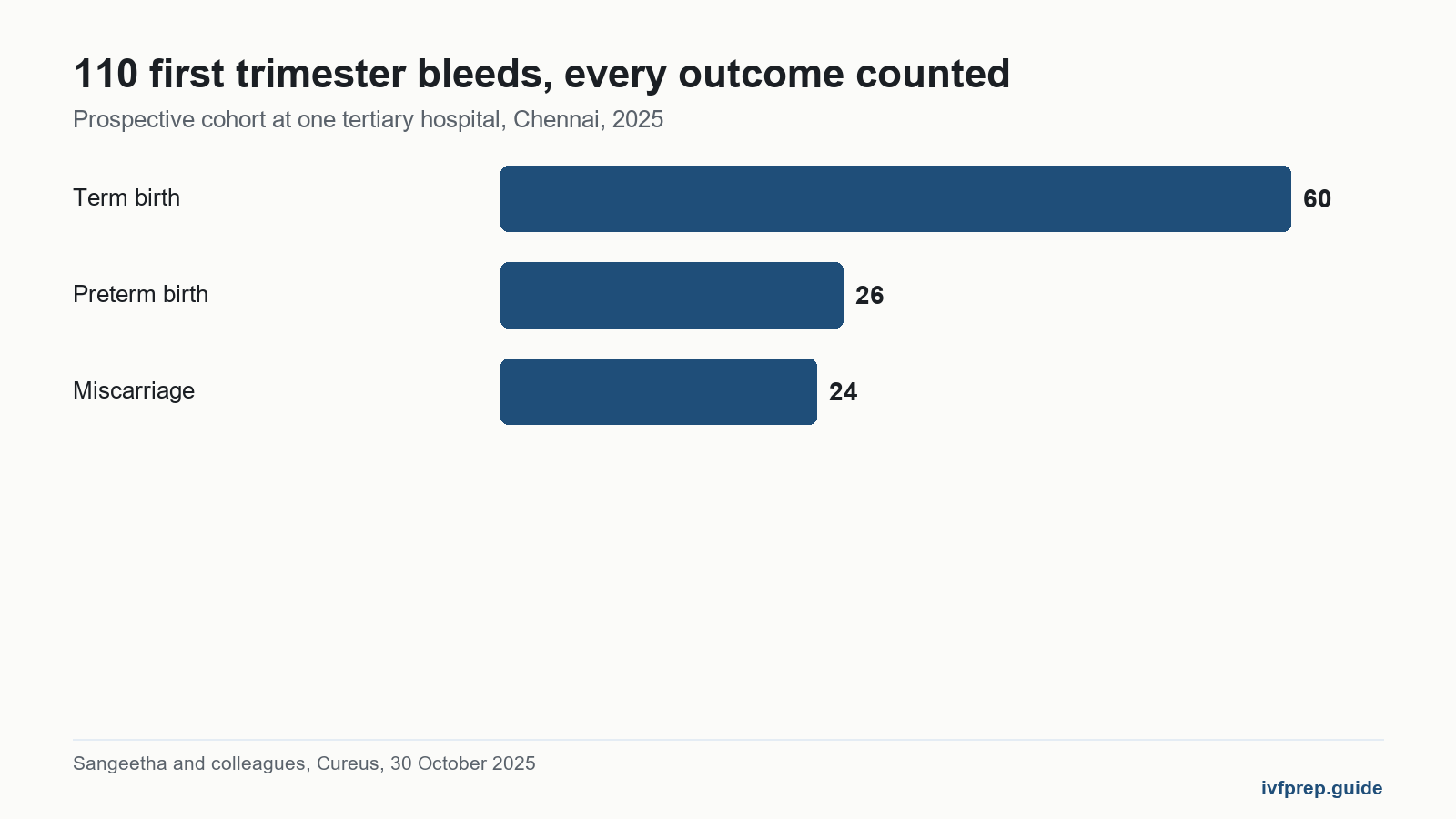
More often than the internet implies, and this is a population figure rather than a forecast. In a prospective cohort published in Cureus on 30 October 2025, Sangeetha and colleagues followed 110 women who presented with first trimester vaginal bleeding at a tertiary hospital in Chennai and recorded what happened to every one of them. Twenty four, 21.8 percent, had a spontaneous abortion. Twenty six, 23.6 percent, had a preterm birth. Sixty, 54.5 percent, delivered at term. So 86 of the 110 pregnancies continued past the first trimester.
Hold that number at arm’s length in both directions. It is one hospital’s population, 110 women rather than thousands, and it counts only women who reached a hospital. A proportion of a cohort is not a probability belonging to anyone in particular. What it is good for is scale: first trimester bleeding is not a synonym for loss, and it is not a clean bill of health either.
| Cohort | Denominator | What was measured | Source |
|---|---|---|---|
| Tertiary hospital, Chennai, 2025 | 110 women presenting with first trimester bleeding | 24 spontaneous abortions (21.8 percent), 26 preterm births (23.6 percent), 60 term births (54.5 percent) | Sangeetha and colleagues, Cureus, 30 October 2025 |
| Right From the Start community cohort, 2009 | 4,510 pregnancies, of which 1,204 reported bleeding | 517 miscarriages. Odds of miscarriage raised for heavy bleeding, mostly where pain came with it; not raised for spotting or light episodes | Hasan and colleagues, Obstetrics and Gynecology, 2009 |
| North Carolina Early Pregnancy Study, 2003 | 151 clinical pregnancies followed with daily diaries | 14 (9 percent) bled in the first eight weeks; 12 of those 14 ended in a live birth; no support found for implantation as a cause of bleeding | Harville and colleagues, Human Reproduction, 2003 |
The middle row is the one the comparison tables should have read first. Heavy bleeding shifts the odds across thousands of pregnancies, and pain alongside it shifts them further, which is why guidance treats that combination as a reason to be seen quickly rather than a reason to conclude anything. Spotting and light episodes moved the odds not at all. Clots sit in the same category of things that feel decisive and are not: what clots can and cannot tell you is here.
When can a scan actually answer the question?
Only once there is something in the uterus large enough to be measured, which is why an early scan often ends with an appointment rather than an answer. NG126 sets out the order. Recommendation 1.4.5 says to look first for a fetal heartbeat, and if there is no visible heartbeat but there is a visible fetal pole, to measure the crown to rump length.
Then the thresholds. If that length is under 7.0 millimetres on a transvaginal scan with no visible heartbeat, recommendation 1.4.6 says to perform a second scan a minimum of seven days later before making any diagnosis, and adds that further scans may be needed. If it is 7.0 millimetres or more with no visible heartbeat, 1.4.7 asks for a second opinion on viability and a repeat scan a minimum of seven days later. Through the abdomen rather than transvaginally, 1.4.8 stretches that repeat to a minimum of fourteen days.
Read those intervals again, because they are the honest answer to how long this takes. The guideline that has looked hardest at the question builds in a week, sometimes two, before anyone is allowed to call it. That is not a clinic being slow with you. The instrument that can answer you is partly a calendar.
What makes bleeding a reason to be seen today?
This part is written straight. NG126 gives two clear triggers. Recommendation 1.3.1 says to refer women who are haemodynamically unstable, or in whom there is significant concern about the degree of pain or bleeding, directly to accident and emergency. Recommendation 1.2.4 says services must have a system that lets a woman referred to her local early pregnancy assessment service be seen within 24 hours where the clinical situation warrants it.
The guideline also lists what an ectopic pregnancy can look like, and the list is broader than most people expect: abdominal or pelvic pain, vaginal bleeding with or without clots, and also shoulder tip pain, dizziness or fainting, urinary symptoms, and rectal pressure or pain when opening the bowels. If you are on luteal support, decisions about that medication belong to the clinic that prescribed it. Bleeding is a reason to telephone them, not a reason to change anything yourself.
Before you telephone the clinic
The left hand column is what services ask for so the call is quick. The right hand items are the circumstances NG126 itself treats as reasons for urgent assessment, quoted from the guideline. Nothing here reads your bleeding or tells you what it means.
Ticks are saved on this device only. Any single item here is a reason to make the call, never a verdict about the pregnancy.
What do people who bled after a transfer actually report?
Three public Mumsnet infertility threads, carrying 27 replies between them and dated April 2023, December 2023 and August 2024 through to February 2025, were read for this article. The accounts below are paraphrased, they are testimony rather than evidence, and none of them is a preview of anyone else’s result.
In the April 2023 thread, all five accounts ended well. One described the lightest pink spotting on wiping at eleven days past transfer and was past seven weeks when she replied. Another had brown spotting the night before test day and was fourteen weeks. A third had pale pink spotting and then a heavier bleed, with scans at roughly seven and twelve weeks both reported as normal. A fourth had a touch of pink three days after transfer and was 29 weeks, with later bleeds her clinic put down to cervical irritation.
In the thread running from August 2024 to February 2025, most went the other way. The woman who started it bled heavily with cramping at six days past a day five transfer and tested negative, and several others described bleeding before their official test date and negative results. One replying in February 2025 described heavy period like bleeding and was still testing positive on test day. The December 2023 thread was mixed: pink spotting that became a red flow at ten days and a negative test for the woman who posted it, and significant bleeding at around twelve days for a replier whose child is now sitting A levels.

Now look at what those threads are rather than what they say. The one where everybody was fine is titled implantation bleeding. The one where most were not is titled heavy bleeding after embryo transfer. Women arrive at the thread whose title already matches the story they are in, and the replies sort themselves the same way, so a thread’s outcome mix is partly a product of its own headline. Read enough of them and you will find whichever pattern you went looking for. That is a fact about forums, not about bleeding.
The accounts agree with the guidance on the sequence: in every one of them the question was settled by a test, a repeat number or a scan, never by looking. They diverge on the belief, stated confidently in all three, that light and pink means one thing and heavy and red another. These women bled every colour and volume on record, in both directions of outcome. One of them was told to continue her medication and assumed clinics always say that, which is its own recurring theme: where clinic advice disagrees has its own page.
What none of it can do is tell you which story is yours. The difference between miscarriage and implantation bleeding, in the only sense that matters tonight, is a number measured twice and a scan performed once there is something to see. Everything else is pattern matching against strangers, and the strangers whose bleeding came to nothing never posted.
Frequently asked questions
Can one blood test tell the difference on its own?
No, and that is not a limitation of your clinic’s laboratory. A single hCG value gives scale with no direction, which is why NG126 asks for two measurements as near as possible to 48 hours apart before management changes. The same guideline also tells clinicians to weigh clinical symptoms above hCG results.
Does the amount of blood settle it?
It changes how quickly you should be assessed, which is not the same thing. Across a cohort of 4,510 pregnancies the odds of miscarriage were raised for heavy bleeding, mostly where pain came with it, and not raised for spotting or light episodes. Both outcomes occurred at every level of bleeding in that study, so the volume in front of you is a reason to telephone rather than a result.
Is brown blood old blood, and does that mean it is over?
Brown usually means blood that took longer to leave, which is a statement about timing and oxidation rather than about a pregnancy. It appears in accounts that ended both ways, and no study has shown colour to separate them. A page calling brown reassuring or red ominous is describing two ends of a distribution and leaving out the middle.
Should I stop my progesterone if I am bleeding?
That decision belongs to the clinic that prescribed it, and this site will not make it for you. The public threads show people stopping on their own, usually having already concluded the cycle failed, and clinics asking them not to. Telephone yours, say what you are seeing and when it started, and ask what they want you to do.
How long before anything is actually certain?
Longer than feels bearable, and the guideline says so in days. Two hCG measurements need 48 hours between them. A scan showing a crown to rump length under 7.0 millimetres with no visible heartbeat is repeated a minimum of seven days later, or fourteen if the scan was through the abdomen. Nobody may shorten those intervals to reassure you, in either direction.
My clinic and an out of hours doctor said different things. Who is right?
This happens often, and usually they are answering different questions. Your clinic knows what was transferred, when, and what medication you are on. An out of hours clinician is assessing bleeding and pain against guidance written for the general population. Where they conflict, ask the service holding your notes, and treat significant concern about pain or bleeding as a reason to be seen regardless.
Finished the page? The same five questions from the top, to see what stuck.
This article is general information, not medical advice, and is not a substitute for care from a qualified healthcare professional. Speak to your doctor about your own situation.
Leave a Reply