
The implantation timeline is counted from ovulation: in the key study, the pregnancy hormone first appeared 6 to 12 days after ovulation, mostly days 8 to 10. A day 5 embryo is five of those days old at transfer, so the window falls 1 to 7 days after a day 5 transfer, 3 to 9 after a day 3.
Listen to this article, about 12 minutes. A synthetic voice reads the article and announces each section title as it begins; tables are read row by row and the questions at the end are left out.
Recorded 3 October 2026 from the article as published that day. Press a chapter to jump there; the highlighted line is what is playing. A play button sits beside every section heading, and once you scroll past this player a bar at the bottom of the screen keeps the controls in reach. Tap or click any sentence to hear the reading start from there.
On this page: a day by day table converting days past ovulation into days past a day 3, day 5 or day 6 transfer, sourced row by row from the 1999 Wilcox study and a 1992 IVF study, plus six clinic test dates people reported.
Think you already know this? Five questions, one minute.
Every answer is on this page. Answer from what you know now; the page fills in the rest.
-
1. In the 1999 urine study, on which days after ovulation did 84 per cent of pregnancies first show hCG?
118 of the 141 pregnancies that lasted six weeks or more first showed hCG on day 8, 9 or 10 after ovulation (Wilcox, Baird and Weinberg, 1999). Read the section
-
2. From which day is an IVF embryo’s age counted?
Embryo age runs from insemination on the day of egg collection; a day 3 embryo is assessed about 68 hours later (Istanbul consensus). Read the section
-
3. About how many days past a day 5 transfer is 9 DPO?
A day 5 embryo is five days old on transfer day, and embryo age matches DPO to within a day, so 9 minus 5 is 4 (Istanbul consensus on embryo days). Read the section
-
4. In the 1992 study of 33 IVF pregnancies, when did the first blood hCG signal appear?
The first signal came at an average embryo age of 7.1 days, range 6.6 to 7.4, measured with a highly sensitive blood assay (Bergh and Navot, 199255259-5/fulltext)). Read the section
-
5. Why does one NHS fertility unit ask patients not to test before the date it gives?
The unit warns the trigger injection can linger for 8 to 10 days, and sets its test at 16 days after egg collection (Guy’s and St Thomas’). Read the section
What does the implantation timeline look like in natural conception?
Almost every page on this subject quotes the same window, and almost all of them got it, directly or third hand, from one study. Wilcox, Baird and Weinberg, writing in the New England Journal of Medicine in 1999, collected daily urine samples for up to six months from 221 women who were trying to conceive. They pinned the day of ovulation from hormone ratios in that urine and took the first appearance of hCG, the pregnancy hormone, as the marker of implantation.
Among the 141 pregnancies that lasted at least six weeks, hCG first appeared between 6 and 12 days after ovulation, and in 118 of them, 84 per cent, it appeared on day 8, 9 or 10. That is the denominator behind every “6 to 12 days” you will read: 141 pregnancies, not a law of nature. It is also a measurement of a hormone in a urine sample, not of a sensation. Nobody in the study was asked what implantation felt like, which is why this site’s look at how long implantation cramps are said to last found that nobody has timed them.
Then nearly every page counts from ovulation, as though everyone reading has one to count from. After a transfer, the embryo’s clock started on the day of egg collection, in a dish.
Why does the timeline move when an embryo goes back on day 3 or day 5?
Because an embryo’s age is counted from fertilisation, which in IVF is the day of egg collection, day 0. Under the ESHRE and ALPHA Istanbul consensus on embryo assessment, a day 3 embryo is assessed at about 68 hours after insemination, when a well developing one has around eight cells. A day 5 embryo is usually a blastocyst, the stage with a fluid filled cavity and an outer layer of cells that will become the placenta, which the guide to blastocyst stages, day by day describes in detail.
In natural conception, the StatPearls chapter on placental physiology places the morula, the ball of cells before the blastocyst, entering the uterus around the fourth day after fertilisation, and implantation about 6 to 7 days after fertilisation. A transfer skips the journey along the fallopian tube, but not the calendar. A day 5 embryo arrives five days into the timeline, a day 3 embryo three days in, and a day 6 blastocyst six.
So the conversion is plain subtraction. Fertilisation happens within about a day of ovulation, so embryo age and days past ovulation, written DPO, line up to within a day. Take the DPO you are reading about and subtract the embryo’s age on transfer day: 9 DPO is 4 days past a day 5 transfer and 6 days past a day 3 transfer. Freezing does not add days. A vitrified embryo is warmed at the age it was frozen, however many years it waited.
How do days past ovulation convert to days past transfer?
The table below does the subtraction and puts the published measurement beside each day, with the source on every row. Transfer day itself counts as day 0. The first column is the embryo’s age, the closest equivalent to DPO.

| Embryo age, about the same as DPO | Days past a day 3 transfer | Days past a day 5 transfer | Days past a day 6 transfer | What the published sources place here |
|---|---|---|---|---|
| Day 3 | Transfer day | Not yet back | Not yet back | Day 3 embryo assessed at about 68 hours, around eight cells (Istanbul consensus) |
| Day 4 | 1 | Not yet back | Not yet back | Morula reaches the uterus in natural conception, around day 4 (StatPearls) |
| Day 5 | 2 | Transfer day | Not yet back | Blastocyst stage, the usual day 5 transfer (Istanbul consensus) |
| Day 6 | 3 | 1 | Transfer day | Earliest first hCG among 141 pregnancies (Wilcox 1999) |
| Day 7 | 4 | 2 | 1 | First blood hCG signal at embryo age 6.6 to 7.4 days in 33 IVF pregnancies (Bergh and Navot 1992) |
| Day 8 | 5 | 3 | 2 | Start of the peak: 84 per cent showed first hCG on day 8, 9 or 10 (Wilcox 1999) |
| Day 9 | 6 | 4 | 3 | Inside the peak (Wilcox 1999) |
| Day 10 | 7 | 5 | 4 | Last day of the peak (Wilcox 1999) |
| Day 11 | 8 | 6 | 5 | Later first hCG, less common (Wilcox 1999) |
| Day 12 | 9 | 7 | 6 | Latest first hCG among pregnancies lasting six weeks or more (Wilcox 1999) |
| Day 16 | 13 | 11 | 10 | One NHS unit’s test day, 16 days after egg collection (Guy’s and St Thomas’) |
Read the right hand column as a range across other people’s pregnancies, not as a schedule. It says where first hCG was found in research samples. It cannot tell you where you are on it, because nothing you can feel or test at home marks the day implantation happens, and every day inside the window is an ordinary day on which nothing is supposed to be noticeable. 9 DPO, for instance, is simply 4 days past a day 5 transfer. The page on why day 9 after a transfer can feel like a period coming works through one of those days in detail.
Transfer day converter
Enter your transfer date and the embryo’s age on that day. It converts the published implantation window into calendar dates and days after transfer. It does not predict anything and it does not know your protocol.
Window from Wilcox, Baird and Weinberg, 1999, 141 pregnancies. Frozen embryos count at the age they were frozen.
Is implantation timed the same way in IVF?
Closely, and the IVF measurement is, if anything, tighter. Bergh and Navot, in Fertility and Sterility in 1992, followed 33 pregnancies from egg donation and frozen embryo cycles, where the embryo’s age is known to the hour, and measured hCG in blood every one to five days with a highly sensitive assay. The first signal appeared at an average embryo age of 7.1 days, within a range of 6.6 to 7.4 days, and its timing followed the embryo’s age rather than how mature the womb lining was.
That is earlier and narrower than the 6 to 12 days from Wilcox, and the difference is mostly method rather than biology. Blood shows hCG sooner than urine, a research assay is more sensitive than anything sold in a pharmacy, and 33 pregnancies is a small group, so treat that precision as indicative. On the shape, the two studies agree: implantation follows the embryo’s age, and it is over well before any clinic’s test day. Neither study can say what any of this means for one embryo, and nor can this page.
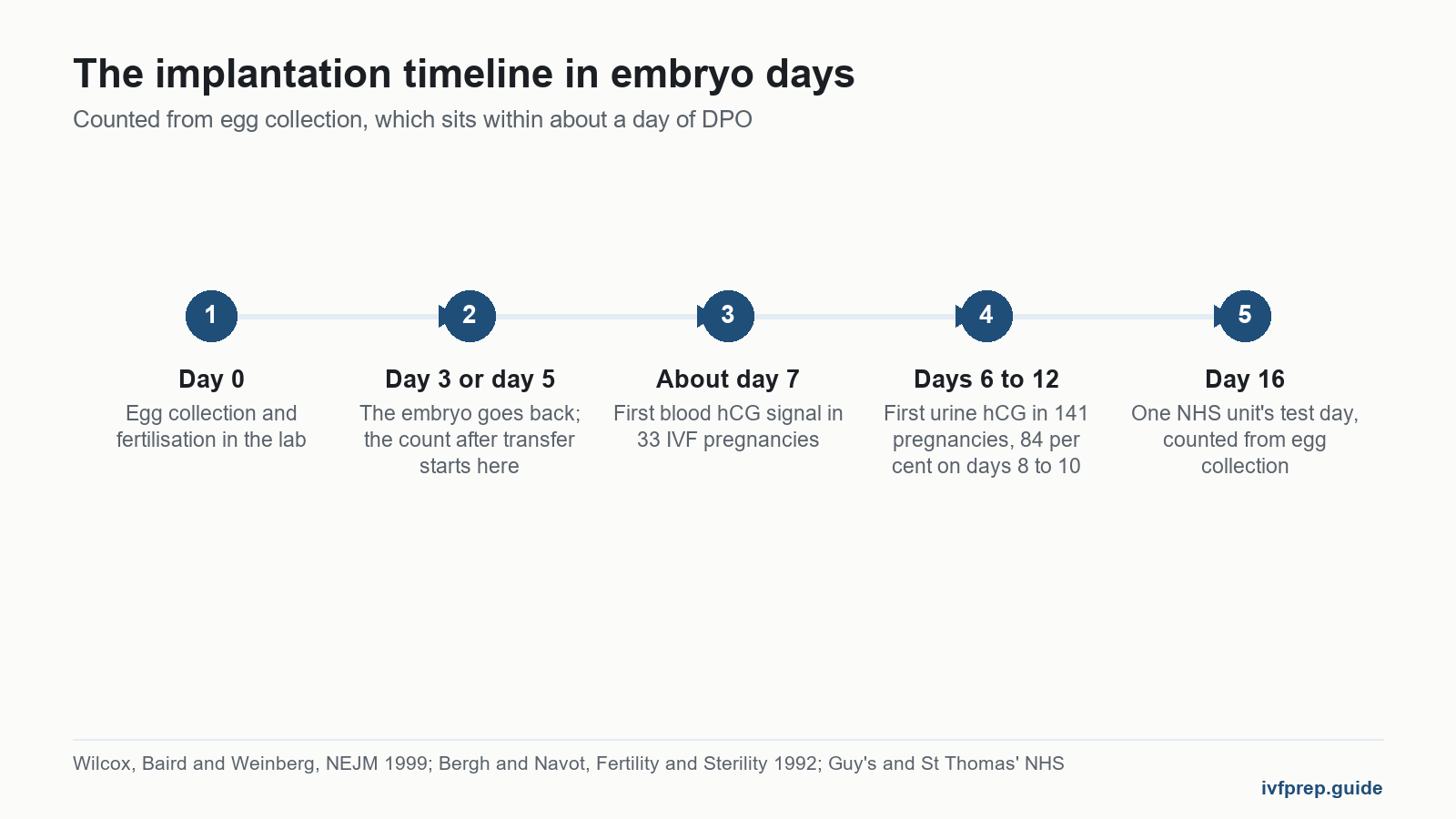
Why do clinics set test day so long after the window closes?
Because the window is when hCG starts, not when there is enough of it to read reliably, and because of the trigger injection. Guy’s and St Thomas’ fertility unit asks patients to test 16 days after egg collection, which is embryo age 16: eleven days after a day 5 transfer, thirteen after a day 3. Counting from collection rather than transfer is the tidiest version of the arithmetic on this page, because it gives every embryo from a cycle the same test day whichever day it went back. The same unit warns that the hCG trigger can stay in the blood for 8 to 10 days and give a false positive, the problem covered in the guide to home pregnancy tests after IVF.

The HFEA’s page on IVF gives no number at all. It says embryos go back two to five days after fertilisation, and that “You’ll be given a date to do a pregnancy test.” Gateshead’s fertility unit asks for its blood test on the allocated day, because the result decides what happens next. Test day, in other words, is a clinic decision, and this site’s frozen embryo transfer timeline puts the usual range at nine to fourteen days after transfer.
What test dates do people report their clinics gave them?
To see how much test day varies in practice, we read two public Mumsnet threads from December 2023 and February 2025, 23 replies in all plus the two opening posts, and picked out every clinic test date given in days after a day 5 transfer. These are reports, summarised in our words, not clinic policy.
In a thread from December 2023, the opening poster’s clinic had booked a blood test 9 days after a day 5 blastocyst transfer. One reply had been given 10 days, and another said her clinic advised waiting the full 14.
In a thread from February 2025, titled after a test date 16 days past a day 5 transfer, one reply reported the same 16 days. Another had 12 days after a fresh day 5 transfer and had been told that anything earlier risked a false positive from the trigger. A third had a blood test at 14 days, because the clinic wanted a first number before advising further.
Six dates, from 9 to 16 days after the same kind of transfer. In embryo age that is day 14 to day 21, every one of them comfortably after the 6 to 12 day window in the published data. The spread reflects clinic policy, how long to wait out the trigger and whether to test blood or urine, not biology: the embryos in these threads were all five days old on transfer day. Cutting against the tidy picture, most posters in both threads also described testing at home before their official date, which is a separate question with its own traps.
Where the accounts agree with the official guidance: every clinic set a fixed date and expected it kept. Where they part company: the threads read a later date as overcaution, while the reasons posters had been given were about the trigger and the type of test.
What can the implantation timeline not tell you?
It cannot tell you whether implantation has happened, on which day, or what any sensation means. The window is a range of days on which hCG was first found in other people’s pregnancies, by daily laboratory tests nobody in the two week wait is having. Nothing you can feel marks it. The evidence on signs of implantation after a transfer is that the symptoms people list are shared with the progesterone and with cycles that did not work, and successful transfers with no symptoms at all are common, which is exactly why you rarely read about them: nobody posts about nothing happening.
The date that counts is the one your clinic gave you. If you have bleeding, pain or anything else that worries you before then, call your clinic. They know your protocol and this page does not.
Frequently asked questions
Is 10 DPO the same as 5 days past a day 5 transfer?
Roughly, yes. A day 5 embryo is five days past fertilisation on transfer day, and fertilisation happens within about a day of ovulation, so five days after a day 5 transfer sits close to 10 DPO. Treat the match as accurate to about a day either way.
Does a frozen embryo add the time it spent frozen?
No. Vitrification pauses development, so an embryo is warmed at the age it was frozen. A day 5 blastocyst frozen for three years is still a day 5 blastocyst on transfer day, and the conversion is the same as for a fresh one.
How do I count a day 6 blastocyst?
Subtract six instead of five. The published window of 6 to 12 days of embryo age then runs from transfer day to six days after it, with the peak of days 8 to 10 falling two to four days after transfer.
Why do some clinics count from egg collection instead of transfer?
Because egg collection is day 0 of the embryo’s age for every embryo from that cycle, so one date works whether it went back on day 3 or day 5. Some NHS units set the test at 16 days after collection for exactly this reason.
Can implantation happen later than 12 days?
None of the 141 pregnancies lasting six weeks or more in the main study showed hCG first appearing later than 12 days after ovulation. That is a range across a research group, which is one reason clinics test after the window rather than during it.
Is the timeline slower after a day 3 transfer?
No. The embryo develops at its own pace either way; a day 3 embryo simply goes back earlier, so the same biological days fall later in the count after transfer. Embryo age 8 to 10 is 5 to 7 days after a day 3 transfer and 3 to 5 after a day 5.
Finished the page? The same five questions from the top, to see what stuck.
This article is general information, not medical advice, and is not a substitute for care from a qualified healthcare professional. Speak to your doctor about your own situation.
Leave a Reply