
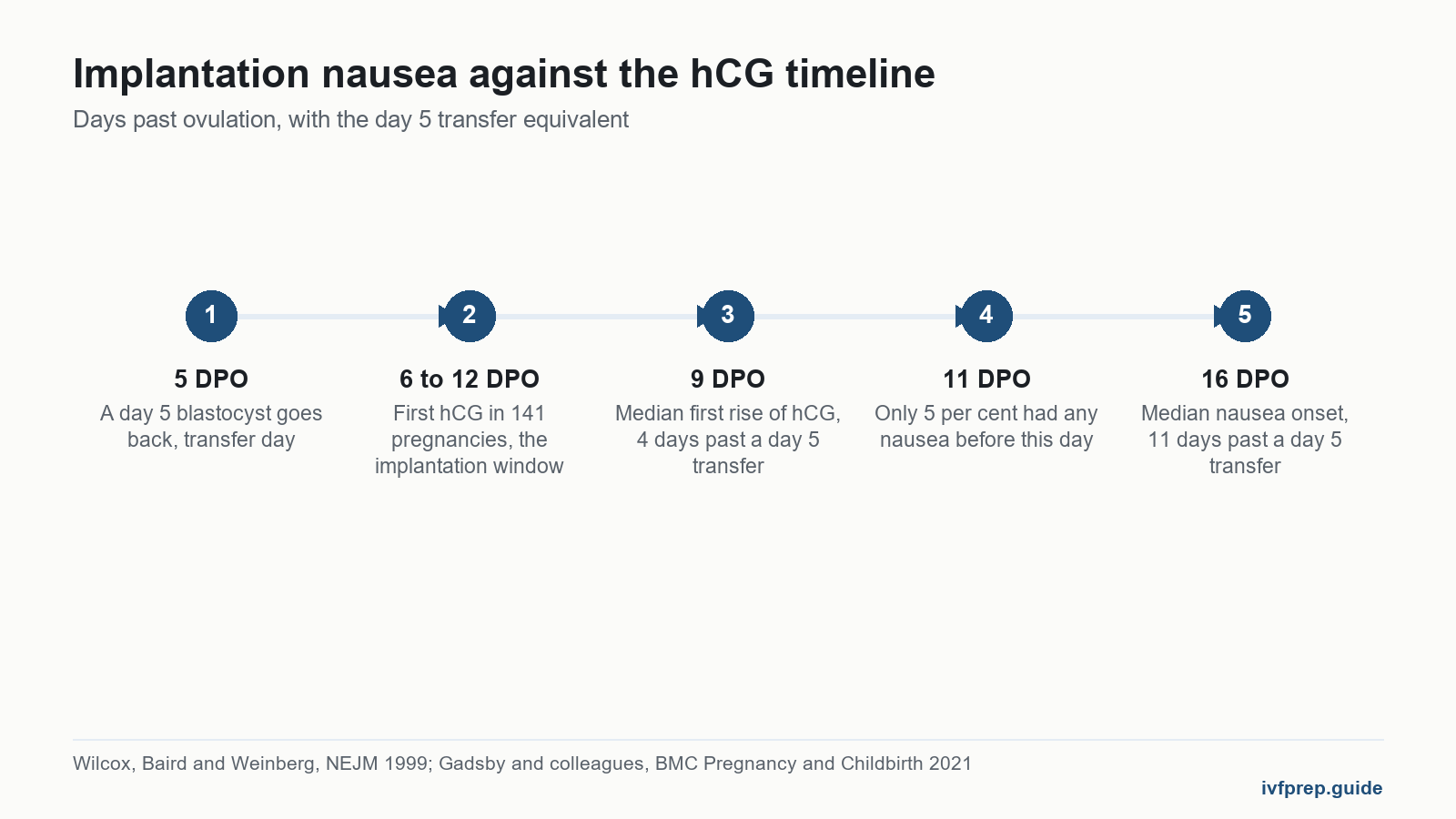
Implantation nausea is mostly a mismatch of dates. In a 2021 diary study of 256 pregnancies, hCG first rose a median 9 days after ovulation, but nausea began a median 16 days after, and only 5 per cent felt it before day 11. After a transfer, progesterone causes nausea too, so it cannot be read either way.
Listen to this article, about 12 minutes. A synthetic voice reads the article and announces each section title as it begins; tables are read row by row and the questions at the end are left out.
Recorded 15 October 2026 from the article as published that day. Press a chapter to jump there; the highlighted line is what is playing. A play button sits beside every section heading, and once you scroll past this player a bar at the bottom of the screen keeps the controls in reach. Tap or click any sentence to hear the reading start from there.
On this page: a table converting the 2021 nausea onset diaries into days past a day 3 or day 5 transfer, the nausea rates printed on two progesterone labels, and eight dated forum accounts.
Think you already know this? Five questions, one minute.
Every answer is on this page. Answer from what you know now; the page fills in the rest.
-
1. In the 2021 diary study, what was the median time from ovulation to the start of nausea?
hCG rose a median 9 days after ovulation, and nausea began a median 16 days after it (Gadsby and colleagues, 2021). Read the section
-
2. About how many days after a day 5 transfer is 16 days past ovulation?
A day 5 embryo is about 5 DPO on transfer day, so 16 minus 5 is 11, which puts the median nausea onset around many clinics’ test day (Gadsby and colleagues, 2021). Read the section
-
3. In the Crinone 8% once daily IVF study printed on the label, what share of women reported nausea?
The label reports nausea in 22 per cent of 139 women in that study (Crinone prescribing information). Read the section
-
4. How many of the 256 pregnancies in the 2021 study recorded no nausea or vomiting at all?
Nausea or vomiting was recorded in 241 of 256 pregnancies, leaving 15 with none in the weeks they were followed (Gadsby and colleagues, 2021). Read the section
-
5. Which of these does the NHS list as a reason to get help with sickness?
The NHS lists being unable to keep food or fluids down for 24 hours among the signs that need help (NHS guidance). Read the section
When does implantation happen, and when does pregnancy nausea start?
The best evidence on the first question is still the 1999 urine study by Wilcox, Baird and Weinberg in the New England Journal of Medicine: among 141 pregnancies that lasted at least six weeks, hCG, the pregnancy hormone, first appeared 6 to 12 days after ovulation, and on day 8, 9 or 10 in 84 per cent of them. Implantation is the event that starts hCG, so that is the window.
The second question was answered much more recently, and far more precisely. Gadsby and colleagues, publishing in BMC Pregnancy and Childbirth in 2021, recruited UK women who were trying to conceive, had them collect daily urine so the lab could date ovulation from the LH surge and catch the first rise of hCG, and asked them to keep a symptom diary from before they knew they were pregnant. That last detail matters. Older studies asked women at their first antenatal appointment, often around 12 weeks, to remember when the sickness began, which is roughly as reliable as asking someone in March when their cold started.
Across 256 pregnancies, hCG rose above 1 mIU/ml, a laboratory threshold far below anything a pharmacy test reads, a median 9 days after ovulation, and within 8 to 10 days in 88 per cent. Nausea or vomiting was recorded in 241 of the 256. Its onset came a median 16 days after ovulation. Two thirds of those women first felt it between day 11 and day 20, and only 5 per cent before day 11. The earliest onset anyone recorded was day 8.
So the hormone comes first and the sickness follows, typically a week or so later. That order makes biological sense: the authors link nausea to a specific stage of development at the junction of embryo and womb, which comes after implantation, not during it.
How do those days line up after a day 3 or day 5 transfer?
Every number above is counted from ovulation, and after a transfer there is no ovulation day to count from. The conversion is subtraction. An embryo’s age, counted from egg collection, matches days past ovulation to within about a day, so a day 5 blastocyst is roughly 5 DPO on transfer day and a day 3 embryo roughly 3 DPO. The implantation timeline after a day 3 or day 5 transfer walks through the arithmetic in full; the table below applies it to nausea, with the source on every row.
| Days past ovulation | Days past a day 5 transfer | Days past a day 3 transfer | What the published data places here |
|---|---|---|---|
| 6 DPO | 1 | 3 | Earliest first hCG among 141 pregnancies (Wilcox 1999) |
| 8 DPO | 3 | 5 | Earliest nausea onset recorded in 241 diaries (Gadsby 2021) |
| 9 DPO | 4 | 6 | Median first rise of hCG; 88 per cent rose on days 8 to 10 (Gadsby 2021) |
| 11 DPO | 6 | 8 | Before this day, only 5 per cent had any nausea (Gadsby 2021) |
| 13 DPO | 8 | 10 | A quarter had started feeling sick by now (Gadsby 2021) |
| 16 DPO | 11 | 13 | Median nausea onset (Gadsby 2021) |
| 20 DPO | 15 | 17 | Two thirds had their onset between day 11 and here (Gadsby 2021) |
| 22 DPO | 17 | 19 | Three quarters had started by now (Gadsby 2021) |
Read down the day 5 column and the shape is plain. In the first week after a blastocyst transfer, the data puts very little pregnancy nausea anywhere: the median onset lands 11 days after transfer, which for many clinics is around test day itself. Two honest caveats. These were natural conceptions, not IVF, and no equivalent diary study after transfer turned up in this research. And a range across 241 women says nothing about where one person sits on it.
Why can progesterone cause nausea in the two week wait?
Because nausea is a listed side effect of the progesterone that supports nearly every transfer, and it starts on its own schedule, not the embryo’s. The prescribing labels give the numbers from the trials that licensed each product.

| Product and study | Women | Reported nausea |
|---|---|---|
| Endometrin label, 100 mg twice daily, ART study | 404 | 32, or 8 per cent |
| Endometrin label, 100 mg three times daily, same study | 404 | 29, or 7 per cent |
| Crinone 8% label, once daily, IVF luteal support | 139 | 22 per cent, with vomiting in 5 per cent |
| Crinone 8% label, twice daily, donor egg transfer | 61 | 7 per cent |
These figures need one warning label of their own. The Endometrin study ran for 10 weeks and the women in it included those who became pregnant and those who did not, alongside egg collection pain and ovarian hyperstimulation. So the label numbers blend medication, procedure and pregnancy into one column. That is not a flaw in this page’s argument; it is the argument. If a drug company with 808 women on its product and a trial protocol cannot separate progesterone nausea from pregnancy nausea, a person on day 4 after transfer cannot either. Back pain gets the same blame on the forums, and the page on what the labels record about lower back ache and implantation finds it missing from the IVF trials altogether. Bloating lands in the same mixed column, and the page on why bloating says nothing about implantation, and the kind clinics want reported sets the leaflet figures beside the OHSS warning list.
The same overlap runs through the rest of the list. This site’s guides to diarrhoea and implantation and signs of implantation after a transfer found the same pattern for gut symptoms, sore breasts and cramps: the medication produces them in cycles that work and cycles that do not. What your own medication may cause is a question for your clinic, which knows your protocol; this page does not. Headaches follow the same pattern, and the placebo groups in the hormone trials show why a headache after transfer cannot be read either way.
Why do so many pages list nausea as a sign of implantation?
Mostly because implantation and early pregnancy get folded into one list. Several of the pages that rank for this search put nausea among the signs of implantation, then say a few lines later that morning sickness usually starts weeks into a pregnancy. Both statements cannot describe the same day. At least one borrows the 11 to 20 day figure from the 2021 study, which is the window for nausea onset, and sets it beside implantation, which that same study dates about a week earlier.
There is also a survivorship problem on the forums, where these lists are born. Someone who felt queasy on day 5 and then got a positive result posts about the queasiness. Someone who felt queasy and got a negative is less likely to come back to it, and someone who felt nothing at all and got a positive has nothing to post. The 2021 diaries show that last group is real: 15 of the 256 pregnancies recorded no nausea or vomiting at all in the weeks they were followed. Successful transfers with no symptoms are common, and invisible for exactly that reason. The guide to conception symptoms before implantation traces the same effect for the days before the window opens.
What do people on IVF forums report about nausea?
To see whether the accounts match the dates, we read three public Mumsnet threads from April 2023, October 2023 and March 2025, about 55 posts in all, and picked out every post that mentioned nausea or having no symptoms. These are what people report, summarised in our words, not findings.

In an April 2023 thread started two days after a day 5 transfer, one poster on Cyclogest and Lubion described nausea and tender breasts from around two days after transfer and put both down to the progesterone. Two days after a blastocyst transfer is about 7 DPO, before the earliest onset in the 2021 diaries. Another poster in the same thread reported barely any symptoms at all.
In an October 2023 thread about the wait after a frozen transfer, a poster who went on to test positive attributed what she felt to her medication, which included two progesterone products and steroids. Another recalled feeling sick in an earlier cycle that had not continued.
In a March 2025 thread for people newly pregnant after IVF, one poster at nine weeks described nausea that began around week 5, the timing the diary study would predict. Another, at about five weeks, reported nothing beyond tiredness. A third, newly positive, was nauseous and exhausted and thought some of it was probably the Cyclogest.
That is eight relevant accounts, ranging from strong nausea to none, and in both outcome groups. Where they agree with the evidence: posters who felt sick within days of transfer mostly blamed the progesterone, and the one who dated a pregnancy onset put it at about week 5. Where they part company with it: the threads still treat each twinge as worth reporting, and nobody reports the cycles where nothing happened.
When is nausea after a transfer a reason to call the clinic?
When it comes with other symptoms, or when you cannot keep fluids down. After a fresh cycle, nausea and vomiting are among the symptoms of ovarian hyperstimulation syndrome listed by Guy’s and St Thomas’ fertility unit, alongside tummy pain and swelling, passing small amounts of dark urine, thirst, diarrhoea, dizziness and shortness of breath. The unit says it can develop after egg collection or transfer, and asks anyone with these symptoms to contact them.
The NHS guidance on sickness in pregnancy lists the signs that mean you need help, including very dark urine or none for 8 hours, being unable to keep food or fluids down for 24 hours, feeling dizzy or faint when you stand, tummy pain, a high temperature or vomiting blood. Those signs matter in the two week wait too, whatever is causing the sickness.
If you have any of them, or anything else that worries you, call your clinic. They know your protocol, your medication and your history, and this page does not. The date that answers the question underneath all of this is the test date they gave you, and the guide to home pregnancy tests after IVF explains why testing early can mislead.
Clinic call log
If you ring your clinic during the wait, note the date, what you asked and what they told you, so the answer is in one place at two in the morning.
This only records what your clinic told you. It does not track or interpret symptoms, and it stays in this browser.
Frequently asked questions
Can you feel sick on the day of implantation?
No study has measured a sensation on the day of implantation, because nothing marks that day outside a laboratory. In the 2021 diary study, the earliest recorded nausea onset was 8 days after ovulation and only 5 per cent began before day 11.
Is nausea at 5 days past a day 5 transfer a pregnancy symptom?
It cannot be told apart. Five days after a day 5 transfer is about 10 DPO, before most recorded pregnancy nausea, and progesterone lists nausea as a side effect. Neither its presence nor its absence says anything about the result.
Does nausea in the two week wait come from the progesterone?
It can. The prescribing labels report nausea in 7 to 22 per cent of women in the trials, which included both pregnant and non pregnant women. Whether it is the medication in your case is a question for your clinic.
Does having no nausea mean the transfer has not worked?
No. In the 2021 study, 15 of 256 pregnancies recorded no nausea at all, and for most of the rest it began after the usual test day. An absence of nausea during the wait is the ordinary picture in either outcome.
Is nausea after a frozen transfer different from after a fresh one?
The timing of any pregnancy nausea follows embryo age either way. A fresh cycle adds the possibility of ovarian hyperstimulation, where nausea with a swollen tummy or reduced urine is a reason to call the clinic.
Why do symptom lists online include implantation nausea?
Many lists merge implantation and early pregnancy into one set of signs, and forums over represent people who felt something and got a positive. The dated studies place pregnancy nausea about a week after the first rise of hCG.
Finished the page? The same five questions from the top, to see what stuck.
This article is general information, not medical advice, and is not a substitute for care from a qualified healthcare professional. Speak to your doctor about your own situation.
Leave a Reply