
There are no reliable signs of implantation after an embryo transfer. Implantation involves a few cells and no nerve supply, so there is nothing to feel, and the progesterone prescribed for the wait produces the same tiredness, sore breasts, bloating and mood changes as early pregnancy. The only measurement that answers the question is the blood test your clinic booked.
Listen to this article, about 14 minutes. A synthetic voice reads the article and announces each section title as it begins; tables are read row by row and the questions at the end are left out.
Recorded 18 October 2026 from the article as published that day. Press a chapter to jump there; the highlighted line is what is playing. A play button sits beside every section heading, and once you scroll past this player a bar at the bottom of the screen keeps the controls in reach. Tap or click any sentence to hear the reading start from there.
On this page: the twelve NHS early pregnancy signs set beside the progesterone pessary leaflet, where eight of them appear under their clinical names, the 1999 study that timed when hCG first shows, the daily diary study that never found a worst day, and the HFEA list of symptoms that are a call to the clinic rather than a search.
Think you already know this? Five questions, one minute.
Every answer is on this page. Answer from what you know now; the page fills in the rest.
-
1. How many of the twelve early pregnancy signs on the NHS page also appear on the Cyclogest 400 mg leaflet’s list for women having fertility treatment?
Breast pain, tiredness and constipation sit in the common band and five more in the uncommon band, as the Cyclogest 400 mg leaflet lists them beside the NHS signs of pregnancy. Read the section
-
2. In the 1999 study that timed implantation with daily urine samples, on which days after ovulation did hCG first appear in 84 percent of the pregnancies that lasted past six weeks?
Wilcox and colleagues, New England Journal of Medicine, 1999 found first appearance between days 6 and 12, with 84 percent on day 8, 9 or 10, in natural conceptions; a day five transfer shifts the calendar. Read the section
-
3. Which single explanation covers sore breasts, tiredness, bloating and mood changes in the two week wait whether or not the cycle worked?
All four are listed effects of progesterone luteal support in the Cyclogest 400 mg summary of product characteristics, and they are the same effects early pregnancy produces. Read the section
-
4. What did the one study that recorded IVF patients’ emotions day by day report about the waiting stage?
Boivin and Lancastle, 2010 followed 61 women and reported stage averages, not a worst day; the mid wait dip is commonly reported, not measured. Read the section
-
5. Which of these does the HFEA list as a symptom of ovarian hyperstimulation to contact the clinic about immediately?
The HFEA page on the risks of fertility treatment lists a swollen stomach and stomach pains, nausea and vomiting, shortness of breath, faintness and reduced urine output, and says never feel you are wasting the clinic’s time. Read the section
That is not what anyone in the two week wait is hoping to read, so this page explains why it is true rather than just asserting it, and it does one thing the symptom lists never do: it puts the NHS list of early pregnancy signs beside the progesterone leaflet, line by line.
Progesterone is also why a good deal of cramping in that fortnight has an ordinary explanation, which we lay out in what actually causes pain after an egg transfer. It is why the side you feel cramps on tells you nothing, which our page on where the cramps are and why the map is wrong goes through with the physiology of pelvic pain, and why the confident figures for how long implantation cramps are supposed to last trace back to no study that ever timed them. Nausea shows the overlap most plainly: the dated diary study behind implantation nausea and the hCG timeline puts the usual onset around 16 days after ovulation, well after the implantation window. Progesterone moves the thermometer as well, which is why a basal temperature implantation dip cannot be read as a sign after a transfer.
So the symptoms you are examining so closely are, in most cases, telling you about your medication rather than your embryo. Discharge is the clearest case: in two trials that swapped vaginal progesterone for injections, discharge reports fell from 17 percent to about 4, as our page on what discharge during implantation actually reflects sets out in a table. That holds for digestive symptoms too: what diarrhea in the two week wait actually points to is progesterone, stress and a fortnight of sudden diet changes. Bleeding with clots gets read hardest of all, and our page on clots in the two week wait explains why it cannot settle the question either. Headaches, which two hormone labels report almost as often in their placebo groups, are the subject of headaches and implantation after a transfer.
What do people report feeling, and where does it come from?
| What you notice | Most likely explanation |
|---|---|
| Mild cramping | The transfer itself, progesterone, or ordinary digestion |
| Sore or heavy breasts | Progesterone: breast pain is in the common band of the pessary leaflet |
| Tiredness | Progesterone, listed as common, plus the exhaustion of the process itself |
| Bloating | Progesterone slowing the gut: abdominal distension, listed as common |
| Light spotting | The catheter, the pessaries, or a sensitive cervix |
| Nausea | Progesterone, or anxiety, which produces it convincingly |
| Mood swings | Progesterone, listed as uncommon, and the situation you are in |
| No symptoms at all | Also completely normal, and not a bad sign |
Look at the right hand column. Every row has an explanation that has nothing to do with whether the cycle worked, and most of them are printed on the medicine’s own leaflet, which is the next section. That is the whole problem with symptom spotting, and it is why the lists you find elsewhere cannot deliver what they promise. The first row is worth pausing on, because a good deal of early cramping is simply the procedure, and our minute by minute account of the egg transfer process sets out which parts of the appointment leave a mark.

Which early pregnancy signs are also on the progesterone label?
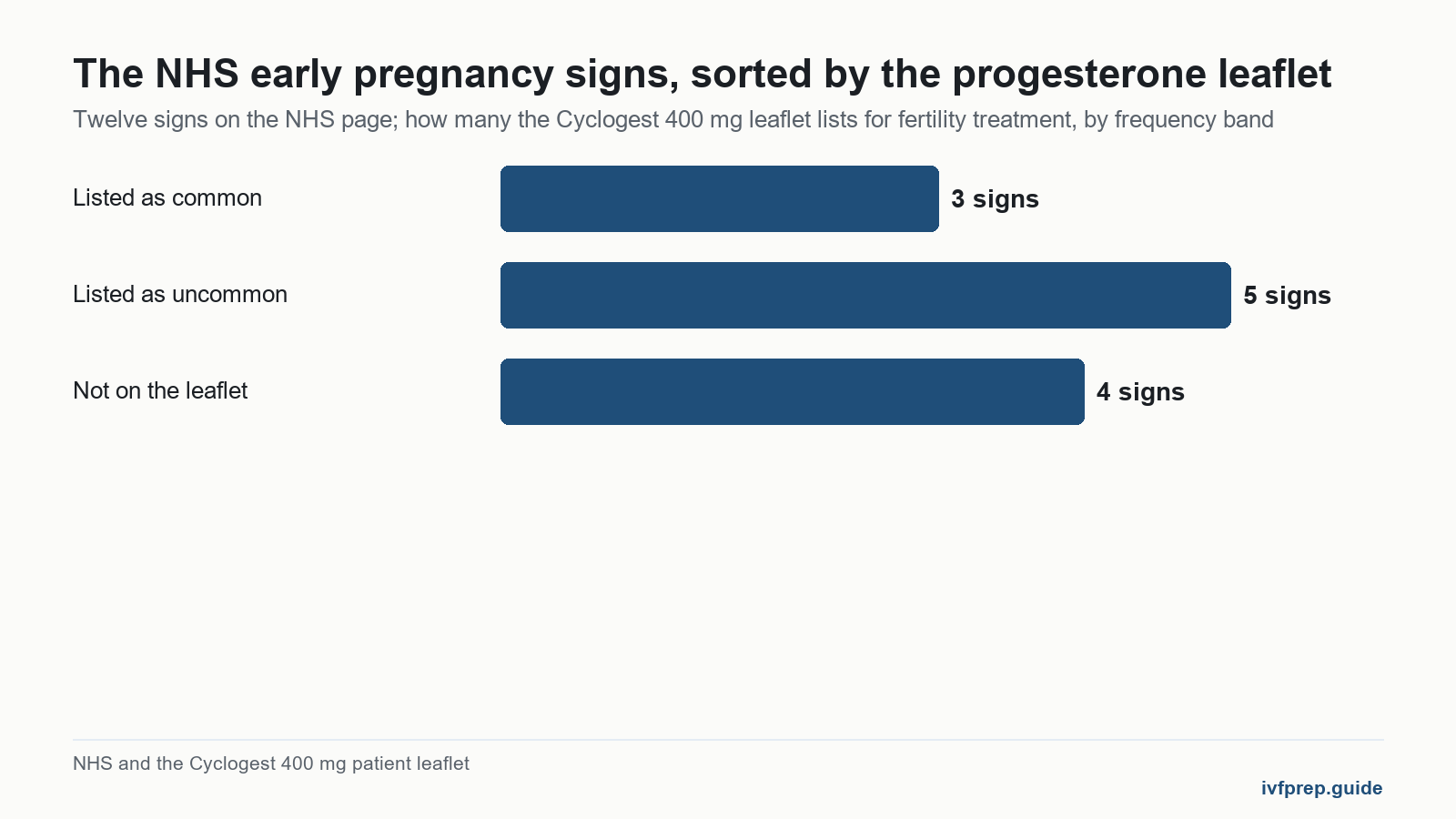
The NHS page on the signs and symptoms of pregnancy, last reviewed on 31 July 2026, names twelve early signs. The patient leaflet for Cyclogest 400 mg pessaries, a progesterone that many UK clinics prescribe for luteal support, revised in October 2022, lists its side effects for women having fertility treatment in two bands: common, which may affect up to 1 in 10 people, and uncommon, up to 1 in 100. Set the two documents side by side and eight of the twelve NHS signs appear on the leaflet under their clinical names.
| NHS early pregnancy sign | On the Cyclogest 400 mg leaflet as | Frequency band |
|---|---|---|
| Sore breasts | Breast pain | Common, up to 1 in 10 |
| Feeling extremely tired | Tiredness | Common, up to 1 in 10 |
| Constipation | Constipation | Common, up to 1 in 10 |
| Changes in your mood | Mood changes | Uncommon, up to 1 in 100 |
| A metallic taste in your mouth | Change in taste | Uncommon, up to 1 in 100 |
| Feeling or being sick | Vomiting | Uncommon, up to 1 in 100 |
| Needing to pee more often | Frequent urination | Uncommon, up to 1 in 100 |
| A bleed like a very light period | Vaginal bleeding | Uncommon, up to 1 in 100 |
| Missed period | Not on the fertility treatment list | The general list says a period may come early or late |
| More vaginal discharge | Not listed | Leakage of the pessary base is listed separately |
| Sensitivity to smells | Not listed | |
| Cravings for new foods | Not listed |
Bloating is not on the NHS list, but it is the most talked about complaint of the wait and it is on the leaflet too, as abdominal distension in the common band. The prescriber’s version of the same document, revised on 13 December 2023, adds fatigue, pelvic pain, headache, hot flushes and night sweats. None of this says your symptoms are imaginary. They are real, they are printed, and they arrive with the medicine whether or not an embryo has attached. Other progesterone products carry their own leaflets, your clinic chose yours for reasons it can explain, and nothing here is a reason to change how you take it. Skin is missing from the NHS list as well, though several transfer medicine leaflets list rashes and itching, which is why an implantation rash is not a sign of anything either way.
Why do the symptom lists keep appearing anyway?
Because people want them, and because after a positive result it is genuinely easy to look back and identify the twinge that meant something. That is memory doing what memory does, not evidence.
The women who felt exactly the same things and got a negative result do not write those posts. So the internet fills up with symptom lists assembled entirely from successful cycles, and every one of them looks like a pattern. The same imbalance shows up plainly in 38 forum accounts of two week wait cramping and how each cycle ended, where severe cramping preceded a negative in one account and a positive in another.
If you have spent an evening comparing your symptoms with a forum thread, you have not done anything wrong. Almost everyone does. It is worth knowing that the exercise cannot work, so you can stop feeling that you are failing at it.
What is actually happening in the first days after a transfer?
Not so you can match symptoms to it. So the days feel less like an empty void, which is its own kind of hard. If the acronyms are still a wall, our plain language guide to the types of assisted reproductive technology explains what each treatment is for and the shape of a cycle.
After a day five transfer an embryo has a short window in which it may hatch from its shell and begin attaching to the lining. If it does, the cells that will become the placenta start producing hCG in very small amounts. The best timing data comes from natural conception rather than IVF: Wilcox and colleagues, in the New England Journal of Medicine in 1999, followed 221 women with daily urine samples, and in the 141 pregnancies that lasted past six weeks hCG first appeared between 6 and 12 days after ovulation, on day 8, 9 or 10 in 84 percent of them. A day five transfer shifts that calendar, which is one reason your clinic set the test date it did rather than the one a forum suggests. Nothing from the embryo reaches your bloodstream until after it has attached, a sequence our page on conception symptoms before implantation lays out stage by stage.
Once hCG appears it climbs quickly. Barnhart and colleagues, in Obstetrics and Gynecology in 2004, modelled 861 measurements from 287 women with an early viable pregnancy: the median rise was 124 percent over two days and the slowest rise they found compatible with a viable pregnancy was 53 percent. The rule that it must double every 48 hours is a rule of thumb, not a floor, and reading any particular number is the clinic’s job, not this page’s.
None of that produces a sensation. The quantities involved are tiny and the tissue has no nerve supply for it. The reason there is no reliable sign is not that medicine has failed to identify it. It is that there is nothing there to feel.
Why do the middle days of the wait feel the worst?
Ask anyone who has done this and they describe the same shape. The first few days pass in a kind of stunned relief that the transfer is done. The last two or three are survivable because the end is visible. The middle, somewhere around day nine to eleven, is where it gets bad: far enough in that symptoms feel as if they should mean something, close enough that testing feels possible, and still too early for either to be true.
That shape is commonly reported, not measured. The one study we could find that recorded IVF patients’ emotions day by day, Boivin and Lancastle’s 2010 paper on 61 women, reported the waiting stage as a mixture of positive feeling and anxiety, averaged across the week rather than plotted to a worst day, and a 2013 trial protocol for a coping card used in the same wait describes the stretch as one of anticipatory anxiety and rumination. So if your worst days land somewhere else, nothing is wrong with you. It is also where the rules you were handed start to feel enormous, so it is worth knowing how far clinic instructions on what to do after a transfer actually disagree and which of them has ever been tested.
- Expect it to be worse than the days either side, so it does not catch you off guard
- It is not a sign of anything that you are struggling more that week. Everyone does

What do you say when people ask how it is going?
They mean well and they will ask, and having an answer ready is worth more than it sounds.
Something like: we will not know anything until the blood test on the fourteenth, so there is nothing to report yet, and I will tell you when there is. It closes the conversation kindly without inviting the follow up questions, and it means you are not explaining hCG kinetics to a colleague at the coffee machine.
You are also allowed to tell nobody. Whatever makes the fortnight survivable is the correct approach.
What is the one thing that does mean something?
The blood test your clinic scheduled. It measures hCG directly, and it is the first point at which anyone can tell you anything real. Our page on the beta test covers what the number means and why a single value matters less than the trend, and why clinics draw it twice explains the second appointment. If you are counting days to that appointment, the way a frozen transfer timeline is put together explains where the date comes from.
Home tests before that date cause a great deal of distress in both directions, particularly after a trigger shot, which can still be in your system and produce a positive that is not a pregnancy. Our page on testing at home covers that honestly, and what a negative test a week after transfer can and cannot mean covers the other direction.

What actually helps in the meantime?
Not a list of positive signs. Some things that make the days pass more kindly.
- Decide in advance whether you are testing early, and stick to whatever you decide, because relitigating it daily is exhausting
- Put something in the diary for the difficult days, particularly around day nine to eleven when the waiting sharpens
- Tell someone how you actually are, rather than the version you give people who ask
- Take breaks from searching. The information does not change and each search costs you something
- Be unavailable to anyone who says relaxing helps. It is not true, it is not kind, and you owe them nothing
Ready for the wait: six things to have in place
None of these reads a symptom. They are the practical items from this page that make the fortnight easier to get through.
Heavy bleeding, severe or worsening pain, a swollen stomach, shortness of breath, faintness or vomiting you cannot keep down are reasons to call the clinic now, whatever this list says.
When should you stop reading and call the clinic?
Heavy bleeding that soaks a pad, severe or worsening pain, a fever, shortness of breath, sudden severe bloating, or vomiting you cannot keep on top of. Those are reasons to phone the clinic now rather than to search. The HFEA lists the symptoms of ovarian hyperstimulation syndrome as a swollen stomach and stomach pains, nausea and vomiting, shortness of breath, faintness and reduced urine output, says that around a third of women have the mild form, and adds: never feel you are wasting the clinic’s time. For bleeding, the NHS says to call 999 if you soak a pad soon after putting it on, have severe abdominal pain, shoulder tip pain or feel faint.
Everything else can wait for your test date. That is not reassurance offered lightly, it is simply where the useful information starts.
If you are trying to make sense of spotting specifically, brown spotting and implantation bleeding cover what is actually going on, and both reach the same conclusion this one does.
Frequently asked questions
Can you feel implantation happening?
Almost certainly not. It happens at a scale far below anything nerves can detect. Cramping around that time is real and is far more likely to be caused by the transfer itself, by progesterone, or by ordinary bowel and bladder changes than by an embryo attaching.
Does having no symptoms mean it did not work?
No. Plenty of people with successful cycles felt nothing at all, and plenty with strong symptoms had negative results. Symptoms come mainly from the medication you are taking, which you would be taking regardless of the outcome.
Why do my symptoms feel so much like early pregnancy?
Because progesterone support produces sore breasts, tiredness, bloating, nausea and mood changes, and those are the same effects early pregnancy produces. Eight of the twelve early pregnancy signs on the NHS page appear on the progesterone pessary leaflet under their clinical names. Your body is receiving similar hormonal signals either way, so it responds similarly.
Is cramping after transfer a good sign or a bad sign?
Neither, in most cases. Mild cramping is extremely common after a transfer and does not predict anything. Severe or worsening pain is a different matter and is a reason to contact your clinic rather than to interpret it.
When will I actually know?
At the blood test your clinic scheduled. That is not a fobbing off, it is genuinely the first reliable answer available. Everything before it is noise, however much it does not feel that way at three in the morning.
Is it worth tracking symptoms during the wait?
For most people it makes the wait harder rather than easier, because it invites reading meaning into things that have none. If tracking calms you, track. If it has you refreshing the same forum thread at midnight, that is useful information about whether it is helping.
Finished the page? The same five questions from the top, to see what stuck.
Sources on this page were checked on 11 October 2026: the NHS signs of pregnancy page (reviewed 31 July 2026), the Cyclogest 400 mg patient leaflet (revised October 2022) and summary of product characteristics (revised 13 December 2023), Wilcox 1999, Barnhart 2004, Boivin and Lancastle 2010 and the HFEA risks page.
This article is general information, not medical advice, and is not a substitute for care from a qualified healthcare professional. Speak to your doctor about your own situation.
Leave a Reply